Choosing the right toolbox setup for the long haul
Key Highlights
- Choose tool storage based on workflow, mobility, and future growth—not just size or price.
- Durable drawers, casters, and steel construction reduce wear in demanding truck shop environments.
- Modular storage systems let technicians expand tool capacity without replacing the entire toolbox.
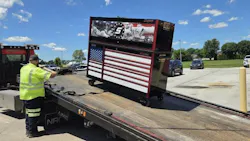
Choosing a toolbox is about more than finding enough space for the tools a technician owns today. The right setup also needs to fit the way a technician works, withstand the demands of a professional shop, and adapt as their career evolves.
For some technicians, that means a large, stationary box with room for every tool they could need. For others, a mobile cart or modular storage system may be a better fit.
With so many options available, finding the right toolbox requires technicians to look beyond drawer count and price tag. Here are some of the key considerations to weigh when choosing a storage system built to last.
Choose toolbox storage for your truck shop workflow
Next, it’s time to think about where and how the toolbox needs to function. The right option for one tech may be completely impractical for another. For example, working from a fixed bay may require different storage needs than a mobile workflow when traveling between jobs.
For Tyler Gallardo, mobile mechanic and owner of Ty The Car Guy, portability is the one feature he would prioritize above all else when shopping for a toolbox. Before switching to a modular Milwaukee PACKOUT storage system, transporting tools between jobs was often a pain.
“If I had to go somewhere and bring tools, I would have to take tools out of the toolbox and just throw them in a bag. Things would get disorganized,” he explained, “and then when I came back, I had to sort it all back out and unpack it and put it back in the toolbox, so it became a hassle.”
That experience shaped how he views tool storage today.
“If you’ve got a 54-in. or 72-in. tool cart, you’ve got to really think about pushing that thing around the shop,” he said.
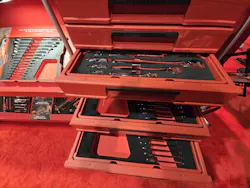
Leaner-sized boxes also provide both financial flexibility and career agility.
“Getting a high-quality, affordable and mobile cart now will be advantageous now as it will save you money for specialty tools that you may need, but also makes you nimble enough to move to a new location as you grow in your career without having to hire a tow-truck to move a much larger box,” said CJ Fay, sr. marketing manager for Sunex Tools.
Nick Trawicki, product marketing manager for storage at Milwaukee Tool, noted that the ability to bring tools closer to the work has become increasingly important as shops grow larger and technician workflows become more dynamic.
“Mobility becomes critical because technicians aren’t static,” he explained. “They are moving between bays, around vehicles, and often working in tight or changing spaces. Storage has to move with them without slowing them down.”
Pablo Vasquez, business development, Sonic Tools USA, added that maneuverability is just as critical.
“Shops are larger, workflows are changing, and technicians often move between bays or service areas throughout the day. A toolbox has to move smoothly and safely while fully loaded, without compromising stability,” he said.
Prioritize durable tool storage for heavy-duty technicians
Beyond size and price, the real foundation of any toolbox or storage system is how well it holds up over time in a shop environment. Think steel construction, drawer slides, casters, load capacity, and overall longevity.
Tommy Crenshaw, fleet maintenance technician at McKee Foods Transportation, said those differences become obvious once a cheaply-made toolbox is loaded with heavy tools.
“You can just feel it when you open the drawer on a cheap toolbox,” he said. “You have 100 lbs. in that drawer, and it doesn’t come out smooth. It comes out and shakes side to side, and you see the drawer sag.”
By comparison, he said his current Snap-on EPIQ toolbox shows little wear despite carrying an enormous amount of weight.
“It’s got 400 lbs. of sockets in it, and it closes on its own and doesn’t even show any fatigue.”
For Felipe Salazar, Jr., auto body painter and technician at Gerber Collision & Glass, that durability showed up in practice. His first toolbox lasted nearly a decade, surviving multiple job changes and the daily wear and tear of moving between shops and working environments.
Milwaukee’s Trawicki emphasized that longevity is built into the fundamentals of the design.
“Durability is foundational,” he said. “A toolbox needs to stand up to tough shop environments, heavy loads, and daily wear over time.”
Vasquez added that long-term performance comes down to the details in the engineering.
“Technicians open and close drawers thousands of times a year, move heavy tools daily, and rely on their storage system in demanding environments,” he explained. “That’s why structural integrity, drawer load ratings, steel thickness, caster quality, and slide performance are all critical engineering considerations.”
But identifying those qualities requires looking beyond marketing claims and evaluating how a toolbox is actually built.
“While mobility and expandability are very important for professional technicians, when it comes to designing and building storage, we don’t trade-off quality,” said Brandon Miller, product manager at Cornwell Quality Tools. “In fact, we err on the side of overbuilding, which is why we use a roll cage (body on frame) construction where our competitors don’t. What this does is prevent ‘racking,’ by keeping the sides of the box (where the drawers are mounted) rigid; that means when a tech pushes on their box, or loads it full of tools, everything stays aligned, and the drawers continue to work smoothly.”
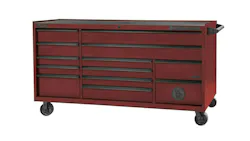
Miller also noted that technicians should pay close attention to component ratings, build methods, and materials before making a purchase.
“It’s important that they research and purchase tool storage that’s meant to handle the weight and usage rates they require,” he continued. “Units with heavy steel gauges will provide greater durability than those with minimal gauges. Slide capacity and caster capacity are also very important. Technicians should research these criteria before finalizing their purchase.”
Plan toolbox storage that grows with your technician career
Storage needs tend to expand gradually as a tool collection grows. Crenshaw’s first professional toolbox, a Snap-on KRL 722 special edition box, cost about $2,500 and met his needs for the first five years of his career. He then added a roll cart and other storage options to his setup before eventually finding a good deal on a bigger box.
“For many technicians, their first piece of tool storage is a budget purchase, void of size and features,” Cornwell’s Miller said. “As they get even a few years into their career, they quickly determine that they have too many tools for their current setup and are ready for something with greater capacity. Features like a power drawer and electronic lock are important to young technicians who are investing in expensive cordless tools and batteries.”
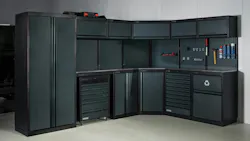
As Vasquez explained, a pitfall that hurts some techs as they shop for a toolbox is basing the decision on what they own today, rather than what they are likely to accumulate over years on the job.
“One of the biggest mistakes younger technicians make is buying only for the tools they currently own instead of the technician they want to become,” he said. “Most technicians don’t stop acquiring tools after their first year; their collection grows throughout their career.”
That mindset is exactly what leads to outgrown setups, early replacements, and wasted money.
“A system has to grow alongside the user, not limit them,” Trawicki stated.
That challenge is becoming even more relevant as modern tools evolve more quickly than in the past, according to Vasquez. He highlighted several trends accelerating that shift, including battery-powered and diagnostic tools that take up more space, technicians carrying more specialized equipment earlier in their careers, and expectations around organization and workflow efficiency continuing to rise.
Career paths and specialization also impact toolbox needs down the line. Storage requirements can change significantly as techs move between roles.
Crenshaw custom-ordered his second box, tailoring the drawer orientation to his specific needs.
“There are a lot of boxes that have a lot of skinny drawers,” he offered. “Well, I’m a big rig mechanic. I don’t have skinny tools.”
For technicians unsure where their careers will lead, expandable and modular systems can be a way to avoid premature replacement. Miller said manufacturers are increasingly designing around that concept.
“Each of Cornwell’s tool storage families is designed with modularity in mind,” he explained. “Additional items like canopies, lockers, and even other roller cabinets can be connected to help the technician grow and expand as their storage needs change.”
This approach can provide flexibility to expand incrementally rather than replacing the entire setup every few years. The toolbox becomes more of a foundation that can be built upon throughout a tech’s career.
“Starting with a flexible and adaptable system gives a young technician the ability to evolve without having to start over,” Trawicki added. “It provides the ability to add, reconfigure, and scale a storage system as one’s career progresses, rather than outgrowing a setup and replacing it entirely.”
Balance toolbox features, organization, and professional appearance
Beyond the functional aspects of a toolbox, like size, durability, and mobility, there is another factor quietly shaping purchase decisions: appearance.
“Another major shift is that technicians increasingly view their toolbox as part of their professional identity,” said Vasquez. “It’s no longer just storage. A toolbox reflects pride, professionalism, and efficiency.”
For Salazar, style also played a role in the system he chose.
“My favorite color is red, that’s my color,” he said. “My favorite soccer team, Liverpool, is red. My first car was a red Honda Civic.” That preference carried over into his toolbox setup, with Milwaukee’s red-and-black design standing out as a factor in his choice.
When color isn’t enough, companies such as Sunex offer several wrapped boxes to fit any tech’s style, from cars to anime. But will they look as good on Day 1,000 as Day 1? Fay said Sunex does extensive product testing and uses high-quality printing materials to ensure the bright graphics won’t lose their luster even in a severe shop environment.
“We even found some expert vehicle wrap installers that could educate our staff on best practices and tools to use to enhance our carts,” he said.
But appearance isn’t only about color or branding. Sometimes, it comes down to small design features that make a difference in day-to-day work.
“[Mine] has a bottle opener that I really like for my lunchtime,” Salazar said with a laugh, citing his love of Mexican food and the bottled Mexican Cokes and Jarritos that often accompany it.
Even small, practical additions can change how a toolbox is used over time. Salazar said one feature he initially overlooked was a heavy-duty worktop surface, designed for tasks like hammering or other impact work. While he didn’t think he needed it at first, he said he’s since found himself wishing he had added it to his setup.
Ultimately, a forever toolbox isn’t necessarily the biggest box a technician can afford, but the one that leaves enough room—both physically, financially, and career-wise—to keep growing.
About the Author
 Lucas Roberto
Lucas Roberto
Lucas Roberto is a Senior Staff Writer and producer of multimedia content for Fleet Maintenance magazine. He holds a bachelor's in media production and a master's in communication from High Point University in North Carolina.