Power tools worth the investment
Key Highlights
- Building a toolbox gradually by focusing on high-use tools and compatible platforms helps manage costs and ensures versatility in repairs.
- Battery-powered tools offer cordless convenience, ideal for mobility and quick access, with considerations like battery life and platform compatibility being crucial.
- Air tools excel in sustained use and heavy-duty applications, providing consistent power for tasks like surface prep and cutting in rusted or tight areas.
- Understanding shop air capacity and tool requirements is essential for integrating tools effectively into the repair process.
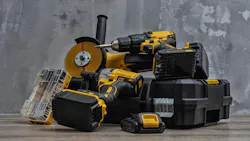
When you’re starting out as a professional commercial vehicle technician, building your loadout is a career investment. We’ve covered the process of choosing the right toolbox and making the most of its storage space, but filling those drawers is just as important (and expensive).
A solid foundation of ratchets, wrenches, sockets, and other hand tools is essential. But techs also need to work efficiently, and the right power tools can make a significant difference in how quickly a job gets done.
Battery-powered and air tools each have their advantages, and the best choice can depend on the job at hand, the shop’s capabilities, and even where a fleet operates. On the automotive side, Chris Biedeger, a technician and contributor to our sister brand VehicleServicePros, offered some insight into the power tools worth considering.
There are some clear differences between battery-powered and air tools, with advantages to each depending on the application and shop environment.
“Battery-powered tools give you a cordless experience and freedom to use them wherever and whenever,” Biediger said. “Whereas with air tools, you need the air supply from a suitable compressor to use them.”
For technicians considering battery-powered tools, Biediger recommends looking at battery life, battery size, and heat generated by the tool. Air tools, meanwhile, can provide consistent power for extended periods when the shop has sufficient air pressure.
That can be particularly useful in applications where technicians are dealing with heavy rust and corrosion. Geography and shop preference can also be factors in the decision.
“If you live in the southern regions of the U.S., as I do, we generally run all cordless tools for the convenience of not dragging an air hose around,” he said.
There is also a difference in how technicians build their tool collections. With battery-powered tools, buying into a particular manufacturer's lineup means future tools can often share the same batteries. Air tools don't require that same commitment to a battery platform, as tools from different manufacturers can use the same shop air system.
With those differences in mind, Biediger offered several power and air tools that can earn a place in a technician's toolbox.
Battery-powered tools for everyday use
One of the first power tools a technician should consider adding to their arsenal is a 1/2-in. impact wrench. The model Biediger uses daily is the Milwaukee Tool M18 FUEL 1/2-in. Mid-Torque Impact Wrench with Friction Ring, No. 2962-20.
“I chose this for a few reasons: it’s lighter than the high-torque version, it is sufficient to use on wheels and suspension parts, and paired with a Milwaukee Tool M18 REDLITHIUM FORGE XC6.0 Battery, it lasts 1-2 days on a single battery charge with heavy use,” he said.
A lighter impact can also help reduce fatigue when a technician uses the tool repeatedly throughout the day. And for techs who are still building their tool collections, a versatile mid-torque impact can cover many of the applications they are likely to encounter without immediately investing in a larger, heavier tool.
Warranty coverage is another consideration when purchasing battery-powered tools. Milwaukee Tool, for example, offers a five-year warranty on its battery-powered tools.
Battery-powered tools are also commonly sold in kits that include the tool, one or two batteries, and a charger. Once a technician has established a battery platform, purchasing bare tools can help avoid paying for additional batteries and chargers.
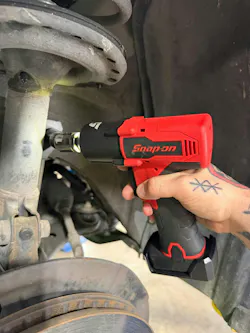
Another option Biediger keeps in his toolbox is the Snap-on 14.4V 3/8-in. Drive Impact Wrench, No. CT861AMDB.
The impact is an upgraded version of Snap-on's 3/8-in. cordless impact, and its smaller size makes it useful when a 1/2-in. impact is more tool than the application requires.
The impact also uses a rocker-style trigger instead of a traditional forward-and-reverse selector, allowing for quick direction changes, which can be useful when working with stuck or corroded fasteners.
Air tools for sustained work
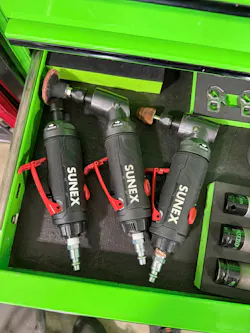
While battery-powered tools offer mobility, some applications still make a strong case for air. Die grinders, for example, are common in repair shops and can handle a range of jobs, including surface preparation, cleaning hub surfaces during brake work, cutting seized components in tight areas, and cleaning mating surfaces with the appropriate preparation disc.
Biediger recommends several die grinders from Sunex Tools, including the 115 Degree Angle Die Grinder, No. SX5204; 0.5-hp Straight Die Grinder, No. SX5207; and 0.5-hp 90 Degree Angle Die Grinder, No. SX5208. All three are 0.5 hp and use a 1/4-in. collet for arbors or carbide burrs.
Having multiple grinders with different configurations can also help technicians avoid stopping to change accessories during a job.
“Personally, I keep one with a surface prep pad, one with a wire wheel, and one with a cut-off disc so I can quickly change between different grinders on a job instead of having to swap out the arbors,” Biediger said.
That approach is also one example of where air tools can make sense when building out a toolbox. Multiple air tools can share the same shop air supply, regardless of manufacturer, eliminating the need to maintain batteries and chargers for each tool.
“Depending on the tool, air tools are generally cheaper than their battery-powered counterparts,” Biediger said.
When access matters
Not every power tool needs to deliver maximum torque. Sometimes, getting the tool into position is the bigger challenge.
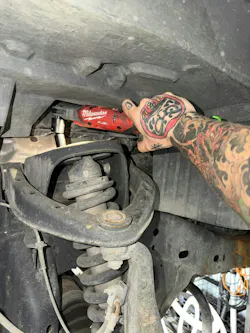
Right-angle impact wrenches can help technicians reach fasteners in areas where a conventional impact might be too bulky. They generally produce less torque because of their design, but the smaller profile can make them useful for specific applications.
One example is the Milwaukee Tool M12 FUEL 1/2-in. Right Angle Impact Wrench with Friction Ring, No. 2565-20. Biediger uses it for sway bar links because of their mounting location, as well as for brake calipers.
The cordless design also eliminates the need to manage an air hose while working around the vehicle, giving technicians a little more freedom when maneuvering around tight access points.
A power tool worth prioritizing
An electric ratchet is another tool that can quickly become a daily-use part of a technician’s toolbox. Unlike an impact wrench, an electric ratchet is not designed to deliver high torque. Instead, it can help technicians quickly remove and install fasteners once they have been broken loose.
That makes it useful across a wide range of shop jobs. A technician can use a traditional ratchet to break a fastener free, then pull the trigger on the electric ratchet to spin it out. During reassembly, the tool can be used to run fasteners down until they are snug before the final torque is applied.
“In my opinion, this is one of the first power tools a technician should invest in,” Biediger said. “Pretty much any job you do in the shop, an electric ratchet can be used.”
Build over time
Technicians don’t need to buy every power tool at once. Starting with the tools that will see the most use can help build a versatile lineup without overspending on equipment that doesn't leave the toolbox often.
For battery-powered tools, Biediger recommends doing some research to get the most bang for your buck.
“I do think if you plan to buy battery-powered tools, do some browsing to see which brand offers the most versatile selection for your application to help keep your toolbox uniform and your tools on one battery platform,” he said.
Once a technician has established a battery platform, purchasing bare tools can also help keep costs down by eliminating the need to buy additional batteries and chargers.
For air tools, the shop’s compressor and air supply need to be able to support the tools being used. Most air tools have a psi rating for optimal operating pressure and performance, so technicians should make sure their shop air can accommodate those requirements.
Ultimately, battery-powered and air tools both have a place in the shop. The right combination comes down to the work being performed, the technician’s preferences, and what the shop can support.
About the Author
 Lucas Roberto
Lucas Roberto
Lucas Roberto is a Senior Staff Writer and producer of multimedia content for Fleet Maintenance magazine. He holds a bachelor's in media production and a master's in communication from High Point University in North Carolina.
 Chris Biediger
Chris Biediger
Chris Biediger is an ASE Master Technician and a Toyota/Lexus specialist. He spent almost 10 years at a Toyota dealership before venturing off with his old foreman to become his new foreman to run an independent Toyota shop, Hill Country Yota Works in New Braunfels, Texas. Biediger has been a technician for 12 years now, and aside from the shop, he also runs TxToolGuy on social media, showcasing tools, shop life, and diagnostic videos.