Proud to be an American—and in trucking

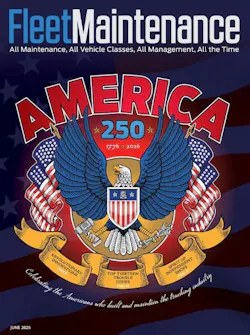
If you've seen the cover of our June issue, you probably guessed that Fleet Maintenance is proud to be American. And I’ve been unabashedly so for most of my life. Since joining the trucking industry, I have been pretty proud of it, too. Putting together an entire issue dedicated to the relationship between the two seemed like an obvious fit with America 250 nearly upon us. And when thinking about putting this together, we wanted to honor everyone who has contributed to American trucking, from the early inventors to the latest innovations, the plant workers stamping metal to midnight shift truck stop clerks keeping fresh pots of coffee.
And in the last six years, particularly in the fleet maintenance space, I’ve met some of the greatest Americans. These include guys who work all day on fixing a rural town’s public vehicles and going home to tend to the farm, to immigrants who came here with nothing, gave their bodies and minds to trucking, and were embraced and rewarded with trucking companies and repair businesses of their own.
This America 250 issue is for all of you.
And for those uneasy with outward display of patriotism, I do empathize.
There was a time in 1998, about a month or so into bootcamp, that I became decidedly less patriotic—I was ashamed to be an American. I knew going in that the whole 12-week introduction into the Navy was meant to break you down and build you back up. The running and pushups were no problem, as I was 18 and weighed a buck ten. I also got used to the exhaustion and indiscriminate yelling in my face for no reason, too, thanks to three sisters.
But nothing could have prepared me for the “hurricane” that hit our barracks one cold February day in 1998. That’s when, while the division is out marching back and forth, the recruit division commanders toss every article of clothing and dismantle every bed, dangling sheets from the ceiling panels to bunk frames. It’s pretty upsetting as they condition you to make sure every shirt and pair of skivvies are perfectly folded and aligned in your locker, and every bedsheet carries crisp 45-degree “hospital” corners. Well, it was all over the place now and we were screamed at until it was all squared away again. This wasn’t the bad part. Getting yelled at was merely a Tuesday in bootcamp.
But then they asked us to stand at our bunks and ordered us to hold the hand of the guy to our left and right. They put on Lee Greenwood’s “Proud to Be an American” and had two squad leaders amble up and down the barracks holding the American flag. And the stocky mustachioed RDC with a perpetual sneer commanded us to close our eyes and “remember our homes and our families,” and “how they miss us,” and “think about what we are fighting for” or some equally cheesy nonsense, but in the tone of “Drop and give me 50, recruit.” I wondered who would fall for this blatant emotional manipulation, and found out pretty quickly.
The lanky blonde guy with glasses squeezing my left hand, and the big heavy guy crushing my right one were red-faced and holding back tears. They fell for it. How could a flag and some dumb country song I never heard before rip these guys to shreds? I was embarrassed for them and disgusted at the world’s most powerful military for messing up my stuff and its lame attempt to make me feel feelings. It changed my perspective for a while; America was a big stupid bully—and not even subtle about it. To say it led to some disciplinary problems for me was an understatement.
As a more mature adult with time to reflect, I realize the hurricane drill was meant to simulate emergency situations and pressure-test the recruits’ nerves. Sometimes you can do everything right and the $#! still hits the fan. And maybe our motley crew did need to be broken down and built back up. It took several more years to humble me, but in the end I achieved things I could never do before.
And after 9/11, Old Glory was the symbol that brought everyone together, politics be damned. And Mr. Greenwood’s twangy anthem took on a new meaning. It was a rallying cry for those in pain and who needed strength. Somehow, I learned humility (or the MK-Ultra program kicked in) and became a somewhat capable submariner. A week after the attacks I joined the captain and chief of the boat on a PR trip to Oklahoma City. I told kids what the Navy was really like, the real truth. Later we were recognized at the state rodeo and got a standing ovation. They weren’t applauding me, but all the people who were fighting to defend the country, and all the people before who gave their lives in the process.
But to be part of that group made me incredibly proud. That doesn’t mean I agree with any or all the things that happened militarily after that, but it was a nice moment.
And trucking, which for this conversation, includes all those involved with commercial vehicles and their maintenance, deserves a standing ovation. For 125+ years, you all have fought exhaustion and resisted apathy to make sure trucks are ready to do whatever they were built for, safely and efficiently. And things don’t go your way every day, but you come back the next day for more. You have helped win wars by building the strongest supply chain the world has ever known, and facilitating the transport of 70% of goods throughout the U.S. You are essential every day, not just during crises. And we salute you!
About the Author
 John Hitch
John Hitch
Editor-in-chief, Fleet Maintenance
John Hitch is the award-winning editor-in-chief of Fleet Maintenance, where his mission is to provide maintenance leaders and technicians with the the latest information on tools, strategies, and best practices to keep their fleets' commercial vehicles moving.
He is based out of Cleveland, Ohio, and has worked in the B2B journalism space for more than a decade. Hitch was previously senior editor for FleetOwner and before that was technology editor for IndustryWeek, and managing editor of New Equipment Digest.
Hitch graduated from Kent State University and was editor of the student magazine The Burr in 2009.
The former sonar technician served honorably aboard the fast-attack submarine USS Oklahoma City (SSN-723), where he participated in counter-drug ops, an under-ice expedition, and other missions he's not allowed to talk about for several more decades.