Fullbay unveils AI-native shop platform at Diesel Connect
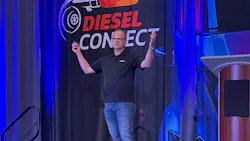
CHANDLER, Arizona — At this year’s Fullbay Diesel Connect conference, Fullbay executives outlined an AI-focused product roadmap that included the introduction of an AI-powered platform called Fullbay Next, expanded automation tools, and the company’s recent acquisition of the predictive maintenance platform Pitstop.
The company said Fullbay Next was built from the ground up, taking "an AI-native approach." The current Fullbay platform is the shop management solution of choice for thousands of independent repairers and fleets. Fullbay calls the Next platform "a major evolution" and will slowly roll the software out starting in July. More details will be released closer to launch.
The conference, held May 19-21, brought together independent repair shops, fleet maintenance leaders, and industry suppliers to discuss the operational pressures facing the heavy-duty repair industry, including hiring and retaining technicians, rising operating costs, and the growing need to improve shop efficiency and vehicle uptime.
Much of the conversation centered on how artificial intelligence and data-driven tools can help shops operate more proactively while reducing administrative burdens. “There is a lot going on in this space,” said Trent Broberg, CEO of Fullbay. “We’re transitioning this company to be AI-first and AI-native.”
AI: the next fleet maintenance frontier
During the conference, Broberg and Scott Gordon, Fullbay's chief product officer, shared details about Fullbay Next, the company’s next-generation platform designed to integrate AI throughout the shop management workflow.
“For the past eight months, the product team has been building Fullbay for the next decade,” Gordon said, adding that Fullbay Next is designed to move beyond traditional shop management software by embedding AI directly into workflows for technicians, service writers, and shop managers. “We’re taking it from a system of record and transforming it into a system of action.”
Gordon told attendees that the platform will have a dark mode, be mobile-friendly, and be adaptive to different shop types. Features include a technician-focused “wrench mode,” AI-assisted writing tools, workflow automation, and enhanced reporting capabilities. “For every major role in Fullbay, there will be an AI assistant to help that role,” Gordon said.
The initial release of Fullbay Next is targeted for solo entrepreneurs and mobile repair operations later this summer, with Phase 2 for shops with three to 19 employees taking place in early 2027.
Ryan Mangum, senior product manager at Fullbay, said the company is focused on using AI to support day-to-day shop operations. “We see AI as a force multiplier,” he said during a session on AI adoption in shops.
Mangum shared several practical applications for AI, such as tools that rewrite technician notes into customer-friendly language without changing the diagnosis. Other use cases included analyzing revenue reports, identifying repeat repairs, and helping technicians narrow potential causes during diagnostics.
“AI is not going to replace your technicians,” Mangum said. “AI can’t smell a coolant leak walking past a truck or feel a bushing that’s about to fail with a thumb.”
Mangum encouraged shops to begin experimenting with AI tools now, even outside of Fullbay’s platform, but recommended taking a measured approach to implementation. “Start small,” he said. “The shops that try AI everything on day one are the ones that turn it off by week two.”
In addition to the AI capabilities coming in Fullbay Next, the company highlighted several AI-focused product developments during the conference, including AI-assisted transcription and translation tools designed to improve communication with English-as-a-second-language employees. Fullbay also demonstrated “Ask Spike,” an AI-powered assistant that helps users quickly access shop and operational information.
“We’re trying to leverage AI to meet you where you are,” Broberg said. “How do we get you the information you need?”
Proactivity to come from Pitstop acquisition
Brobert also touched on Fullbay’s recent acquisition of Pitstop, an AI-powered predictive maintenance platform focused on fleet intelligence, telematics, and fault-code analysis. The acquisition is intended to expand Fullbay’s capabilities beyond traditional shop management and into predictive maintenance and proactive fleet communication.
Shiva Bhardwaj, senior vice president of product at Fullbay and the former CEO of Pitstop, said predictive maintenance is designed to help fleets identify failures before they result in breakdowns or costly downtime. “The problems are always there, but it is about when they are going to cause failure,” Bhardwaj said.
The platform analyzes telematics data, fault codes, and maintenance history to identify patterns across large datasets. Bhardwaj said integrating repair history with telematics and diagnostics data allows fleets and shops to move toward more proactive maintenance planning.
“Downtime is a cost to the fleet and their ability to generate revenue,” Bhardwaj said. “The highest costs are in unplanned downtime.”
Shop challenges continue to mount
Several conference sessions focused on the challenges shops are facing. Jamie Irvine, consultant at Heavy Duty Consulting Corp., said repair shops are operating in an increasingly difficult financial environment shaped by labor inflation, parts cost volatility, and a freight market that remains under pressure. “Every dollar in your business is more important than ever before,” he said.
Irvine said many shops are losing profitability through operational inefficiencies rather than a lack of work. He encouraged shop owners to focus on utilization rates, standard operating procedures, and cost controls before investing heavily in new software tools. “The counterintuitive thing is that the tools that I get will make me better,” he explained. “They don’t if you don’t have the foundation.”
Technician recruitment and retention can also be difficult, especially when trying to attract younger workers into the diesel technician profession. Cindy Barlow, director of industry relations for WyoTech, said relationships and career development opportunities are increasingly important for recruiting younger technicians.
“The employers say, ‘We pay well.’ The younger people say, ‘Will you invest in me?’” Barlow said.
Barlow emphasized that compensation remains important, but many technicians are equally focused on scheduling flexibility, career growth, and workplace culture.
Economic uncertainty in the trucking market is also affecting shops. Alex Leslie, senior research associate at the American Transportation Research Institute, said many fleets continue to delay truck purchases due to high equipment costs and weak freight conditions. With fleets holding onto trucks longer, preventive maintenance and repairs are creating revenue opportunities for shops, Leslie said.
Conference speakers emphasized that being successful in the year ahead will require shop operators to increase efficiency and control costs. While technology will help, they emphasized that shops must combine technology investments with stronger processes, workforce development, and financial discipline.
“What happens inside your shop is what really matters,” Irvine said.