PacLease 'proving grounds' pilot digital tools to improve fleet uptime
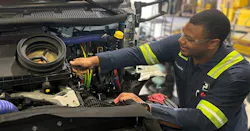
At PacLease, continuous improvement starts with proof. Across locations in the United States and Canada, company-owned facilities serve as the testing ground for new maintenance strategies, training programs, and performance management systems before they are deployed across the franchise network.
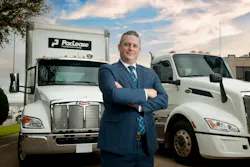
In North Texas, that approach has taken shape under the leadership of Joe Vatalaro, director of maintenance for Paccar Leasing Company in the region. Vatalaro and his maintenance team support Paccar company store locations as well as over 500 PacLease franchise locations across the U.S. and Canada.
The PacLease company stores in Dallas and Grand Prairie operate two high-volume service locations supporting more than 500 trucks and staffed by roughly 16 to 20 technicians. Together, the locations handle more than 200 service events every month, supporting a fleet that is approximately 70% full-service lease and 30% rental. The equipment mix spans Kenworth and Peterbilt medium- and heavy-duty trucks, day cabs, and vocational units including dump, flatbed, and vacuum trucks.
For Vatalaro, the role of a company store is not simply to maintain equipment. It’s also to validate operational standards before asking others to adopt them. “Company stores set the standards,” he said. “We gather the data, establish the process, implement it, and then spread it throughout the franchise.”
That emphasis on evidence is critical when driving network-wide change. “It’s hard to say, ‘do this,’ without proving it,” Vatalaro explained. “As a result, PacLease audits its company locations, evaluates preventive maintenance best practices, and measures how changes affect PM currency, service frequency, and the variable cost base tied to revenue.”
Strategic lever
That mindset is what led PacLease to invest heavily in standardized training initiatives. Rather than focusing only on technical repairs, the organization developed structured programs addressing customer service, internal systems, warranty processes, and tire management.
Customer Service Training, PLC Portal Training, Warranty Best Practices Training, and Tire Program Training were all piloted first at company-owned locations before being rolled out to franchise stores. Each program addresses a specific operational need:
- Customer Service Training improves communication and sets clearer expectations with customers, reducing delays tied to incomplete information.
- PLC Portal Training helps technicians and service advisors navigate systems more efficiently, reducing administrative time and improving the accuracy of documentation and billing.
- Warranty Best Practices training ensures submission of complete, accurate claims.
- Tire Program Training standardizes inspections to prevent roadside events before they occur.
The result is tangible across PacLease locations, Vatalaro noted. “These initiatives have led to faster cycle times, fewer reworks, reduced claim delays, and lower customer downtime while strengthening trust in the service process,” he said.
Scorecard accountability
Training alone, however, does not sustain improvement. To reinforce consistency and accountability, PacLease introduced the Service Scorecard and Warranty Scorecard. The tools benchmark top service metrics and compare location performance against industry standards.
“The scorecards highlight bottlenecks in real time, flag documentation gaps before claims are submitted, and create transparency across teams,” Vatalaro explained. “With them, technicians can understand what affects their performance scores, supervisors gain objective coaching tools, and leadership can identify where support is needed and where best practices are emerging.
“Since the scorecards were implemented, PacLease has seen improved shop throughput, higher documentation accuracy, reduced warranty exposure, and stronger alignment across locations,” Vatalaro added.
The PacLease Dallas location exemplifies how those principles come together on the shop floor. The operation is a purpose-built service center staffed by factory-certified technicians and equipped with OEM diagnostic tools. PacLease Dallas also uses Paccar Prognostics, a system that leverages real-time data and machine learning to anticipate potential downtime events.
“Over the past year, Prognostics has delivered an 80% improvement in repair efficiency, significantly reducing roadside breakdowns and minimizing customer downtime,” Vatalaro related.
Customer perspective
That focus on uptime is critical for customers like Blake Hubbard, vice president of Hubbard’s Express, an expedited air freight and delivery carrier with locations in Grapevine, Chandler, and Austin, Texas. Founded in 1983, Hubbard’s Express has grown rapidly since 2018, expanding its services tenfold and now handling more than 100,000 shipments annually.
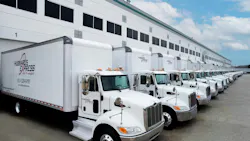
With that growth, the Hubbard’s Express fleet has expanded every year. Today, the company operates 30 Peterbilt and Kenworth medium-duty trucks and 28 Peterbilt Model 579 day cabs under a full-service lease with PacLease, including support with mobile service units and replacement vehicles when needed.
“On-time delivery is non-negotiable in expedited air freight,” Hubbard said. “Our back is always against the wall and we’re only as good as our last shipment.
“Uptime is everything in our operation,” Hubbard continued. “For customers who rely on us to meet strict, same-day operating windows, downtime is unacceptable.”
What sets PacLease apart for Hubbard is not just the lease structure but how the service operation integrates into his business. “Beyond fixed costs and replacement vehicles, it’s the technology, documentation, and communication that make the difference,” he said.
“Along with a strong working relationship between our fleet manager and PacLease shop foremen, their scorecards and diagnostics capabilities lead to proactive maintenance,” Hubbard added. “In a business like ours, we need that essential reliability to continue to grow and be successful.”
Building a repeatable model
For PacLease locations and their customers, a maintenance model built on proof, measurement, and accountability strengthens execution, improves visibility, and helps prevent problems before they occur.
“That improvement is not anecdotal, it is measurable,” Vatalaro said. “By setting standards, an effective approach to maintenance doesn’t just support fleets. It also earns their trust.”
About the Author

Seth Skydel
Seth Skydel, a veteran industry editor, has more than 36 years of experience in fleet management, trucking, and transportation and logistics publications. Today, in editorial and marketing roles, he writes about fleet, service, and transportation management, vehicle and information technology, and industry trends and issues.