How digital warranty tracking gets fleets their money
Key Highlights
- Digital warranty tracking and automated documentation significantly reduce claim processing time and administrative workload.
- Integrated systems enable fleets to recover more warranty revenue by ensuring accurate record-keeping and timely alerts for claims.
- Automation tools like AI invoice scanning and comprehensive dashboards improve data integrity and increase warranty recovery rates by over 10%.
- Proper understanding of warranty terms, documentation requirements, and claim windows is crucial to prevent revenue loss.
- Using digital platforms can turn warranty management from a costly process into a profitable revenue stream for fleets and repair shops.
Warranty recovery can feel like more trouble than it’s worth, especially for smaller fleets juggling claims alongside day-to-day shop operations. But with tighter margins and rising repair costs, fleets are increasingly turning to digital warranty tracking, automated documentation, and centralized maintenance platforms to avoid missing reimbursement opportunities and reduce the administrative burden that comes with claims processing.
 gettyimages1334503619
Danger of manual data entry
When the paperwork goes missing or doesn’t appear elsewhere in the system for other shops or dealers to see, the hunt for the claim wastes additional time.
Shiva Bhardwaj, SVP of product for Fullbay and founder of predictive maintenance platform Pitstop, said digital shop records prevent serious problems.
“Let’s say we get a warranty job that’s not logged anywhere—maybe it was manually logged on the shop side, but it wasn’t stored properly—then the part subsequently fails and is changed,” he theorized. “Can the fleet track that initial repair?”
That search could ultimately prove fruitless if the documentation is simply lost. How much otherwise productive time was spent searching for lost or missing records?
“The fleet might not know they don’t have the record,” Bhardwaj said. “But when shop software is tied into the fleet software, those records can be matched, and you can make sure you’re alerting the fleet, confirming it’s a warranty-covered part."
One fleet of 300, Bramco, was manually filling out invoices, taking up to 20 minutes per form, according to a white paper published by Samsara. And because the legacy system only provided lump sum figures, the fleet could not drill down into specific costs, leverage VMRS, or track warranty information. This often led to losing out on warranty money owed among other inefficiencies, the case study asserted. Once Bramco turned to the Samsara platform, they began using AI invoice scanning to eliminate manual entry while centralizing the internal work orders, vendor invoices, and parts purchasing info into a single system.
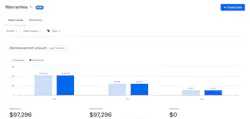
“We brought all that together,” Eisenberg said. “Imagine having access to all your vehicle information, all your fault codes, all your warranty information in one place.”
Samsara’s Holcomb further explained Connected Maintenance can “capture that information in the system, let it run in the background, and then alert you when action is required,” Holcomb explained. “That way, with just a few clicks, you can follow up and recover revenue that might otherwise be missed.”
The employees also no longer had to perform the manual data entry.
“We helped them reduce processing time from 20 minutes to under two minutes per work order,” Eisenberg said. That equals 400 hours per year saved, or the equivalent of 50 full days of labor.
On the warranty side, now the new warranties for trucks, tires, and engine replacements could be logged into the system. With this data captured, Bramco said it saw an ROI for the platform sevenfold in the first year alone.
But the biggest benefit is getting back the money on a part that didn’t work as promised.
Brian Mulshine, senior director of TMT product management for Trimble, said customers who use TMT’s warranty tool and automated identification of coverage “consistently see a 10% or greater increase in warranty recovery through improved data integrity and management oversight.”
One large customer recently told Mulshine they get between $300,000 and $500,000 back every month in warranty claims, crediting TMT’s tracking abilities.
“To ensure no revenue slips through the cracks, the system also features comprehensive dashboard reporting,” Mulshine added. “These reports highlight any completed repairs that have potential for warranty reimbursement, allowing your service administrator to review the specific circumstances and initiate claims that might otherwise have been missed.”
Recovering labor costs
While parts warranties are usually pretty straightforward, the labor side of “parts & labor” can be more contentious. OEMs often use flat-rate calculations to determine their liability, regardless of how long the repair actually took if you did it at your own shop.
“Many smaller fleets are under the impression that the warranty will cover everything,” said Darry Stuart, president of DWS Fleet Management Services. Stuart is an independent “limited-time executive”. “They might file for a thousand bucks but get back only three hundred. That’s where the additional repair hours disappear.”
The manufacturer determines what the flat rate is. And though fleet may have 10 hours on a job, the book may only pay six, Stuart explained. “Very few fleets actually audit or track what they get back on a claim.”
Then there’s the question of the labor rate. Some warranties flat-rate the repair, some allow hours worked. Still others, dealers mostly, allow charges based on their door rates. This can be turned somewhat to the fleet’s advantage if the fleet door rate is lower, say $100 an hour compared to the dealer’s $175-$200.
“Fleet maintenance costs can become a revenue maker,” said Gerry Mead, VP of truck service technical services at TravelCenters of America. “You do your own work internally because it’s less costly than sending it out. Your door rates are much, much cheaper than the $180 or $200 we see [at dealers] today.”
At the opposite end of the spectrum are suppliers whose definition of a reasonable labor rate is—being generous—decades old. Matt Stone, chief marketing officer at Fullbay, asked users what their “worst warranty work horror story” was on Fullbay’s Diesel Community chat platform.
One shop owner replied, “We had a warranty failure on an A/C compressor. We requested paperwork from the vendor to file a labor claim, and after reading the fine print, I threw the papers in the trash. The vendor was willing to pay up to 3 hours of warranty labor…at $10 per hour. We don’t buy from that vendor any longer.”
Stone said this story perfectly illustrates “why shops need to understand the terms before a repair, not after.”
This helps reduce the technician’s shock when they are expecting labor reimbursement closer to their normal labor rate, but it is a small fraction.
Stone said, “Shops eat that loss with no recourse.”
He advised that shops know four key things:
- Reimbursable labor rate
- Max hours covered
- Documentation required
- Claim window
“Without that, warranty work becomes a profit killer disguised as a vendor benefit,” Stone asserted.
Following these best practices might not remove all the pain from the warranty process, but like Novocain at the dentist, at least it will dull the worst of it so you can grit through the procedure.
About the Author
 Jim Park
Jim Park
Jim Park is an award-winning journalist who has covered the trucking industry since 1998. Prior to that, he racked up 2 million miles as a driver and owner-operator pulling tank trailers over-the-road. He continues to maintain his CLD.
Jim's previous driving experience brings a real-world perspective to his work. Jim's strong suits are equipment and technical matters, emerging technology, vehicle spec'ing, safety, and driver issues. He has hosted an overnight radio show for truckers, produced many technical and training videos, and has published three research papers on driver fatigue and the driver shortage. He has earned 9 Jesse H. Neal awards, including “Best Range of Work by a Single Author” in 2020.