Fuel prices top trucking concerns as economy concerns ease

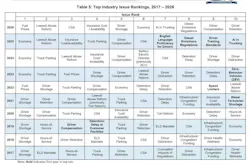
CHARLOTTE, North Carolina—The cost of diesel fuel was named the Top Industry Issue for fleets in 2026, according to American Transportation Research Institute’s annual survey tackling idnsutry stakeholders' biggest concerns. The 22nd edition of the report was released at the American Trucking Associations (ATA) Management Conference & Exhibition earlier this week, and it looks a lot different than the 21st one.
ATRI Top Industry Issues Ranking
| 2026 | 2025 |
|---|---|
| 1. Fuel Prices | 1. Economy |
| 2. Lawsuit Abuse Reform | 2. Lawsuit Abuse Reform |
| 3. CSA | 3. Insurance Cost / Availability |
| 4. Insurance Cost / Availability | 4. Truck Parking |
| 5. Driver Shortage | 5. Driver Compensation |
| 6. Economy | 6. CSA |
| 7. AI in Trucking | 7. English Language Proficiency for Drivers |
| 8. Diesel Emissions Regulations | 8. Diesel Emissions Regulations |
| 9. Driver Compensation | 9. Driver Training Standards |
| 10. Driver Retention | 10. AI in Trucking |
Fuel prices barely cracked the top 20 last year, coming in at No. 18. But the conflict with Iran and closing of the Strait of Hormuz have shocked the global oil supply, with avergae diesel prices rising by nearly three-quarters from Oct. 2025 to 2026. According to the the U.S. Energy Information Administration, national average on-highway diesel price reached $6.276 per gallon on October 20, up about $2.66 from a year prior.
The economy, which was the 2025 top concern, dropped to sixth place. Diesel prices, though, are closley tied to overall economy, though, with the surging price of oil as a leading contributor to a 3.4% uptick in inflation this past August, ATRI noted in the report.
The use of artificial intelligence in trucking moved up three spots to No. 7 seventh , while diesel emissions regulations held steady at No. 8. The 2026 survey collected responses from nearly 3,100 trucking industry stakeholders.
Impact of rising diesel concerns
In response to the increase in fuel prices, the Trump administration has temporarily allowed the use of red-dyed diesel for on-road applications through December 31, 2026, with the IRS suspending federal penalties for its sale and use during that period.
The switch could save fleets 24.4 cents per gallon, equivalent to the federal diesel excise tax and associated fee. However, the tax payment has been deferred rather than definitively forgiven, and state laws and fuel taxes may still apply.
And where fleet maintenance operations are concerned, these rising costs can reach far beyond the fuel budget. Don Davis, vice president of Fleet Services at ABF Freight System, said higher fuel costs also drive up the cost of maintaining the fleet in almost every aspect.
"The fuel pricing impacts everybody," he explained. "It impacts our component pricing because delivery fees go up for components. It impacts our labor because people with service trucks are charging fuel surcharges or changing their labor rates to make up for their increased costs, so it's certainly it's been a challenge."
ABF operates about 4,500 trucks across 240 service centers in the U.S., with its maintenance operation a combination of in-house and outside repair vendors. In-house shops handle much of the OTR fleet’s maintenance, while outside providers support many pickup and delivery operations. The fleet also uses dealers for advanced diagnostics and internal engine repairs.
Davis said the company has managed inflationary pressure on components, but rising costs remain a challenge. ABF has continued investing in its fleet through an extended freight downturn rather than waiting it out ahead of anticipated emissions changes.
“We never pulled back because of the uncertainty,” he said. “We never really got heavy into pre-buy. We’ve really invested during the downturn. We feel that we're poised really well when things do turn back around."
Among those investments is the new Mack Pioneer, which ABF has been running in limited numbers in its long-haul operations for about nine months. Mack says the truck delivers up to 11% better fuel efficiency than its previous highway models, offering fleets another way to offset rising diesel costs.
For Davis, preparing for new equipment means getting trucks into the fleet early enough to understand how they operate and what it will take to maintain them. He recognized that new technology means new challenges.
"We're not going to stay away from that," he stated. "We need to have some in the fleet to understand how they’re going to operate and learn ourselves how to work on this equipment, how to maintain the equipment,” he said.
ABF is not extending vehicle life either as a response to the economic environment, Davis said. Instead, the company bases its replacement decisions on TCO, replacing trucks when the cost and value equation favors bringing in new equipment.
"If anything, we've probably pulled our age down a little bit in the last five years," he said.
Davis also sees potential for AI to improve predictive maintenance. AI in trucking rose as a concern from No. 10 in ATRI’s 2025 survey to No. 7 in 2026, reflecting growing indsutry-wide awareness of the technology. For maintenance teams, Davis said, the opportunity is to process vehicle data quickly enough to identify likely failures, rather than relying primarily on preventive maintenance schedules.
“I think we’re finally going to get to the point where we can digest the data at the speed we need to truly make predictions,” he said.
The value of those tools will depend on whether technicians see them as useful support for their work, Davis added.
“You get the standard pushback, and it's understandable," he offered. "[But] we can't replace the skillset of a driver or a technician in our shops, and I think once they understand that and they see the value of the tool to make their lives easier, it certainly is impactful."
For fleets such as ABF, the challenge will continue to be balancing immediate cost pressures with longer-term investment in equipment, maintenance capabilities, and technology.
About the Author
 Lucas Roberto
Lucas Roberto is a Senior Staff Writer and producer of multimedia content for Fleet Maintenance magazine. He holds a bachelor's in media production and a master's in communication from High Point University in North Carolina.