Three traits that make independent shops attractive to investors
Key Highlights
- Strong EBITDA and operational profitability are key drivers of truck repair shop value to investors.
- Shops with self-sustaining teams reduce owner dependence and make acquisitions easier to transition.
- Adaptability, mobile service, strong culture, and fleet-focused operations can strengthen long-term business value.
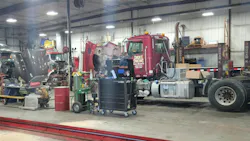
There continues to be a lot of investor interest in truck repair shops. For shop owners who are thinking about hanging it up, this is good news—especially those who’ve done a good job of increasing the value of their business.
What makes an independent truck repair shop valuable to a potential buyer?
It’s not about shiny trucks, fancy equipment, or plaques on the wall—at least not directly. It’s more about financial horsepower, the capabilities of the team, and the business’s ability to adapt, innovate, and continue moving forward faster than the competition.
Here are some insights into the three primary characteristics investors look for when acquiring truck repair shops. And even if a shop owner isn’t looking to sell, these are still important areas to focus on because they are the bedrock of a successful, valuable business that produces dividends for whomever happens to own it.
1. Operational profitability
When evaluating the worth of a business, investors like to look at an accounting term known as EBITDA, which stands for earnings before interest, taxes, depreciation, and amortization. EBITDA measures a business’s ability to generate profit from operations.
Chandler Kohn, who leads Focus Investment Banking’s heavy-duty truck parts distribution and service practice, said 10-15% EBITDA is typically the desired range for a truck repair shop.
“A shop doing over $3 million in EBITDA (at least $20 million in sales) could be a platform shop for a smaller private equity firm,” Kohn said. “For a firm looking to add more shops onto an existing platform, anything above $750,000 EBITDA (at least $5 million in sales) is ideal.”
“Profit is what an investor is looking at,” added Peter Cooper, CEO of Ascend Consulting, which works with diesel repair shops all over the country. “An investor doesn’t want to buy assets. An investor wants to invest in potential.”
That is why assets (depreciation) are excluded from the EBITDA formula. That said, assets can still factor into a shop's overall evaluation. While the value of a business is typically based on a multiple of EBITDA, some buyers could be hesitant to acquire a shop that is in major need of renovations and/or equipment upgrades.
“As part of our due diligence process, we do a complete inspection of all properties and equipment to ensure they are up to our high standards,” said Gary Price, CEO of True North Fleet Services, a network of fleet maintenance and repair providers that is supported by Garnett Station Partners, a New York-based principal investment firm. “Additionally, we do a full environmental inspection to ensure all partners’ properties meet required standards.”
Bill Kerry, owner of Kerry Brothers Truck Repair with multiple Detroit-area locations, takes notes while touring a shop he’s thinking about acquiring. “Maybe there’s an oil leak in an air compressor, or maybe a welder is 25 years old and on its last leg,” Kerry related.
Whatever the case, Kerry works with his CFO to create a budget for shop improvements so everybody knows what they’ll be dealing with if they move ahead with an acquisition. He doesn’t get too worked up about a necessary upgrade here or there.
“As we’ve grown and expanded in recent years, we’ve done a good job of updating equipment at our original shops,” Kerry said. “So we have a lot of good backups that can be deployed to other shops as necessary. One thing we’ve come to rely on is our Fullbay software. That means a shop is also going to need good Wi-Fi, so we plan for that as well.”
2. Self-sustaining staff
Another characteristic that’s appealing to an investor is the fact that a shop can function efficiently without the owner needing to be in the middle of everything. This is especially important when the owner plans on riding off into the sunset once they sell.
“If you as a shop owner ever start to seriously think about selling your business, take a week or two off,” Cooper suggested. “Then when you come back, take stock of what didn’t go very well. Then you can identify what needs fixing, and which areas need better processes in place so employees can run things without you.”
It should be noted that some investors like the owner to stick around a while to ensure a smoother transition. That said, the owner isn’t supposed to be spending their time under the hood of a truck. As Cooper explained, the owner should be functioning as the visionary of the company, providing inspiration while working on the next big idea or big customer relationship that will help catapult the business forward. But when it comes to the day-to-day operations, the staff needs to be self-sustaining.
3. The desire to adapt and innovate
True North Fleet Services is an example of an investor that likes shop owners to stick around for a while after an acquisition. The objective is to enable a smoother transition, as well as provide the on-the-ground leadership needed to continue growing the business. To that end, Price said they are looking for owners who possess a certain mindset.
“The buffalo is the only animal in the entire animal kingdom that runs into a storm,” Price said. “So first and foremost, we’re interested in partnering with shop owners who have a buffalo mindset because we need that cultural alignment.”
True North also likes it when a shop has an established mobile service offering, along with a desire to continue growing it. That’s because mobile service can be a high-margin business and provides a lot of value to fleets that are increasingly concerned about uptime.
For investors like Kerry, mindset and culture are also important attributes to consider. But since he typically buys shops from owners looking to retire, he’s scrutinizing the mindset of the employees. If an acquisition won’t be a good cultural fit, the chances of a failed transition are significantly higher.
“We obviously like it when a shop has an outstanding reputation, but also when it shares many of the same values we have,” Kerry said. “You can walk into any shop and sense how the place operates within five minutes. Just look at how clean it is and how the employees are walking around and what their attitudes are.”
Kerry also likes to assess if a shop is a good fit from an operational standpoint.
“At Kerry Brothers, our business model goes far beyond just fixing what’s broken when a customer comes to us,” Kerry said. “To be honest, if a customer only wants us to be that kind of shop, we don’t even have an interest anymore. Our focus is on those 52-week business fleet customers who depend on us to keep their vehicles moving and have us do everything. Not all shops think the same way.”
Differing ways of thinking and conducting business can create a lot of friction post-acquisition. The more open-minded and collaborative a shop staff can be, the better. That’s not only an attractive characteristic to a potential investor, but also a shop owner who’s simply looking to continue owning and growing their business.
The same can be said about a healthy EBITDA and owner-independent team. Those things are attractive to investors, but also shop owners who want to continue reaping the benefits of their well-run and successful businesses. Then, if the time ever does come to sell, that business will be worth a lot more to whomever is thinking about acquiring it.
About the Author
 Gregg Wartgow
Gregg Wartgow
Gregg Wartgow is a freelancer who Fleet Maintenance has relied upon for many years, writing about virtually any trucking topic. He lives in Brodhead, Wisconsin.