Fleet supervisor builds resume-building site for diesel techs
Key Highlights
- Digital technician profiles help fleets evaluate skills beyond traditional resumes.
- Better technician screening can improve hiring outcomes and reduce costly turnover.
- Schools and fleets are testing new tools to connect technicians with maintenance careers.
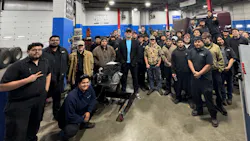
No maintenance professional needs to be reminded how fast, cheap fixes in the bay typically end up costing more in the long run versus taking your time and using quality parts. But considering the persistent issue of technician turnover and reports that two-thirds of shops are understaffed, too many hiring managers may be settling for quick fixes and failing to properly vet candidates when it comes to filling vacant technician positions.
“The problem with turnover is typically during the selection process, not the actual employment process,” Bill Black, CEO and president of National Fleet Management, told Fleet Maintenance last year. He noted techs may exaggerate their skillset or both parties realize it’s a bad match.
Another issue is that it takes a long time to find suitable quality techs. With repair parts, you can hit up any number of ecommerce sites to select any number of reputable replacements. It’s not that easy with people. The hiring process has often become an SEO game where years of experience are distilled into keywords, and the most attractive resume does not always correlate with the most suitable technician.
That’s because oftentimes the best techs are typically too busy building the skills you want in the shop versus researching what will make them stand out in a stack of resumes. This also makes hiring difficult for the shop, because they don’t always know what kind of tech they are getting.
Seeing this unending recruiting nightmare up close and not seeing any lasting solutions in the marketplace, maintenance supervisor Sean Carson decided to create one himself. Through his newly formed company Diamond Fleet Tech Network (DFTN), Carson has created a hiring tool for technicians to market themselves better to shops, with each profile including the tech's skills, certifications, equipment experience, and career goals.
The platform’s interface guides techs to accurately and easily convey their skills and abilities. Carson, the company founder and president, provides a layer of hands-on assistance to the techs, as well as potential employers. Shops that use the platform to make a hire then pay a finder’s fee to DFTN.
We recently caught up with the new entrepreneur—who left his job as a fleet maintenance supervisor to work in the platform full-time— to discuss how the platform works and why it could make the hiring process easier for both the techs and hiring shops.
Fleet Maintenance: What was the original inspiration for the site?

Sean Carson: The idea came from seeing the same problem from several angles. I spent roughly 15 years in transportation operations with Walmart and Tyson before moving into fleet leadership with PepsiCo in 2020. During COVID, I was trying to staff maintenance operations while much of the country slowed down. Technicians did not slow down. They kept food, freight, and fleets moving, yet many were still represented by weak resumes and hiring systems that did not reflect their value.
I later spent about a year in hospice social work. That experience reinforced the importance of understanding the person before judging the worker. When I returned to technician hiring at McKee Foods, the same problems were still there: post-and-pray recruiting, strong people looking poor on paper, and hiring managers burning time trying to find the few details that really matter.
The final push came when I heard ATRI data indicating that 65.5% of fleets were struggling with technician recruitment and retention. Last November, I started building the first version while working full time, using no-code tools and learning as I went. I built the website, intake flow, database, profile system, employer request process, and the early operating playbook. I have bootstrapped it without outside investment, paid advertising, or debt. I was not a software founder looking for a market. I was a fleet operator with a problem I could no longer ignore.
FM: How would you describe what the platform is and what it can do?
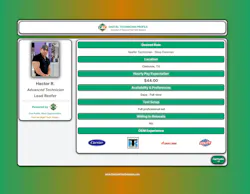
SC: Diamond Fleet Tech Network is a technician hiring visibility platform built around a living “Digital Technician Profile.” It is not another place where a technician has to upload a resume, complete a long application, and hope someone responds.
A mechanic or student spends less than five minutes completing a mostly click-to-select intake. We turn that information into a polished, shareable profile that shows the signals a fleet or shop actually cares about: hands-on experience, equipment and OEM exposure, certifications, tools, desired role, pay expectations, shift preferences, location, and relocation interest. The technician keeps the link and can have it updated as certifications, skills, and experience grow.
For students, the same profile can also function as a digital business card. At a career fair, an employer can scan a QR code and immediately review the student’s live profile instead of collecting another paper resume that may be outdated by the next semester. Schools can post the QR code on campus or provide it directly to students, reducing the hours spent on resume building and preserving more time for hands-on instruction.
FM: What problem do you think this platform solves?
SC: A profile will not fix every cause of the technician shortage. It cannot repair poor culture, tool debt, pay problems, or the lack of skilled-trade awareness in K-12 education. But technician visibility is one source of friction we can fix right now. Long term, I want DFTN to become a nationwide network where technicians, schools, and employers can find one another through one live Digital Technician Profile. Profiles will remain free for technicians and schools, while the employer side evolves from individual contingency placements toward membership access that gives fleets and shops an ongoing view of the talent pipeline.
FM: For hiring managers visiting the site, what are they seeing and how can they be confident these techs are legitimate?
SC: A hiring manager sees a practical snapshot of fit instead of trying to decode a resume. The profile shows what the technician has worked on, the environments they know, OEM and equipment experience, certifications, tools, schedule needs, compensation expectations, desired roles, and relocation interest.
The profile begins with information supplied by the technician, but my active representation goes much deeper. I often spend an hour or more speaking with a technician before presenting that person to an employer. I want to understand the person first: why they are looking, what they are good at, where they need support, what schedule fits their life, and what type of operation will allow them to succeed. I clarify work history, certifications, experience, and expectations before making an introduction.
DFTN vetting is not a replacement for an employer’s normal background, credential, driving-record, employment, or technical checks. It creates a more informed starting point. The goal is not to guarantee that every profile is a perfect hire. It is to replace a cold keyword match with a clearer, honest conversation about fit.
FM: How does it work on the hiring side and what happens after a shop finds a great candidate?
SC: An employer can visit the request-technicians page, upload a job description, paste a job link, or complete a short form. I then speak with the employer to separate true must-haves from preferences: location, pay, shift, equipment, travel, experience level, and the realities of the shop.
At school career fairs, the process can begin even faster: an employer scans a student’s QR code, reviews the live profile, and keeps the link instead of carrying away a stack of resumes.
From there, I search the network and speak directly with potential matches. If a technician is interested and the role appears aligned, I share the Digital Technician Profile with the employer. The employer decides who it wants to interview, and I make the introduction. A technician does not need to build a new resume or complete a traditional application just to be seen. If the employer requires a formal application for onboarding or compliance later, that can happen after mutual interest exists.
FM: Have you placed any techs yet, and has it been a success?
SC: One of the clearest examples is Hector Rodriguez. The Dallas-Fort Worth reefer role he accepted had been open for roughly seven months. Hector did not have to build a new resume or complete a traditional application to get the first conversation. His profile showed the relevant experience, I understood what he wanted, and the employer could quickly see the fit. The role was filled in about six weeks, and Hector has passed the 90-day mark as a Lead Reefer Technician.
We have since helped technicians who had not touched a resume in years, students who felt lost in the usual placement process, and experienced people who needed opportunities outside their immediate market. More recently, DFTN placed a traveling field technician with a heavy-equipment contractor after the employer had struggled to find the right person.
The school traction is another success. The message has been consistent across large, midsize, and smaller programs: instructors want students spending more time gaining hands-on experience and less time forcing technical ability into a generic resume. Feedback from schools has directly shaped the profiles, including student-focused fields such as graduation date, GPA, and attendance.
Over time, I also want the network to support earlier conversations with junior-high and high-school students about the security and importance of skilled-trade careers.
About the Author
 John Hitch
John Hitch
Editor-in-chief, Fleet Maintenance
John Hitch is the award-winning editor-in-chief of Fleet Maintenance, where his mission is to provide maintenance leaders and technicians with the the latest information on tools, strategies, and best practices to keep their fleets' commercial vehicles moving.
He is based out of Cleveland, Ohio, and has worked in the B2B journalism space for more than a decade. Hitch was previously senior editor for FleetOwner and before that was technology editor for IndustryWeek, and managing editor of New Equipment Digest.
Hitch graduated from Kent State University and was editor of the student magazine The Burr in 2009.
The former sonar technician served honorably aboard the fast-attack submarine USS Oklahoma City (SSN-723), where he participated in counter-drug ops, an under-ice expedition, and other missions he's not allowed to talk about for several more decades.