Training access remains a challenge for fleet technicians
Key Highlights
- Fleet technicians report the least access to needed training, with only 44% saying training is available.
- Training gaps often stem from unavailable topics, quality concerns, time constraints, cost and travel demands.
- Electrical and electronic systems are the top training priority for truck technicians, cited by 64% of respondents.
In the vehicle repair industry at large, access to needed training improved significantly in 2026, with 69% of respondents saying they have access, up from 59% in 2025, according to the 2026 ATMC Training Benchmarks Survey. This is a 17% Year-over year increase from the previous survey. But the latest data show that access varies considerably depending on where a technician or other vehicle repair professional works. Dealership technicians continue to have a training edge over aftermarket and fleet techs.
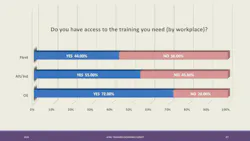
About 72% of respondents in the OE/dealer sector said they have access to the training they need, compared with 55% of aftermarket and independent shop respondents. Only 44% of fleet respondents said they have adequate access to training. The 2026 survey included auto, diesel, and collision techs and a small portion of other related roles.
This gap isn't entirely new. The 2023 ATMC Training Benchmarks Survey, cited in our 2024 coverage, found that 55% of fleet technicians said they lacked access to necessary training, compared with 46% of aftermarket and independent technicians and 32% of OE technicians.
The 2026 results suggest that while training access has largely improved across the industry, fleets in particular continue to struggle.
Not all techs have equal access to training
ATMC's survey is designed to establish benchmarks for training metrics and methods while identifying trends that can help training providers tailor their offerings to the needs of the industry. The 2026 survey received 2,685 responses, according to ATMC.
The increase in overall training access is encouraging, but the workplace breakdown suggests that technicians may not have equal opportunities to develop their skills.
For fleets, this can create a difficult balancing act. Pulling a technician out of the shop for training means losing that technician's labor for the duration of the class, while leaving technicians untrained can make it more difficult to diagnose and repair increasingly complex modern commercial vehicles.
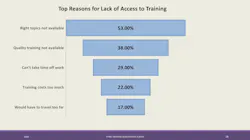
The survey's top reasons for a lack of access to training illustrate that the problem goes beyond simply deciding whether to pay for a course.
Among respondents who said they did not have access to needed training, 53% said the right training topics were not available. Another 38% said quality training was not available. Time was also a barrier, with 29% saying they could not take time off work. And 22% pointed to the cost of training, while 17% said they would have to travel too far to attend.
That means even an employer willing to invest in technician development may still have difficulty finding relevant, high-quality, and practical courses.
The survey also found differences in how the cost of training is handled.
At OE dealerships, 85% of respondents said their employer pays for training, compared with 56% at aftermarket and independent shops and 74% at fleets. Employee-funded training accounted for 8% at OE dealerships, 30% at aftermarket and independent shops, and 16% at fleets.
This suggests that indie shops are more likely to place at least some of the cost on their techs, which could be a consideration as shops compete for experienced workers. While training is an expense, it can also be a tool for recruitment and retention.
Training content
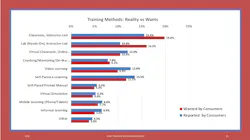
Access isn't the only piece of the puzzle, as training content and methods are a factor too. The survey also compared the training technicians receive with the methods they prefer, highlighting continued demand for instructor-led and hands-on learning as vehicle systems become more complex.
The survey also found a gap between the training technicians receive and the formats they prefer. Classroom, instructor-led training accounted for 15.5% of reported training, while 19.8% of respondents said they would prefer that format. Hands-on, instructor-led lab training accounted for 10.4% of training, compared with 16% who preferred it.
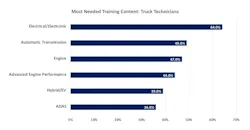
It's also important to consider what technicians actually want to learn, with electrical and electronic systems topping the list for truck technicians.
Electrical/electronic training was requested by 64% of respondents, followed by automatic transmissions at 49%, engine training at 47%, advanced engine performance at 44%, hybrid/EV training at 39%, and ADAS at 36%.
These results reflect the growing role of electrical and electronic systems across today's commercial vehicles, from powertrains and aftertreatment to safety and driver-assistance systems.
Closing the gap
Overall access to needed training has increased substantially since last year, and the industry continues to provide technicians with a range of training options. But the workplace data show that access is far from equal.
Fleet technicians remain the least likely group surveyed to say they have access to the training they need, while independent technicians also trail their OE dealership counterparts. And in an industry environment where attracting and retaining quality techs is becoming increasingly challenging, offering quality training can be a major asset.
About the Author
 Lucas Roberto
Lucas Roberto
Lucas Roberto is a Senior Staff Writer and producer of multimedia content for Fleet Maintenance magazine. He holds a bachelor's in media production and a master's in communication from High Point University in North Carolina.