Premier Truck Group overjoyed with diesel techs hired from Fort Bliss
Key Highlights
- Veteran recruitment programs can help truck repair shops strengthen technician staffing and retention.
- Structured training and ongoing support help veterans transition into diesel technician careers.
- Military experience can translate into valuable skills for service operations, including teamwork and decision-making.
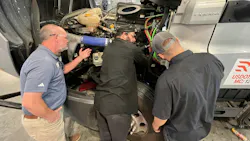
It’s not the norm for any diesel repair shop these days, but Premier Truck Group (PTG) of Springfield, a mammoth 53-bay facility in Missouri, currently boasts a strong technician staffing level and has “also been fortunate to maintain a very good retention rate,” reported Nate Sonnentag, the shop’s longtime service manager.
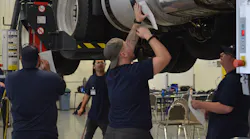
One reason is that PTG, a subsidiary of Penske Automotive Group, established a technician hiring program in 2021 with Fort Bliss. Universal Technical Institute instructors train troops heading back to civilian life for up to 12 weeks in the diesel arts. Veterans who complete the hands-on training and coursework are then eligible for service technician roles at PTG.
The El Paso base is one of the largest U.S. Army installations in the country, so there are plenty of potential recruits. As of last year, 160 veterans had been hired by PTG through the program. Five work at the Springfield location, which also operates as a SelecTrucks dealership. The technicians underwent six to eight weeks of Freightliner-specific training, according to the shop.
Thanking vets for their service
SelecTrucks offers a used truck discount program for veterans called Proud to Serve. Here are the details:
- Available to U.S. and Canadian military veterans starting or expanding a trucking business.
- Vets can save up to $6,500 on a qualifying used truck and pick up to two of three options: a down payment match, a warranty upgrade, or help buying new tires.
- The program has run since 2017, with savings to vets passing the $1 million mark in 2025
- For every qualifying truck sold through the program, SelecTrucks donates $500 to a veterans charity, with $80,000 given since 2022.
And these former soldiers have brought no small amount of bliss to the Show Me State.
“They bring a strong work ethic, are eager to learn and grow, and are great teammates,” Sonnentag said. “Those qualities have made them valuable additions to our team and help us continue to provide a high level of service to our customers.”
Tyler Haase, PTG human resources manager for Kansas and Missouri, called the program a “great success” and noted that hiring veterans with freshly printed DD-214s offers advantages over their civilian counterparts.
“When recruiting former military personnel, you are often bringing in individuals who have faced significant challenges throughout their careers, giving them a perspective that is incredibly valuable in the workplace.”
But such benefits require earnest effort from the employer. First, PTG flies prospective hires to visit the locations where they'd like to work and helps them find housing once they decide.
“We take the time to build relationships with the students and support them through their transition from military service to civilian careers,” Haase said. “While transitioning to civilian life, veterans often face significant changes and adjustments.
“As hiring managers, we recognize that transition and take the time to properly train new hires in their roles while providing ongoing support,” he continued.
This includes regular one-on-one meetings for veterans to ask questions, provide feedback, and discuss any issues they have getting acclimated to life off the base.
“In return, we gain team members who bring discipline, accountability, and a strong desire to learn,” Haase said.
Sonnentag encourages all hiring managers in the industry to consider what veterans can bring to the repair sector, even if their direct experience appears less extensive than that of other candidates. They still routinely possess critical traits such as integrity and adaptability.
“Our experience has shown that those qualities can translate very well into our industry,” he asserted.
A medic's mindset
PTG Springfield employs 16 veterans in total, 13 of whom work in the service department. Eleven are technicians, including the Fort Bliss hires.
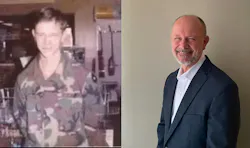
Assistant service manager Scott Whitehill also served in the Army as a medic from 1983 to 1986, where he learned a very different kind of triage. Even practice exercises could end in casualties, and Whitehill would have to jump in and field-dress broken bones and wounds.
He served at Fort Lewis, Washington, in the Ninth Infantry Division—the same as Forrest Gump, Whitehill noted proudly. And like the eccentric Gump, Whitehill had a variety of jobs after his discharge. He provided physical therapy for the recently paralyzed, worked for 17 years in the pool and spa industry, and rebuilt and resold wrecked motorcycles.
Since 2011, he has worked for PTG, starting as a service advisor for Joplin Freightliner. His military training has served him well in ensuring customer uptime.
“Like a medic, there's urgency based on what the fleet needs and what we can provide,” he said, explaining that the work involves identifying which trucks to fix first and what parts, tools, and technicians are needed for the job. “Definitely, that triage mindset is forefront here in what we do.”
Those skills have been put to maximum use lately, with PTG opening its new facility in August, combining the volume of four facilities under one roof. Several things have changed since the move, and Whitehill has created meticulous checklists to ensure things run smoothly.
“Scott does a great job of staying calm, focused, and collected in high-pressure situations, and I believe his military experience has contributed to that,” Sonnentag said. “While working on trucks is obviously very different from his previous experience, the ability to remain composed, assess a situation, and work effectively under pressure translates extremely well to our industry.”
Fortunately, Whitehill may have packed away his uniform but never dropped his Army-instilled mindset of focusing on the “most efficient, quickest way to do a job that gets the best results,” he said.
“Achieve and move on—I learned that in the service, and it's been with me ever since,” he concluded.
About the Author
 John Hitch
Editor-in-chief, Fleet Maintenance
John Hitch is the award-winning editor-in-chief of Fleet Maintenance, where his mission is to provide maintenance leaders and technicians with the the latest information on tools, strategies, and best practices to keep their fleets' commercial vehicles moving.
He is based out of Cleveland, Ohio, and has worked in the B2B journalism space for more than a decade. Hitch was previously senior editor for FleetOwner and before that was technology editor for IndustryWeek, and managing editor of New Equipment Digest.
Hitch graduated from Kent State University and was editor of the student magazine The Burr in 2009.
The former sonar technician served honorably aboard the fast-attack submarine USS Oklahoma City (SSN-723), where he participated in counter-drug ops, an under-ice expedition, and other missions he's not allowed to talk about for several more decades.