Experience still the best teacher for diesel technicians
Over the years, various studies have found that driver behavior affects fuel efficiency by up to 30%. If a similar study were conducted on technician tool efficiency, my working hypothesis is that the person matters 100%.
On second thought, maybe I don’t need a study; it’s pretty obvious. Just watch one of those videos where people take turns trying to hammer a nail into a log, usually a parent versus their teen child. Some of those real old-timers get the job done in two or three nonchalant thwacks. And even when the kid does make contact, their unsure hands hit the nail sideways and end up bending at a right angle.
This is not to impugn “kids these days,” but to point out the importance of experience—which brings both muscle memory and wisdom. For instance, if you need to loosen a hard-to-reach bolt and don’t have a long-enough wrench, a clever DIY type or newer tech may quickly link two wrenches together to increase reach and torque.
A master tech, meanwhile, knows this solution comes with risks: leveraging an unstable extension on a corroded or warped lug nut could damage the fastener or slip off and break your knuckle. Sure, this trick may shave a few seconds off a 10-hour job, but fixing up a bloody knuckle takes much longer—and hurts. The wiser move is to spray penetrating oil first and use a breaker bar or other better-suited tool. But they likely had to learn that the painful way.
I bring this up because experience, even the bad kind, makes the average become good and the good become great. A shop full of good techs will get by, while one with employees seeking greatness will continuously improve. And that is a crucial component of modern fleet maintenance: teams have to do more with less as the costs of parts and repairs rise. According to ATRI’s latest cost-per-mile study, maintenance and repair increased 8.6% YOY in 2025 and are up 45% since 2019. Freight rates went up about 11% from 2019 to 2025, according to DAT Freight Analytics data.
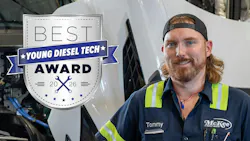
To that end, we made sure that this issue and the adjoining Fleet Diagnostics supplement include some of the industry’s best techs and experts to share their experiences to improve our readers’ performance, including Tommy Crenshaw, our first Best Young Diesel Tech of the Year.
Best Young Diesel Tech of the Year: Tommy Crenshaw
The lead tech for McKee Foods Transportation’s Gentry, Arkansas shop will be the first to say there are plenty of techs with stronger technical skills. Our judges, though, looked at everything that matters, including leadership and integrity. We also could only consider techs under 35 whom someone nominated.
A former supervisor named Sean Carson nominated Tommy, who checked all the boxes in terms of skill, including eight ASE certifications, superior theoretical knowledge, and plenty of experience diagnosing and repairing several engine makes and OE systems.
“He’s the guy who sees a colleague struggling and steps in, whether it’s with technical help or a word of encouragement. His integrity shows in every action,” Carson wrote. When another tech at the 10-bay shop needs to attend OE training, Tommy will stay late and handle their work so they can learn and get better.
That paid off this year, when the shop’s techs pulled a major upset at the Arkansas Trucking Championship by winning the Team Award. Up against far larger fleets, essentially the Kobra Kais of wrenching competitions, the McKee guys held a higher overall average score, with Crenshaw coming in third overall.
The future skills competition
One thing that makes techs like Tommy “the best” in our eyes is that he told Carson after being nominated, “I don’t know if I would say I’m the best, but I always try to be better every day.” This is something anyone can do.
Tommy, though, had an edge that many millennials growing up in the early 2000s did not: mechanical mentoring from practically the cradle. His dad and his mom’s dad both taught him about car, truck, and farm tractor engines from the time he could hold a flashlight. His father, Douglas Crenshaw, also believed kids belonged outside in the summer to learn self-reliance and actually live, so he’d cancel the cable subscription and make Tommy and his sister Christina stay outside. Doug would sound a dinner bell when it was time to come in. It was a small enough town that if Tommy was out of earshot, some neighbor would surely pass on the message.
And when Tommy scraped together some money to buy a beat-up pickup at an auction, Doug told him to figure out the repairs on his own. Tommy did, and McKee’s uptime is better for it. He also makes a decent wage, loves what he does, and gets outdoors with his wife Cady as much as he can. Any parent would be happy with that outcome.
Tommy acknowledges that growing up around a farm and being pushed to figure things out gave him an edge, saying, “Some people I’ve met had never worked on anything a day in their life until tech school.”
I have a feeling that won’t be the case in a decade. The technician shortage is a big deal now, but it’s far less vulnerable to AI displacement than white-collar jobs. More parents will steer their kids toward the trades, which means shops could be far more selective. And even though AI is making troubleshooting easier (see the supplement), experience will still matter, because AI is just a fancy new tool. Those who learn early and often will always have an advantage over the dilettantes, who have worse odds of being really good, let alone the best.
Take it from Tommy, who said, “You can tell when somebody’s actually passionate about the job and the career, and then someone that’s just doing it to get by.”
At some point, that simply won’t cut it.
About the Author
 John Hitch
Editor-in-chief, Fleet Maintenance
John Hitch is the award-winning editor-in-chief of Fleet Maintenance, where his mission is to provide maintenance leaders and technicians with the the latest information on tools, strategies, and best practices to keep their fleets' commercial vehicles moving.
He is based out of Cleveland, Ohio, and has worked in the B2B journalism space for more than a decade. Hitch was previously senior editor for FleetOwner and before that was technology editor for IndustryWeek, and managing editor of New Equipment Digest.
Hitch graduated from Kent State University and was editor of the student magazine The Burr in 2009.
The former sonar technician served honorably aboard the fast-attack submarine USS Oklahoma City (SSN-723), where he participated in counter-drug ops, an under-ice expedition, and other missions he's not allowed to talk about for several more decades.
Related
 Dobbs Peterbilt Diesel technician