NACFE report highlights truck maintenance challenges in the Messy Middle
Key Highlights
- NACFE identified technician training as critical as fleets adopt more complex truck technologies.
- New powertrains require updated safety procedures, tools, and service capabilities.
- Predictive maintenance and diagnostic systems can help fleets improve uptime and reduce downtime.
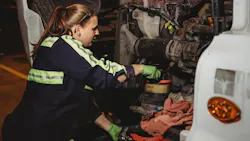
The North American Council for Freight Efficiency’s (NACFE) recent report, Messy Middle Powertrain Service & Maintenance, highlighted several maintenance challenges and trends that fleet technicians are currently grappling with.
The goal of the report is to serve as a guidebook for OEMs, fleets, shops, technicians, and others on the complex issues fleet maintenance faces today. The report also focuses on available resources for technician training and service center operations. NACFE conducted its research with the University of California, Riverside, and the report’s primary author, Marcos Alvarez, interviewed fleet service managers, OEMs, NACFE personnel, and others.
According to NACFE, the Messy Middle is the era that trucking has been in since 2020, when industry technology and vehicle complexity boomed. The industry now has an abundance of technology and equipment options, including alternative fuels, battery-electric vehicles (BEVs), charging infrastructure, powertrains, artificial intelligence (AI), and autonomous vehicles (AVs). This overabundance of options has created challenges for technicians and maintenance managers as they struggle to keep up with every new trend, product, and technology.
Report findings on commercial truck maintenance challenges
NACFE compiled 10 primary takeaways from its report:
- Maintenance costs are becoming a bigger purchasing consideration. Beyond routine repairs, fleets must account for investments in shop infrastructure, specialized equipment, technician training, compliance documentation, and recordkeeping.
- Technician expertise remains the key factor in uptime. As trucks become more advanced, OEM diagnostic platforms and intelligent service tools will play a larger role in helping technicians identify faults and return vehicles to service faster.
- Service of alt-fuel vehicles introduces new safety requirements. Working on natural gas, hydrogen, battery-electric, and others requires different procedures, specialized equipment, and enhanced safety training compared to diesel service.
- Training must become an ongoing process. Rapid advances in vehicle technology mean fleets will need continuous education programs, along with systems to track technician certifications and skill development.
- Digital diagnostics are now essential shop equipment. Computers, software subscriptions, and regularly updated diagnostic hardware are increasingly necessary for servicing modern trucks and should be included in maintenance budgets.
- Warranty management will grow in importance. As vehicle systems become more sophisticated, understanding and complying with OEM warranty requirements will be critical.
- Maintenance standards will continue to evolve. Fleets should expect changing service procedures and regulatory requirements as new technologies mature, creating additional compliance and labor demands.
- Infrastructure maintenance extends beyond the truck. Fleets adopting alternative fuels or electrification must also maintain fueling or charging equipment, while the reliability of public infrastructure can directly affect vehicle availability.
- AI will continue to strengthen predictive maintenance and aid technicians.
- Specialization within the technician workforce will increase. As fleets operate a wider mix of powertrains and technologies, shops may need technicians with expertise in specific vehicle systems.
You can download the full report from NACFE here.
About the Author
 Jenna Hume
Jenna Hume
Digital Editor
Digital Editor Jenna Hume previously worked as a writer in the gaming industry. She has a bachelor of fine arts degree in creative writing from Truman State University and a master of fine arts degree in writing from Lindenwood University. She is currently based in Missouri.