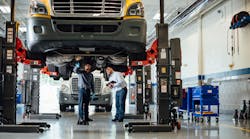
Everyday hazards, big consequences for shop safety
Key Highlights
- Make cleanup part of every repair: clear tools and hoses, remove spills, and keep walkways and bays organized.
- Train lift operators, inspect lifts before each shift, and arrange qualified annual inspections.
- Use documented lockout/tagout procedures that isolate every energy source, including residual air or hydraulic pressure.
- Secure dump boxes with purpose-built supports and use clear communication, spotters, and high-visibility clothing when moving vehicles.
- Investigate incidents by asking why repeatedly, invite technicians to raise concerns, and address hazards with practical improvements.
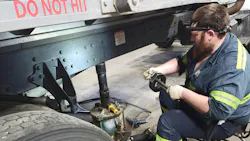
Truck driving typically lands on OSHA’s list of occupations with the most likelihood for accidents. But the people who help keep trucks up and running face plenty of risks too. In fact, many of the most common types of workplace hazards are things heavy-duty technicians encounter every day:
- Harsh chemicals and flammable materials that can burn, cause allergic reactions, etc.
- Big, heavy machinery that can crush a person
- Potential for electrocution
- Potential for cuts and burns incurred during routine activities
- Potential for more serious injuries sustained from welding and cutting activities
OSHA says many of these hazards can be controlled with proper work practices and PPE, but it requires training and an ongoing commitment from employers. Additionally, shop leaders can’t just focus on a select few of the most daunting potential hazards.
“You’re always on the lookout for the big, scary items that can be catastrophic,” said Mike Blimling, vice president of truck technology and maintenance for NationaLease. “What I actually worry more about are those smaller day-to-day incidents that are less obvious, but can cause injuries and really add up over time.”
Slips and trips
Slip and trip hazards represent one of those everyday risks that can sometimes fall off the radar.
“This can be a tough one because there are so many things that can come into play,” said Seth Murphree, truck service risk team leader for TravelCenters of America. “It really comes down to good housekeeping.”
Tools, parts, supply boxes, etc. can’t be piled up in traffic areas. “A cleaner shop is a safer shop,” Blimling said. “There needs to be a place for everything, and everything must be required to be in its place.”
This can be easy for technicians to forget when they are so focused on efficiency. But safety and efficiency go hand in hand, and it’s up to the shop leader to make that point known.
“My techs know that cleaning up is part of the repair process,” said Nate Taylor, owner of New England Fleet Services in East Granby, Connecticut. “I don’t even want someone clocking out of a job until the bay is cleaned. That involves sweeping, collecting scrap metal to throw in the scrap trailer, and cleaning up any spills with spill mats and speedy dry which we keep in each bay. Technicians also need to get their tools off the floor before they clock out and pull the next job in.”
Whenever there’s an oil spill specifically, Blimling said the floor should also be cleaned with a degreaser and floor scrubber. And he’s not just talking about huge spills that require immediate containment. Things like gear and penetrating oil naturally come off a truck during service and could create a slip hazard. “Anytime a truck leaves the bay, look around and clean up the floor if you have to,” Blimling advised.
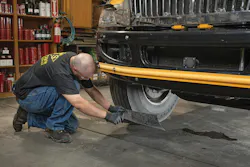
Turning our attention back to trip hazards, air hoses and extension cords are a big concern. That’s why Murphree is a big fan of hose reels. “The time it takes to manually coil up a hose and hang it on a hook can deter some technicians from doing it,” Murphree said. “A hose reel makes it a lot easier and faster.”
Lifting equipment
Vehicle lift mishaps represent one of those “big and scary” safety hazards Blimling alluded to earlier.
“Because lifts are so familiar and part of most technicians’ daily routine, it may be easy to become complacent about lift safety,” said R.W. “Bob” O’Gorman, president of the Automotive Lift Institute (ALI). “It is that complacency, assuming the lift is fine to use, that is potentially dangerous.”
There are a few things shops can focus on to help prevent complacency from setting in.
Training. Only people who have been properly trained should operate a vehicle service lift. Training requirements are outlined in the ANSI/ALI ALOIM safety standard which, in part, says that training should be based on the lift manufacturer’s instructions and warning labels, along with ALI publications including Lifting It Right, Safety Tips, and the annual Lifting Points Guide. “A copy of these materials is included with every ALI Certified Lift,” O’Gorman said.
ALI also offers an online Lifting It Right training course that O’Gorman recommends all lift operators take annually.
Inspections. The ANSI/ALI ALOIM standard also mandates that all vehicle lifts be inspected at least annually by a qualified lift inspector, such as an ALI Certified Lift Inspector. On a more routine basis, O’Gorman said technicians should inspect their lifts before starting each shift to make sure there are no signs of leaks, damage, excessive wear, loose concrete, or questionable adapters or accessories.
“If any of those issues are present, or if the technician has noticed the lift making unusual noises, sudden movements, or operating erratically, they should report the situation to their supervisor and not use the lift until the problem is resolved,” O’Gorman said.
Encourage safe behavior. Technicians should also be made to feel comfortable about reporting any unsafe lift use by their coworkers.
“It’s human nature to not want to tell on your coworker,” Blimling said. “But you’re not really telling on them; you’re looking out for them.”
Similarly, Taylor said it’s important to make technicians feel comfortable about asking for assistance when they need it. For instance, not all heavy-duty techs are comfortable using automotive-style lifts because the lift points can vary.
“We make sure one of our light-duty or hybrid technicians helps with the lift setup if a heavy-duty tech ever needs to work on a smaller vehicle,” Taylor said. “Nobody in my shop is ever on an island, especially when it comes to safety.”
Vehicle movement
Vehicle movement creates another potential “big and scary” safety hazard in a shop.
“A shop needs strong controls in place to prevent unplanned movement, and to reduce risk when there is planned movement,” Murphree said.
Those controls include documented policies for the proper use of things like wheel chocks and lockout/tagout (LOTO) procedures.
“From what I’ve seen, LOTO can vary widely across the trucking industry because there are different methods you can use,” Murphree said. “The main thing to consider is energy isolation. A truck might have additional equipment or maybe even a subsystem like hydraulics. Along with the power unit itself, it’s important to have a standard operating procedure (SOP) that talks about the methods for isolating all of those energy sources.”
For example, if a technician is working on an air suspension system, they can isolate the source of energy at the power unit. But if the technician doesn’t drain the residual air out of the system itself, it will still have some degree of energy. That could pose a risk when the tech goes to take the airbag off. A good LOTO SOP will address this type of thing.
OSHA standard 29 CFR 1910.147 outlines LOTO procedures for general industry, which includes vehicle repair shops.
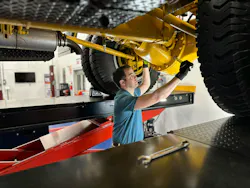
“Additionally, TMC has developed a recommended practice on LOTO procedures,” Murphree pointed out in reference to TMC RP 543A. “The Tire Industry Association (TIA) also has recommendations. We look at all of that guidance with the goal of developing our own SOPs that exceed those industry standards.”
Dump boxes pose another risk. “Never work on a truck with a dump box in the upright position unless it is properly supported,” Blimling said.
Makeshift solutions like 4x4s are not considered proper support. Companies manufacture bracing equipment specifically for this application. Technicians must put that bracing equipment into proper position, and then lower the dump box onto it. Then, after the pressure is relieved from the hydraulics, it’s safe to begin work on the truck.
Shops also need to think about their SOPs for planned vehicle movement when vehicles are being moved into, around, and out of the shop. That starts with clear communication protocols.
“An effective communication SOP will often involve the use of two-way radios, or sometimes the use of a spotter to help guide drivers into a bay,” Murphree said. “It’s a good idea to do a combination of both if you can.”
Hi-vis clothing can also play an important role in mitigating risk.
“Have some hi-vis safety vests available so the spotter can grab one,” Murphree said. “Many shops will also make sure there are reflective elements to their technicians’ uniforms, which helps keep everyone visible at all times.”
If using a spotter, a clear set of hand signals should be used. Then that spotter needs to have a conversation with the driver as to what those signals will mean and what the expectation is.
Ultimately, the easier shop leaders can make it for technicians to stay clean and organized, the easier it becomes to maintain a safe, yet efficient shop. Murphree said it’s also important for shop leaders to study the safety incidents they have experienced in order to determine what the real hazard is.
“When you think you know what caused a certain accident, ask yourself ‘why’ seven more times to really figure out what’s behind it,” Murphree suggested. “Also, take the time to ask the technicians if anything can be done to make things easier and safer for them.”
“My techs have been doing this longer than I have, so I want them to come to me with concerns and ideas,” Taylor added. “Then, the best way I can prove that I take their safety seriously is to spend money on the things they need to stay safe. That’s the best way to build trust.”
About the Author
 Gregg Wartgow
Gregg Wartgow is a freelancer who Fleet Maintenance has relied upon for many years, writing about virtually any trucking topic. He lives in Brodhead, Wisconsin.
Related
 dreamstime_xxl_315866240