Key Highlights
- Refrigerated transport, pioneered by Frederick Jones, created the foundation for today’s connected cold chain operations.
- Weight reduction, maintenance tools, and vehicle advances have shaped trucking efficiency for nearly a century.
- Early innovations in lighting and alignment continue to influence fleet uptime, safety, and maintenance practices.
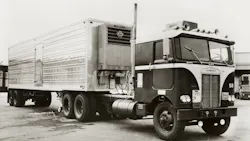
The first decade of American trucking brought foundation to the industry, with Alexander Winton creating the first "semi truck", or auto hauler, along with innovations in maintenance and components.
As trucks became more practical and reliable, the years that followed brought a new era of specialization and refinement, one full of tools and parts that would revolutionize the budding industry.
As trucks became more capable and fleets grew larger, manufacturers spent the next quarter century introducing purpose-built equipment, with the birth of refrigerated transport among the era's most significant innovations.
1934 - Pneumatic wrenches make an impact
In 1932, Robert Potts filed a patent for a hand-held power tool to tighten or loosen nuts and screws, stating that either an electric or pneumatic-driven motor could be used. The Ingersoll-Rand Company acquired the patent and launched the first commercial air-powered impact tool. With shop air readily available, the tool immediately improved productivity in the shop and reduced technician fatigue. In 1939, Chicago Pneumatic developed and launched its own design, offering both pneumatic and electric versions.
1938 - The birth of refrigerated transport
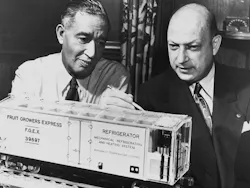
According to the Thermo King legend, the modern cold chain came to be from a $6 bet on a golf course. In the late ’30s, refrigerated trailers used blocks of ice and salt to cool perishable freight, but one trucking company owner noted to his friend and owner of a movie sound equipment business, Joseph Numero, that raw chicken was spoiling before reaching Chicago from St. Paul. Numero wagered that his genius employee, Frederick McKinley Jones, could solve the dilemma in 30 days. Jones, a self-taught engineer orphaned as a boy and raised by a Catholic priest in Cincinnati, rose to the challenge and developed the first mechanical transport refrigeration unit. Mounted to the front of the trailer, the TRU, patented in 1940, offered continuous cooling and consistent temperature control on the road. Numero quickly pivoted to co-found U.S. Thermo Control Company with Jones, who became chief inventor.
Jones’ invention goes beyond just getting whatever flavor of ice cream you want this summer. The 700-lb. Model C, developed for the military, was deployed on ships and trucks to get needed temperature-sensitive food, medicine, and blood to the front lines during World War II. Thermo King’s postwar advancements included start-stop operation to reduce fuel consumption.
TRUs have evolved to run on diesel and battery power, but the key goal is still to make sure the chicken doesn’t go bad. That is now done with real-time temperature monitoring, telematics, and algorithms that can predict future failure with 95% accuracy, noted Adam Wittwer, president of Thermo King Americas.
“With telematics and connected solutions, customers can see what’s happening in real time and make more informed, data-driven decisions, while still relying on the performance they’ve always known,” he added.
While no accommodation or honor could truly match Jones’ contributions to society, spread across 60 patents, he has the distinction of being the first African American to receive the National Medal of Technology.
1942 - Freightliner’s weight loss plan
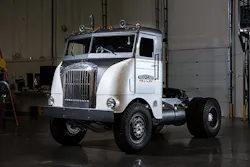
Leland James, founder of Consolidated Freightways, was keenly aware that the heavier the truck, the less a customer could haul. His solution for his Freightliner trucks was to reduce weight by placing the cab over the front axle, as the shorter cabover design maximized payload capacity.
Then in 1942, James rebranded the company as Freightliner Corp. to coincide with the launch of the Model 600 “Shovelnose,” credited as the first all-aluminum cab. Aluminum production had skyrocketed as America churned out aircraft for the war effort, making the lightweight metal more practical for trucks. The new material reduced the truck’s weight by about 1 ton, allowing for more payload and less work for the era’s more modest engines while climbing the steep grades of America’s West.
Now owned by Daimler Truck North America, Freightliner’s focus on weight and efficiency has helped it remain the Class 8 market leader for over four decades.
1955 - Hunter revolutionizes alignments
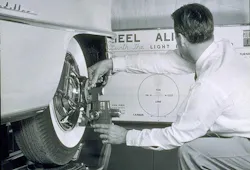
After serving with the U.S. Army Corps of Engineers during World War II, Lee Hunter Jr. returned to St. Louis and founded Hunter Engineering in 1946. Initial products included the Kwikurent battery charger and on-car wheel balancer, but the major breakthrough that made Hunter a ubiquitous name in vehicle repair came in 1955 with the Lite-A-Line alignment system. It projected light beams through mirrors onto a calibration chart, allowing techs to quickly and accurately measure angles, such as camber and toe, in real time. The system transformed a time-consuming task into a relatively simple PM, becoming the industry standard. In 1967, Hunter expanded into the medium- and heavy-duty segment by offering systems for larger tires and wheelbases, higher loads, and multi‑axle configurations.
Products like Hunter’s HawkEye Elite, which use high-def cameras, sophisticated software, and targets that clamp to the tires, are all rooted in that first innovation.
“These solutions contribute to longer tire and component life, better fuel efficiency, lower operating costs, and increased vehicle uptime—supporting more reliable, predictable maintenance across fleet operations,” noted Hunter product manager Alan Hagerty.
1956 - Modern highways take shape
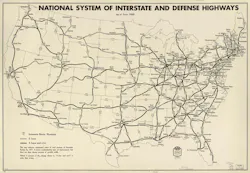
As a young lieutenant colonel fresh off the war to end all wars, Dwight D. Eisenhower was part of a military convoy that traveled from Washington, DC, to San Francisco along the Lincoln Highway, now the present-day Interstate 80. The convoy averaged 6 mph. Being slowed by Midwestern mud and sluggish Salt Flats stuck with Ike. Then, as Supreme Allied Commander during World War II, he saw Germany’s Autobahn and how effective it was in speeding up efficient transportation.
With these in mind, as president, Eisenhower challenged America’s governors to help conceive of an interstate system to connect the country, something the public had been behind for decades. Previous highway acts had expanded the roadways, but were overall lacking. In 1956, Eisenhower’s roughly 41,000-mile system was approved. It introduced strict design standards, such as 12-ft. wide lanes and bridges with 14-ft clearance, no traffic lights, and the numbering system. Fuel taxes initially funded 90% of construction costs, though it is now also supported by the Highway Trust Fund. The first portion was built west of St. Louis on what is now I-70. Construction on I-69, which will span from the Canadian to the Mexican border, is ongoing.
1958 - Truck-Lite designs sealed marker lights
If you think trailer lighting causes issues in the shop now, imagine when lights were neither sealed nor replaceable. Moisture, dirt, and road salt slipped into the housing, causing corrosion and premature failures. Inventor George Baldwin set out to solve the problem in his Jamestown, New York, garage with partner Harry Grosser. The duo developed a fully sealed polycarbonate housing for marker lights and tested the prototypes’ moisture resistance in the kitchen sink. The tests worked, and the pair formed Truck-Lite to create and commercialize corrosion- and shock-resistant stop, turn, and tail lights. Now owned by Clarience Technologies, Truck-Lite continues to innovate with LED lighting, wiring harnesses, and systems designed to improve fleet CSA scores and reduce maintenance demands. Truck-Lite’s Road Ready trailer telematics platform builds on Baldwin’s original idea by using sensors and diagnostics to identify lighting and electrical faults before they lead to roadside violations or downtime.
About the Author
 John Hitch
John Hitch
Editor-in-chief, Fleet Maintenance
John Hitch is the award-winning editor-in-chief of Fleet Maintenance, where his mission is to provide maintenance leaders and technicians with the the latest information on tools, strategies, and best practices to keep their fleets' commercial vehicles moving.
He is based out of Cleveland, Ohio, and has worked in the B2B journalism space for more than a decade. Hitch was previously senior editor for FleetOwner and before that was technology editor for IndustryWeek, and managing editor of New Equipment Digest.
Hitch graduated from Kent State University and was editor of the student magazine The Burr in 2009.
The former sonar technician served honorably aboard the fast-attack submarine USS Oklahoma City (SSN-723), where he participated in counter-drug ops, an under-ice expedition, and other missions he's not allowed to talk about for several more decades.