PitPro robotic wheel changer starts work at Calgary tire shop
Key Highlights
- PitPro’s automated wheel changer can remove and replace four tires in under 15 minutes.
- The system combines tire service with tread, pressure, lug nut, and torque checks.
- Automation could help tire shops handle demand spikes without adding bay space or headcount.
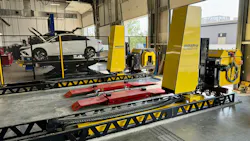
PitPro Automation, the startup behind the first automated wheel-changing system, has deployed its first production unit at a Kal Tire location in Calgary, Alberta.
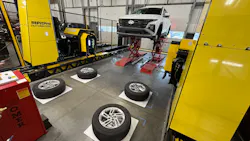
The system, which fits inside one bay and comprises an alignment lift flanked by two gantry robots, is designed to ease the physical burden on tire technicians and increase shop throughput.
The gantry robots perform fastening and lifting movements simultaneously on both sides of the vehicle, much like a NASCAR pit crew would on the racetrack. In demonstrations, the PitPro system has removed and replaced four tires in under 15 minutes, or up to 90% faster than a human, the company said. The current system can accommodate Classes 1-3 vehicles.
The system’s sensors can also measure tread depth and tire pressure, and detect broken and stripped lug nuts. The automated system also precisely torques fasteners to within 1% of OEM specs and digitally logs that data.
For Kal Tire, a major Canadian independent tire dealer with more than 280 stores, the deployment of this first-of-its-kind shop equipment, the timing could not be better, as 78% of Canadian drivers use snow tires, according to the Tire and Rubber Association of Canada. Though Alberta gets less snow than in the eastern provinces, any increased demand in tire service usually transfers directly into more physical strain on the techs. A Ford F-150’s tire/wheel assembly weighs 70 lbs. (31 kg).
"Tire service is physically demanding work, and Canadian winters create intense demand spikes," said Kenneth Chaun, SVP of strategy & innovation at Kal Tire, who noted seasonal wheel swaps are one of shop's highest-volume services. "By reducing repetitive lifting, PitPro can help limit fatigue and physical stress while enabling our ability to serve more customers, more consistently."
And hiring a robot will also allow the techs to focus on higher-value work, such as performing vehicle inspections, identifying safety issues, and ensuring work is completed properly, he said.
"We see automation as a force multiplier for our team members, not a replacement for them," Chaun added.
So far, the techs have been receptive to the PitPro system, as Kal Tire routinely adds new technology to improve techs' workloads.
"They have already embraced innovations such as semi-autonomous tire changers and balancers and digital vehicle inspections, making PitPro a natural next step in using technology to support technicians and enhance service delivery," Chaun said.
He added that if the PitPro system consistently performs as designed, the shop will be able to work on more vehicles without adding bay space or headcount. A tech still positions the vehicle, lift, and jacks, of course.
Training the staff to work with the robot is ongoing, according to PitPro co-founder and CEO Jeremy Conrad, who added the first production unit is doing what it’s supposed to: “It’s still early, but all the core metrics are meeting our expectations.”
So what goes into making a decision to enter a sales contract with an untested new technology?
"The investment decision is not just about the equipment cost," Chaun said. "It is also about training time, adoption by team members, impact on workflow, reliability and whether it actually makes the job better."
He advised when making such a decision, shop leaders should "involve the people closest to the work," because "technicians and store teams can quickly tell you whether a technology is practical in a real service environment."
If it helps them do their jobs more safely, consistently or efficiently, adoption is much more likely," he added. "The best technology should make the work easier to do well, not harder to manage."
PitPro's future plans
The unit was shipped by truck in separate custom crates 1,300 miles from California.
He called the successful install “a defining moment for PitPro and proof that our technology is ready for the real world."
The team is already collecting data and finding ways to make the process more efficient, as demand for automating physical, monotonous labor will likely climb as shops struggle to fill roles.
“As it was the first install, we learned a lot and are making changes to how we pack and ship,” Conrad said.
PitPro has at least one other install slated for this year, and Conrad said they are in talks to schedule more.
About the Author
 John Hitch
Editor-in-chief, Fleet Maintenance
John Hitch is the award-winning editor-in-chief of Fleet Maintenance, where his mission is to provide maintenance leaders and technicians with the the latest information on tools, strategies, and best practices to keep their fleets' commercial vehicles moving.
He is based out of Cleveland, Ohio, and has worked in the B2B journalism space for more than a decade. Hitch was previously senior editor for FleetOwner and before that was technology editor for IndustryWeek, and managing editor of New Equipment Digest.
Hitch graduated from Kent State University and was editor of the student magazine The Burr in 2009.
The former sonar technician served honorably aboard the fast-attack submarine USS Oklahoma City (SSN-723), where he participated in counter-drug ops, an under-ice expedition, and other missions he's not allowed to talk about for several more decades.