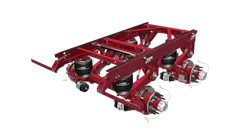
Hendrickson walking beam suspension marks 100 years of HD performance
Key Highlights
- Walking beam suspensions continue to help vocational trucks maintain traction and distribute loads across uneven terrain.
- Modern suspension designs balance durability, ride quality, weight reduction, and payload capacity across vocational applications.
- Proper suspension specification and real-world testing help fleets improve component life and long-term vehicle performance.

Some mechanical ideas remain relevant because the problem they solve never disappears. Vocational trucks still encounter uneven ground, shifting loads, and conditions that can force one axle higher or lower than the other. Whether the vehicle is collecting refuse, delivering concrete, hauling material from a jobsite, or working in a mine, it must maintain traction and distribute weight without placing excessive stress on a single axle.
The walking beam suspension was developed around this challenge. In 2026, Hendrickson marks the 100th anniversary of its patented walking beam design, a milestone that underscores how enduring that equalizing beam concept has been in heavy-duty trucking. The equalizing beam connects two driven axles through a central pivot, allowing the suspension to move across uneven terrain while sharing the load between them. When one wheel rises over an obstacle, the beam transfers part of that movement to the other axle rather than allowing one axle to carry a disproportionate amount of weight, equalizing the load carried by the axles on each end of the walking beam.
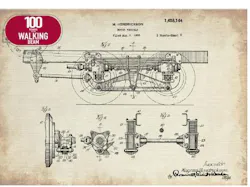
Hendrickson patented its original walking beam concept in 1926, laying the groundwork for a suspension architecture that has now been in continuous use for a century. At the time, roads outside major cities were often rough, rutted, and poorly developed, so the design helped vehicles travel across those surfaces while reducing the concentrated loads that could otherwise cause damage to tires, rims, drive axles, suspension components, and the road itself.
A century later, the equalization principle behind the walking beam remains central to many heavy-duty suspensions. Nearly everything surrounding it, however, has advanced.
Building a modern suspension around a proven principle
Early walking beam suspensions were designed for a largely utilitarian vehicle market. Their priority was carrying heavy loads through demanding conditions, even when the resulting ride was harsh. Early steel leaf spring components offered the strength required for heavy vocational work, but their stiffness could produce a rough ride when the truck was lightly loaded or empty. With less weight compressing the springs, road impacts and vibrations were transferred more directly into the cab, body, and mounted equipment.
Modern vocational vehicles place broader demands on the suspension. Fleets require stability and off-road mobility, yet they also must consider driver comfort, vehicle weight, and the growing amount of sensitive equipment mounted on the truck. Hydraulic systems, electronic controls, and body components can all experience accelerated wear when subjected to continuous vibration. Minimizing those impacts and vibrations helps extend the auxiliary equipment life.
Advances in material and manufacturing processes have helped suspension designers and engineers address this need. Earlier designs relied heavily on cast steel and ductile iron, while newer generations make greater use of fabricated structures and higher-strength steels. Utilizing fabrications also gives manufacturers more flexibility to accommodate different beam lengths, capacities, and vehicle configurations without creating dedicated tooling for every variation.
Spring technology has advanced alongside the walking beam, giving suspension engineers more flexibility to shape how the system behaves on the road. Modern rubber load springs help screen out road inputs that would otherwise reach the cab, body, and mounted equipment, while progressive spring designs can be tuned to feel compliant in day-to-day service and provide firmer support when the vehicle is heavily loaded or operating off-highway. As a result, contemporary suspensions can deliver a smoother, more controlled ride without compromising the stability demanded in heavy-duty environments.
Reducing suspension weight creates another practical advantage. Every pound removed from the chassis can contribute to additional payload, which has a direct operating value in weight-sensitive applications. A refuse vehicle that can carry more material before returning to the landfill may complete its route with fewer trips. Concrete and aggregate fleets face similar calculations, making suspension weight part of a much larger productivity decision.
Matching the suspension to the work
Walking beam-based suspensions are available in several configurations because vocational trucks operate under widely different conditions. The right design depends on factors such as load capacity, ride quality, terrain, available space beneath the chassis, and the fleet’s maintenance priorities.
Spring design is one of the primary levers fleets and OEMs use to tailor these suspensions to specific vocational roles. Traditional steel spring systems are typically specified where operators value long-term durability, familiar service procedures, and straightforward field repairs, including remote or harsh operating locations. Rubber spring systems become attractive when reducing suspension weight and further limiting vibration into the chassis take priority, particularly for vehicles that spend significant time traveling empty or with partial loads. Progressive spring configurations are then applied in heavy-duty applications that must carry heavier payloads or work off-road, providing additional support as operating demands increase so fleets can preserve the stability they need while maintaining ride quality.
Articulation also affects how well the suspension performs on uneven ground. As the axles articulate through different positions, the suspension must allow enough wheel travel to help the tires maintain contact with the surface. Maintaining that contact supports traction and reduces the likelihood that one axle will carry an excessive share of the load. Depending on the suspension, diagonal articulation may range from approximately 15" to more than 17".
Torque rods provide another layer of control. Longitudinal torque rods help the axles resist the forces created during braking and acceleration, while transverse rods limit side-to-side movement and support lateral stability. On a loaded refuse truck making an emergency stop, the longitudinal rods help keep the axles properly positioned as the body’s weight shifts forward. When that same vehicle crosses uneven ground at a disposal site, the transverse rods control lateral movement of the axles as one side rises above the other.
A carefully planned vehicle specification helps bushings, springs, mounting hardware, and other suspension components operate efficiently within their intended design limits, reducing strain that could otherwise shorten component life. These relationships explain why fleets need to work with their truck dealer and OEM to help specify the most appropriate suspension for their application rather than choosing a configuration, spring type, or capacity rating in isolation.
Hendrickson, a privately held commercial vehicle industry supplier known for suspension and integrated ride systems for heavy-duty trucks, trailers and specialty vehicles, traces its walking beam technology to its original suspension design developed by company founder Magnus Hendrickson in 1926. The company has continued to refine that foundational equalizing beam concept across several modern configurations. Its RT suspension remains the closest to the original architecture. The steel spring system is familiar to generations of operators and technicians, while its straightforward construction and broad parts availability continue to serve fleets that value field repairability. The configuration can also suit vehicles with packaging constraints, such as vacuum trucks that need space beneath the chassis for large piping.
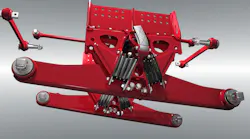
Among Hendrickson’s other walking beam-based suspension systems, HAULMAAX EX uses rubber spring technology to reduce weight and improve ride quality while maintaining stability for on- and off-highway applications such as refuse trucks, concrete mixers and dump vehicles. The ULTIMAAX suspension is designed for higher capacity, predominantly off-highway work, including mining and oil field applications where heavier loads and greater articulation require additional support.
Validating heavy-duty performance before production
Hendrickson’s walking beam suspensions are closely associated with durability, but that reputation depends on how thoroughly each design is validated before it reaches a production vehicle. Modern validation focuses on shortening development time, improving confidence for OEMs and fleets, and ensuring that heavy-duty products behave predictably in the field.
Heavy-duty validation begins with understanding how the vehicle is actually used. Laboratory assumptions alone cannot fully represent a logging road in Canada, an oil field in Texas, or a mine where vehicles may regularly encounter overload, corrosion, and extreme articulation.
A thorough validation program therefore starts in the field. Sensors and measurement equipment are installed on vehicles to record the forces entering the suspension during actual operation. Engineers then use that data to define the loads, movements, and durability cycles that the full suspension and the individual components must withstand, creating a test plan grounded in the application rather than a generalized idea of heavy-duty service.
Those real-world measurements are then reproduced in a laboratory, where repeated loading, articulation, and shock are applied under controlled conditions. Data gathered in demanding operating environments is brought into Hendrickson Truck Commercial Vehicle Systems’ test laboratory in Woodridge, Illinois, where a dedicated tandem test rig can apply those same forces to a complete tandem suspension. By condensing months of proving ground and fleet operation into a controlled test campaign lasting several weeks, engineers can observe how components behave under accelerated life conditions and confirm that they meet or exceed the criteria defined in the design validation plan.
This approach also affects how quickly new suspensions reach the market. When OEMs understand how the laboratory test plan reflects real-world forces and see consistent correlation with field performance, they can place greater confidence in the lab results. In many cases, that trust reduces or eliminates the need for long, redundant fleet trials before a new suspension can be released, helping OEMs and fleets adopt updated designs sooner.
Validation also must reflect differences among markets. Vehicle configurations, regulations, road quality, and loading practices vary by country and even by state. In some regions, potential vehicle overload conditions shape the design criteria; elsewhere, salt exposure, rough terrain or packaging constraints may create the dominant concern. Developing an effective suspension therefore requires local field research rather than assuming that a successful North American specification will transfer unchanged to another market.
That application work continues after the vehicle enters service. Hendrickson’s sales, service, and engineering teams regularly visit fleets, review installations, and troubleshoot vehicles in the field when operating conditions reveal an unexpected challenge. Details such as torque rod length, clocking angles of bushings, axle alignment, and component clearance can have a cumulative effect on ride and component life, so installation and layout development become part of the suspension’s long-term performance rather than an afterthought.
For fleets, that means the suspension is supported through both “push” efforts, where Hendrickson works closely with OEM engineering teams, and “pull” efforts, where field sales and service staff provide training, troubleshooting, and specification guidance directly to fleet operators.
Carrying the concept forward
The walking beam suspension has endured because load equalization remains valuable wherever trucks must carry significant weight across uneven terrain. Its future will depend on continuing to refine the complete suspension around that principle.
Weight reduction and maintenance will remain major priorities as vocational vehicles become more expensive, and fleets focus more closely on total cost of ownership. Electric drive axles will introduce new packaging and interface requirements, while sensing technology may give operators a clearer understanding of vehicle weight and loading conditions.
Suspension components will also need to work more closely with braking, wheel end, tire inflation, and vehicle control technologies, creating complete ride systems that manage load, vibration, and traction as an integrated whole rather than a collection of independent parts.
After 100 years, the walking beam suspension no longer represents a single fixed design. It serves as an engineering foundation that continues to be adapted to new materials, powertrain options, and operating demands. Vocational trucks can be powered by diesel, natural gas, or electricity, and can even be equipped with the most advanced sensing systems. For fleets, the enduring value lies in specifying a suspension that reflects the work the vehicle will perform, verifying that every component around the suspension is designed, validated, and supported to perform dependably over the long term.
About the Author
Gerry Remus
Vice President & General Manager, Hendrickson Truck Commercial Vehicle Systems
Mark Williamson
Manager, Product Marketing & Tech Services, Hendrickson Truck Commercial Vehicle Systems
Related
 Haulmaax Ex