Electric APUs: Fleets' answer to rising diesel prices
Key Highlights
- High diesel prices can strengthen the case for APUs by reducing idling fuel use and engine wear.
- Diesel APUs face higher maintenance costs, while older electric systems had performance and battery limitations.
- Lithium-ion electric APUs can provide longer service life, lower maintenance needs, and faster potential payback.
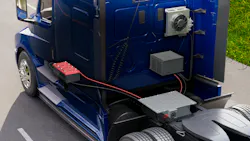
Many will remember that in the fall of 2004, the Boston Red Sox won their first World Series in 86 years. Those who worked in the trucking industry will remember that’s when diesel fuel eclipsed $2/gal. It happened the week of September 29 and was a 40% jump from the same week in 2003, according to EIA data. If you think that’s bad, the U.S. average diesel price reached $6.291/gal in September 2026—an unbelievable 68% increase over September 2025.
It’s no coincidence that as the 2004 fuel price panic took hold and fleets sought ways to save fuel, the industry also got a lot more interested in auxiliary power units. APUs are an efficient alternative to idling the engine when a driver needs to run a truck’s hotel loads. The scaled-down generators use far less fuel, benefiting a fleet’s fuel spend and environmental impact, while also avoiding maintenance costs associated with wear and tear on the engine and aftertreatment system. Stacked with regulatory changes, these benefits have driven significant levels of APU adoption in the years since.
With the current diesel prices, now is a good time for fleet managers to evaluate if APUs are right for their assets. And for those who have already adopted, they should still consider if they have the right APU for their application.
Since the early 2000’s the industry has had two primary routes to achieve these goals: electric or diesel-powered solutions. Electric systems used the main engine to charge a power pack while driving, which in turn provides power during rest periods. Diesel engine-based systems used a small diesel engine to provide the necessary power.
Diesel or electric? The age-old discussion has existed as long as APUs. Do I want a second diesel engine on my truck, with all the accompanying maintenance & reliability issues? Can I get the performance levels I need from an electric APU? Can either provide me with an acceptable return on investment?
Is any of that different today? Until very recently, the answer would have been, “not really.” However, technological advancements have changed the dynamics of assessing the viability of one vs. the other.
The “diesel squeeze”
Let’s start by examining what I like to refer to as the “diesel squeeze.” Several factors have had a major impact on the value proposition related to diesel APUs.
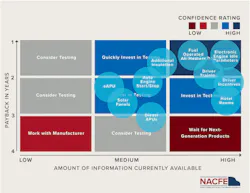
It should be noted that engines have become more efficient, as idle burn was previously 1-1.2 gph. According to Department of Energy (DOE) data, modern engine idling on a Class 8 truck consumes 0.8 gph, or 8 gal. over a 10-hour rest period. Using mid-September pricing, that equates to over $50. A recent confidence report from the North American Council for Freight Efficiency (NACFE) found that modern APUs burn about 0.25 gal per hour, or $15.70 over 10 hours. Diesel APU efficiency has remained between 0.2 and 0.3 gph for many years.
Diesel APU maintenance requirements and reliability challenges have also remained, while increased labor and component costs further challenge the solution’s viability. NACFE said diesel APU maintenance can be $600 per year. Furthermore, certain states require an APU aftertreatment device installed at the OEM to remain compliant. This pushes up the acquisition and maintenance costs even further. With fleets looking for a return on investment that falls comfortably within their normal trade cycle, justifying a diesel-based solution has become a real challenge.
Read more: Diesel vs. electric APUs: Comparing TCO
Electric APU early challenges
The reputation of electrical solutions is far from stellar. They have had many challenges of their own. The systems traditionally provided inadequate performance, leading to low levels of driver satisfaction and/or unmanageable restrictions on driver behavior, ultimately leading to poor idle reduction performance. This, coupled with the required costly battery replacement, resulted in a questionable return on investment.
Caught between these two options, many fleets opted out of APU adoption, instead seeing truck idling as the most attractive alternative, despite the higher maintenance cost associated with more complex truck engines and emissions systems.
A turning point: Lithium-ion technology
The emergence of suitable and affordable Lithium-ion battery technology has dramatically tilted the return on investment equations. Not only does this technology provide a virtually maintenance-free power source that matches truck life (10+ years), but it is also lightweight and capable of operating in a wide range of ambient conditions.
When integrated with compatible high-efficiency HVAC systems, Li-ion electric APUs provide ample power to support extended rest periods (10+ hours), even with additional hotel loads. Features that provide starting battery monitoring and jump-start functionality are also now incorporated into some systems, further enhancing the payback criteria. Combining high reliability, ultra-low maintenance requirements, and substantial residual value at time of trade makes for a compelling value proposition.
Over my 22 years developing efficient and sustainable HVAC and APU solutions for U.S. trucking—currently as head of Transtex’s DClimate division—I have learned that understanding drivers’ needs and their specific applications are prerequisites for the successful deployment of any APU system. Driver acceptance and engagement are essential to ensure the APU is utilized to its fullest potential.
Major game-changing breakthroughs have not been common in the APU space, but the arrival of viable Lithium-ion technology is undoubtedly one to look at. DClimate customers have realized an ROI of less than two years. Whether fleets have long embraced APUs or previously dismissed them, the emergence and evolution of lithium-ion solutions fundamentally changes the equation. For many operations, it may finally represent the breakthrough idle-reduction technology that they have been waiting for.
About the Author
 Martin Duffy
Martin Duffy
Martin Duffy is the Executive Vice President at Transtex, DClimate division, where he leads the company’s electric auxiliary power unit (eAPU) division focused on advanced idle-reduction technologies for heavy-duty trucking fleets.
With more than two decades of experience in transportation technology and fleet efficiency solutions, Duffy has worked closely with major North American fleets to develop and deploy systems that reduce fuel consumption, lower emissions, and improve driver comfort. His work at Transtex focuses on accelerating the adoption of next-generation lithium-ion APU systems designed to meet the evolving operational and regulatory demands of the trucking industry.