Cummins alters X10, X15 production rollout in wake of proposed EPA27 revisions
Key Highlights
- Cummins plans a phased production ramp for the MY2027 X15 and X10 engines, supporting customer confidence and quality improvements.
- Both are built on the engine maker's fuel-agnostic HELM platform.
- These changes come on the heels of the Trump EPA's proposed changes to a major Biden-era regulation.
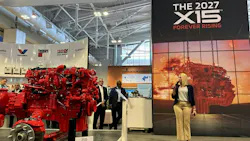
Based on its initial interpretation of the EPA proposed amendments to EPA's Heavy-Duty 2027 NOx final rule, Cummins has revised its production schedule for the MY2027 X15 engine and new X10 engine, both built on company’s fuel-agnostic HELM platform.
The X15 will have a limited production starting next Jan. 2027, progressively ramping up to full production by Q4. The new mid-bore X10, which replaces the L9 and X12 models, will also start a limited run in January, and ramp up to full production in Q3.
The B6.7 will remain available through 2027 with the next-generation B platform expected to launch in 2028.
“Our long-term product strategy has not changed,” Cummins Chair and CEO Jennifer Rumsey said. “This is about improving the transition, not changing the destination. A phased production ramp will allow us to support customers while building confidence in our new products through real-world operation and maintaining our focus on quality.”
By changing cylinder heads and making other fuel system changes, the HELM platform can accommodate several alternative fuels in addition to diesel. The X15N, which runs on natural gas, is available now, while a hydrogen version is expected by the end of the decade.
Why the change?
If the amended EPA27 guidlines go through, NOx limits would be reduced by upwards of 82% as planned, though the extended useful life and warranty requirements would be pushed back to 2030. The proposal would also create a compliance payment program allowing manufacturers to continue selling a limited number (5%) of engines meeting current standards.
Over the last three years, the industry has expressed serious concerns that the aggressive new rules and timetable would negatively impact the trucking industry and overall economy, as allowable NOx emissions were slashed by 82%, while increases to useful life and warranties put more of a burden on OEMs. These changes would drive costs up by an estimated $20,000-30,000. Many in the industry also remembered what followed the last major NOx change in 2010. Early SCR and EGR systems experienced reliability issues, leading to significant downtime issues for fleets.
The 2027 final rule called for:
- NOx emissions: 35 mg/bhp-hr during normal operation, 50 mg/bhp-hr at low load, and 10 mg/bhp-hr at idle. The current standard is 0.20 g/bhp-hr.
- Useful life: Increases across board, with up to 650,000 miles/32,000 hours for heavy heavy-duty engines, almost 50% higher than the previous 435,000 miles/22,000 hours standard
- Emissions warranty: To match the useful life, warranties would also need to be increased—to as much as 450,000 miles for heavy-haul applications.
“There’s no question the rules will be a challenge for manufacturers to meet, but in ways different than previous emissions milestones,” Allen Schaeffer, executive director of the Engine Technology Forum, told Fleet Maintenance in 2023. “Technically the required NOx emissions reductions are significant, to the tune of 82% lower than today’s levels—which are already near zero (0.20 g/BHP-hr.)."
After a lobbying push on behalf of the trucking industry, the Trump administration’s EPA decided to roll back aspects of the Biden era regulation. When EPA Administrator Lee Zeldin announced the proposal in July at the Great American Fair in Washington D.C., he was joined by Rumsey and leaders from Daimler Truck North America and Paccar.
Changes to DEF derates
At the same time, the EPA is moving to greatly reduce the impact of DEF inducements on new diesel trucks and nonroad equipment. When a fault related to the diesel exhaust fluid system is detected, the vehicle will provide audible and visual alerts to the operator, as opposed to the engine derating and potentially slowing the truck down to 5 mph. Zeldin has been advocating for this change since last summer, noting the severe productivity losses fleets and farmers face are oftentimes due to faulty sensors that could take weeks to fix. The EPA also issued guidance last March to allow NOx sensors to meet the required urea quality monitoring duties held by DEF sensors. This followed an analysis of DEF system fault data provided to the EPA by 14 manufacturers.
OEMs have also released software updates to allow older equipment to comply with the EPA’s guidance.
“If finalized, these [NOx rule] changes will help manufacturers keep improving their vehicles without being forced to rush products to market before they’re ready,” Zeldin stated. “Combined with the Trump EPA’s first proposed deregulatory action to address ongoing DEF problems, this will ease real burdens for operators.”
The EPA estimated the “commonsense” proposal could save American truckers $12 billion, with as much as $6,000 per vehicle.
The EPA scheduled a public hearing on the proposed rule for July 29-30. Written comments due August 29. For more info, visit the EPA website.
About the Author
 John Hitch
John Hitch
Editor-in-chief, Fleet Maintenance
John Hitch is the award-winning editor-in-chief of Fleet Maintenance, where his mission is to provide maintenance leaders and technicians with the the latest information on tools, strategies, and best practices to keep their fleets' commercial vehicles moving.
He is based out of Cleveland, Ohio, and has worked in the B2B journalism space for more than a decade. Hitch was previously senior editor for FleetOwner and before that was technology editor for IndustryWeek, and managing editor of New Equipment Digest.
Hitch graduated from Kent State University and was editor of the student magazine The Burr in 2009.
The former sonar technician served honorably aboard the fast-attack submarine USS Oklahoma City (SSN-723), where he participated in counter-drug ops, an under-ice expedition, and other missions he's not allowed to talk about for several more decades.