Wash & Dry Van: Trailer cleaning tips
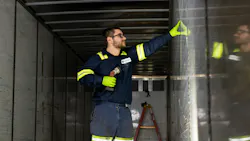
Keeping trailers clean is about more than appearance. Regular washing helps fleets protect equipment from corrosion, maintain compliance and customer confidence, and extend trailer life. But cleaning different trailer types, from reefers and livestock haulers to tankers and flatbeds, requires different tools and techniques to avoid damage while effectively removing grime.
Here are some expert tips and best practices for shops that want to clean trailers manually.
Dry van and reefer exteriors
Big Rig Mobile Wash always starts by simply rinsing off any heavy debris with a pressure washer. Then they go into their two-step cleaning process.
“Our first step uses an acidic (low pH) cleaner to target the lighter debris on top that we want to remove first, things like aluminum oxidation and road film,” explained Cole Luedeking of Big Rig Mobile Wash in Beloit, Wisconsin. “Then the soap we use in the second step can actually clean the vehicle. That (high pH) alkaline-based soap cuts into the grease, oil, fuel, and general grime that
is on the trailer.”
A third step may come into play with dry vans that have an aluminum strip along the bottom. “We’ll often hit that with an aluminum brightener,” Luedeking said. Everything is then thoroughly rinsed top to bottom with the pressure washer
Dry van and reefer interiors
Moving to the inside of a dry van, Dylan Greve, a technician for Transport Services based in North Royalton, Ohio, said he will typically pour some detergent and degreaser onto the floor all the way to the nose of the trailer. Then he’ll start cleaning with a pressure washer.
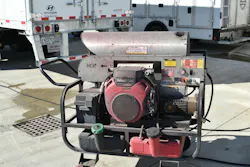
“I start at the doors and work the soap toward the nose of the trailer, and then work back to the doors and out of the trailer,” Greve said. “I’ll keep doing that until the soap is gone. A reefer is a little trickier because you have to focus more on the grooves in the floor to get all of the grime out.”
A reefer is also trickier in that it may require a special cleaning chemical.
“If the reefer is used to haul food, you need to use a food-safe detergent that prevents odor and residue,” said Rahul Natesh, CEO of JLE Truck Wash. “You could also spray a food-safe sanitizer that you don’t rinse off as a final step. We’ll typically do that if the reefer has experienced a significant spill, or if the fleet simply requests it.”
Livestock haulers
Another type of enclosed trailer, a livestock hauler, is an entirely different animal when it comes to cleaning. This is one of Deluxe Truck Stop's specialties. In most cases, fresh water and a disinfectant are all that’s needed for a basic cleaning, according to Nick Wollenman, general manager. That said, they also offer what’s referred to as a bio washout where hot water and a pressure washer are also used. The right approach largely depends on what the trailer has been hauling, i.e. cattle versus hogs, and how much “debris” is being left behind in the trailer.
As for the disinfectant, Deluxe Truck Stop uses a product they helped another company develop when disease became rampant in the hog industry several years ago.
“It’s a hydrogen peroxide-based sanitizer,” Wollenman said. “It was actually first used in the hospital industry. We were looking for a disinfectant that wasn’t so high in chloride because people can get sick or burned when it’s handled inappropriately. Our hydrogen peroxide sanitizer does a great job.”
Tanker exteriors
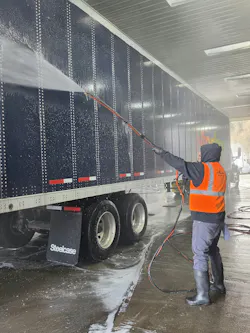
This is another type of trailer that requires some special cleaning techniques. In fact, cleaning the inside of a tanker often requires specialized equipment and properly credentialed employees.
As for tanker exteriors, Natesh said strict chemical control is needed to avoid damaging the stainless steel. Likewise, soft-touch brushes are used on ladders, fenders, and splash guards to thoroughly clean those areas without scratching.
A high-pressure rinse is the final step. “The rinse must be really thorough so the tanker isn’t left with a cloudy appearance,” Natesh said. “Our automated system douses the tanker with plain water, and then a wash bay attendant takes a fresh water hose to really spray it clean before it exits the bay.”
Tony Vertin, CEO of Ver-tech Labs offered some additional tips for washing tanker exteriors:
- Apply a low-pH brightener first, applying from bottom to top
- Apply a high-pH cleaner directly on top of the brightener
- Ideal dwell time is 30-45 seconds, but be careful the chemicals don’t dry before that
- Clean with a soft brush from front to back in sections 8-10 ft. wide
- High-pressure rinse with warm water in the 90-100 degree F range
- Keep nozzle within 18 in. of surface, spray at 15-45 degree angle
- Rinse from top to bottom
Flatbeds
These trailers tend to accumulate a lot of road film and debris.
“We like a high-pressure rinse to remove mud and chain/strap residue,” Natesh said. “Then, stronger degreasers are often needed due to the exposed surfaces of a flatbed. We buy a heavy-duty degreaser in concentrate form. For flatbeds, we may dilute it a bit stronger to take care of the extra grease and grime we typically encounter.
We’ll finish up with brighteners on aluminum components if the fleet requests.”
5 frequently forgotten steps that should become standard when washing trailers
Washing trailers on a consistent basis helps protect paint, prevent corrosion, and overall preserve both trailer life and a fleet’s brand image.
However, careless cleaning can actually do more harm than good in some regards. Paint and decals can become stripped, metals can become spotted and scratched, and improper washing can lead to various maintenance issues down the road.
Kurt Gustafson, general manager of Cox Fleet, offers some advice on how fleets can take a few precautionary steps when washing trailers to help prevent many of the common issues Cox Fleet technicians run into when performing trailer maintenance.
Tip #1: Don’t neglect the undercarriage
A lot of dirt and debris can become a fixture of the undercarriage. Road salts during the winter months can really cause problems, leading to significant corrosion on axles, wheel ends, upper couplers, crossmembers, landing gear … you name it.
“Unless you wash that salt off, it’s just going to stick there and eat away at the steel underneath a dry van,” Gustafson said. “Taking this simple step could literally add years to the life of a dry van.”
Tip #2: Be on the lookout for wall tears
Fleets hauling food in a reefer need to have the interior washed out on a regular basis. Gustafson said that before sending a technician in with pressure washer guns a blazin’, take a minute and look around to identify any tears in the walls.
Wall tears create an easy way for water to get trapped inside the foam and insulation. That will deteriorate the foam and compromise the reefer’s cooling potential, and may also lead to health and safety issues like mold. “Any wall tears should be properly repaired and sealed before spraying a bunch of water and chemicals on them,” Gustafson said.
Tip #3: Inspect electrical connections
Moisture tends to travel along cables, ultimately making its way to wherever those cables lead. When you’re talking about electrical cables, the end result is water intrusion into connections that ultimately causes them to become packed full of corrosion.
“Part of a routine trailer PM should include opening those connections to inspect them and add some dielectric grease,” Gustafson said. “A fleet should confirm that these PMs have been getting done prior to washing a trailer.”
Tip #4: Keep an eye on couplers and subframe channels
The upper coupler is another area where water can become trapped. Likewise, toward the back end of the trailer, there are numerous channels where the subframe is located.
“If a technician is spraying in there and leaves all that water sit in those channels, that can cause issues if the trailer doesn’t move for a while,” Gustafson said. “If you can cover those holes so water doesn’t get in there, great. Or maybe there’s a way to vacuum the water out when you’re done. Whatever you do, that little extra effort is well worth it.”
Tip #5: Watch the wheel ends
The wheel end is yet another area where water can become trapped.
“Take the time to make sure those hubcap plugs are covered,” Gustafson said. “If you get water inside a hub, it’s going to cause wheel end damage. Many technicians don’t even think about that because they assume a hubcap is sealed. But hubcaps have what amounts to a tiny pressure-release valve in the center. If you hit those head on with a pressure washer, water will get inside that hub.”
In summary, taking the time to clean trailers is an important step toward maximizing trailer life. But careless cleaning can cause issues, sometimes very costly issues. Adding these five steps to your standard operating procedure for washing trailers can help avoid them.
About the Author
 Gregg Wartgow
Gregg Wartgow
Gregg Wartgow is a freelancer who Fleet Maintenance has relied upon for many years, writing about virtually any trucking topic. He lives in Brodhead, Wisconsin.