Snow away: How shops aid in war against winter weather
Key Highlights
- Shops begin winterizing fleets in the fall, checking coolant, DEF, heaters, washer fluid, wipers, hoses, and batteries.
- Technicians prepare for common storm-time problems, including frozen air dryers and valves, fuel gelling, hydraulic hose failures, and electrical issues.
- Staffing plans, mobile technicians, and stocked fuel additives and filters help shops respond quickly during severe weather.
- Clearing parking areas, moving trucks indoors, limiting open garage doors, and promptly removing water reduce workplace hazards.
- Salt, snow-clearing equipment, and shared responsibility help keep shop entrances, sidewalks, and service areas safe.
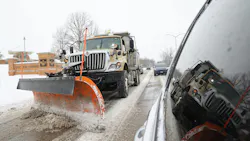
When it snows, kids pray that the overnight accumulation on the roads will force school cancellations. Most everyone else hopes the plows can clear the way so they can safely get to work or wherever they are going.
“During the winter months up here, people just jump in their cars and go where they need to go,” said Chris Hardy, highway commissioner for the Brown County Highway Department in northeastern Wisconsin. “The snowplow drivers take care of the rest—and it all just seems to magically happen.”
Hardy called these drivers “unsung heroes,” though kids trudging to class would disagree. But even heroes need help.
“There’s a lot of magic going on in the background with the technicians who keep that equipment running during those really long shifts," Hardy noted.
He sees this in his own public sector fleet department. The technicians start getting trucks and equipment ready for winter in October, which is typically several weeks before the first heavy snowfall in northeastern Wisconsin.
Third-party repairers also spend a lot of time in the fall helping snow removal fleets prepare for the coming season.
“We get together with our customers to set up winterization packages for all vehicles in their fleets,” said Jacob Marshall, shop manager at Commercial Truck & Mobile Repair’s St. Paul, Minnesota, location.
The packages include:
- Inspecting freeze point of coolant
- Checking DEF quality
- Checking operation of the block heater
- Switching over to winterized windshield washer fluid
- Inspecting wiper blades
- Checking condition of coolant hoses
- Checking operation of heating controls
- Isolating battery cables and checking for corrosion
Marshall’s team of 15 technicians will also check over some of their snow removal customers’ equipment. They’ll inspect salt spreader hoppers for corrosion in the chain drive and check hydraulic hoses.
“Some customers simply request replacement of the hydraulic hoses as part of an annual PM,” Marshall said. “Otherwise we’re looking for cracks and seepage at the fitting, and just grabbing a wrench and making sure those fittings are snug.”
This October, St. Paul hit 90 degrees F on Oct. 10 and 11, but shops like Commercial Truck know that won’t last—and they need all the time they can get to check every detail to ensure local plows keep running once the snow starts falling. You also never know when an early-season snow event will sneak in ahead of schedule, and some things are bound to go unexpectedly wrong throughout the season.
Shops can prepare for those variables with the following best practices, as told to us by fleet professionals in some of the snowiest areas in the country.
Set up for the right services
During heavy snow events, the Brown County Highway Department runs 12-hour plowing shifts with a shift change at 7 p.m. Thus, it’s imperative for the shop to have two to four technicians working the night shift. The other six to eight come in during the day.
“Our techs are helping fuel trucks and load salt, and make sure the plows are working properly,” Hardy said. “Sometimes they run into things like blown hydraulic hoses and valve issues. Salt and electricity don’t work well together. So we also see a lot of electrical connection issues that take a little time to sort out.”
Ian Preston is the service manager at Hunter Truck’s Buffalo, New York, location. Buffalo is known for its punishing lake effect snowstorms, sometimes dumping multiple feet of snow at a pace of several inches per hour. But Hunter Truck’s snow customers need them, so unless the authorities have issued a driving ban, all staff are typically expected to come in. And even when there is a driving ban, shops that support snow removal operations are deemed essential. Preston said he’ll typically ask those technicians who live relatively nearby to make it in, including himself.
Whoever is in the shop during a snow event will often run into air dryer issues due to moisture getting in the system. Another somewhat common issue is valves that are freezing up.
“With some of the newer vehicles and the low micron rating on the filters, even the slightest amount of fuel gelling can restrict fuel to the engine,” Preston added. “So we’ll do a fair amount of work where we add treatment to the fuel tank, flush out the lines, and change the fuel filter.”
It’s a relatively easy diagnosis when a customer has been out plowing for hours in the cold.
“If we see a Cummins with a 559 code, for example, 90% of the time it’s a fuel filter that’s gelled up,” Preston said.
Over in Minnesota, Marshall’s techs run into a lot of fuel gelling too. He watches the extended weather forecast and works with his parts manager to stay ahead of the sub-zero-temperature stretches the Twin Cities is famous for.
“Some of our customers have trucks that are idling all day long and sometimes freeze up,” Marshall related. “We’ll get ahead of that and stock a plethora of anti-gel additives and fuel filters. Those times are also when we go all hands on deck with six mobile technicians running all day long.”
Keeping a shop safe during a snowstorm
Shop managers also need to think about keeping their techs, drivers, and customers safe during snow events. Good preparation is the key.
In the early stages of a snowstorm, Preston’s second-shift staff makes sure there are no trucks parked in the areas of the parking lot where the plowing contractor needs to push the snow piles. Then they cone off those areas so the contractor knows what to do when he arrives in the middle of the night. Additionally, right before they punch out for the night, the second-shift staff moves as many trucks into the shop as possible.
“We have 23 bays,” Preston pointed out. “We want to limit the need for our techs to go outside when it’s snowing. We want to get as many trucks inside, melted off, and cleaned up as possible. The less water we have in the shop, the better. Our shop is always heated, so things are usually in pretty good shape by morning when the day shift starts showing up.”
Of course, keeping a shop completely free of slushy slop is nearly impossible during snowstorms. Marshall said his shop’s culture of teamwork comes into play here.
“We work hard to make sure there aren’t any tools or anything else left lying on the floor,” Marshall said. “Walking over a tiny puddle of water is easier when there isn’t a bunch of other stuff in the way. We also have a policy to keep the garage door open as little as possible. And when some water is running from one bay into the next, the two technicians work together to squeegee it to the floor drain as quickly as possible.”
Marshall’s shop is also aware of the ice dams that tend to form on the shop roof. When those dams eventually start melting in the sun and dripping to the pavement below, that creates a major slip hazard when the water starts freezing again.
“We have a wheel loader and an F-350 with a plow and spreader to clear our parking lot,” Marshall said. “Any technician can jump in the truck if needed. For every time we plow the parking lot, we’re clearing and salting the sidewalks and ice dam areas twice. We like to keep four to six feet clear in front of each service door. We also keep a 5-gallon bucket of salt inside each service door. When you think about it, salt is extremely cheap.”
Preston agrees 100%. “Salt is cheap, but slip and falls are not,” he reminded.
Hiring a snow removal contractor is also cheap, if you hire a good one. That allows Preston’s technicians to stay focused on fixing vehicles instead of plowing snow. That said, the shop still has a large snowblower, loader, and one-ton pickup with salt spreader from when it used to handle all of its own snow removal. Preston’s crew has to put it to use from time to time.
“With some of the storms we get here, the snow might accumulate several inches before our contractor can get back to our facility,” Preston said. “It’s good to have this equipment to take care of the smaller cleanups in between.”
Preston’s facilities manager handles most of the in-house snow work at Hunter Truck in Buffalo. On the other hand, a lot of shops must rely on more of a team effort.
“If something at our shop needs to be shoveled, plowed, or salted, any technician will jump in and do it if they have a quick minute,” Hardy said. “If a storm is really bad, though, we have more of a formal schedule and appoint someone in charge. But generally our guys do a really good job of jumping in where they can to stay on top of it and help each other out.”
Getting through a snowstorm really does require a team effort—whether you’re part of the crew out doing the plowing, or part of the fleet maintenance team helping to ensure that the equipment can make it through another storm.
About the Author
 Gregg Wartgow
Gregg Wartgow is a freelancer who Fleet Maintenance has relied upon for many years, writing about virtually any trucking topic. He lives in Brodhead, Wisconsin.
Related
 dreamstime_xxl_142177612