How diagnostic tools are offering more guidance
Key Highlights
- Guided diagnostic tools help technicians identify root causes, reduce trial and error, and improve repair consistency.
- Integrated diagnostic and repair information can reduce troubleshooting time and ease technician training challenges.
- Remote diagnostics give drivers and shops an earlier look at vehicle faults, helping reduce repair delays and downtime.
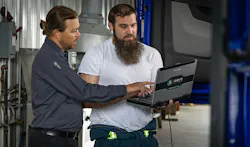
As diagnostic tools become more capable, their value increasingly depends on how well they help technicians interpret information and work through problems. Beyond identifying fault codes, newer platforms are adding guided troubleshooting, connecting repair information, and enabling some diagnostic work before a vehicle reaches the shop.
Giving more guidance
One of the biggest changes in diagnostic software has been the move from simply displaying fault information to actively guiding technicians through the troubleshooting sequence.
Abraham Sandoval, owner of T&T Repair, said Detroit Diesel, Cummins, and Volvo platforms increasingly do more than define a fault. They can walk technicians through tests, identify related faults and point them toward the next step.
He has also seen the quality of troubleshooting information improve over time. In the past, diagnostic information was more static, often providing the code definition, the system reaction, and a schematic. Newer versions increasingly offer step-by-step instructions that tell technicians where to connect, what to check, and how to proceed.
The added structure can help techs apply their judgment more systematically, which can be particularly valuable as shops struggle to find experienced workers. In Fullbay’s 2026 annual State of Heavy-Duty Repair Report, 43% of shop respondents named hiring qualified technicians their top challenge.
“By providing guided troubleshooting, technical information, wiring diagrams, live data and documented diagnostic processes within a single workflow, diagnostic tools help technicians make more consistent decisions and reduce reliance on trial and error,” said Bruno Gattamorta, chief commercial officer at Cojali USA, which makes Jaltest.
Jason Hedman, product manager at Noregon, said a consistent, easier-to-use interface can also reduce the time it takes techs to learn the tool itself. “It can also make the process more consistent between technicians, which shops could measure through things like diagnostic time, training time and repair rates,” he explained.
Ryan Richard of Guy’s Truck and Tractor Service said that consistency was one reason his shop adopted JPRO. Since the interface remains familiar regardless of the truck make, it can simplify the first stages of diagnosis, particularly on road calls.
Documented processes also protect the shop’s side of the invoice. “If it’s not documented, how do you prove it to your customer? You can’t prove what was ruled out, you can’t prove if that repair was necessary,” Gattamorta said.
As the need for tools increases, some shops are providing additional support internally. Justin Steen, operating partner at Uptime Fleet Service, said the company has a diagnostic leader in its Northern California operation and maintains a hotline technicians can call for help.
While tools, procedures and internal support can give techs a consistent path for knowing what to check next and when to escalate a difficult problem, it is important to put the right information in front of technicians without requiring constant moves between platforms, subscriptions and tools.
Mike Heath, marketing manager at Diesel Laptops, said that with inflation, tech shortages and leaner shops, it just isn’t practical for a tech to log into four different systems or wait until the experienced tech is free for a question anymore. “Everyone needs access to the most information possible in the least amount of places,” he said.
That is one reason all-makes platforms and linked repair information remain attractive, even when a shop still needs OEM applications for certain repairs.
As the amount of vehicle data grows and the tools used to interpret it become more capable, the divide between OEM and aftermarket software may matter less than how effectively those systems work together.
“I don’t think the future is OEM versus aftermarket,” Gattamorta said. “I think it is OEM plus aftermarket. If we can build that ecosystem together, everybody benefits, but most importantly, the customer gets the vehicle repaired faster, with better information and fewer barriers.”
Diagnosing before the bay
More diagnostic work is being done upstream, with data being collected and analyzed while equipment is still operating. Some diagnostic actions can be performed remotely before the vehicle reaches the shop, giving techs “a much better starting point when the vehicle arrives,” Gattamorta said.
Driver-facing tools can provide fault information and severity to help a driver or fleet determine if a vehicle needs to stop immediately or can keep going.

“Running and decoding diagnostics tells the driver what the problem is and the severity, where a simple ‘check engine’ light does not,” said Chris Oliver, chief marketing officer of Trucker Path.
Diesel Laptops, recently acquired by Snap-on, has a Diesel Decoder device that plugs directly into the diagnostic port, linking to a smartphone via an app. Heath said it is designed to give owner-operators and small fleets a clearer starting point than a generic code reader.
“It reads the real fault codes, including the manufacturer-specific ones, so you’re not stuck staring at a vague number that could mean 10 different things,” Heath said.
Diesel Laptops also offers a subscription tier that adds bidirectional capability and allows drivers and fleets to take action, such as forcing a DPF regen or resetting the aftertreatment system on engines it supports, Heath explained.
Having more information can also help a driver communicate more effectively with a shop and reduce downtime. “Better understanding the problem and what’s needed for the repair will help our users shorten their downtime when a repair is needed,” Oliver said.
Heath concluded that, ultimately, everyone wants to save time and money and be as efficient as possible. “I think when you tie all this together, these products help everyone do more of those things.”