Tool trends: Cordless impact gun adoption amping up
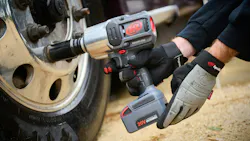
As battery-powered impact wrenches have made gains in both power and popularity, some power tool pros are beginning to wonder how long it could take for technicians to completely “cut the cord” once and for all—including technicians working in heavy-duty shops.
“I’ve had some guys in semi shops who end up buying as many as 12 cordless tools simply because they do not want to drag around an air hose anymore,” said Kevin Wampler, owner of Wampler Tools, an independent tool distributor serving the Columbus, Ohio, area. “The cordless impact gun is always at the top of the technician’s list, especially the smaller sizes. I haven’t seen the 3/4” or 1” models catching on just yet, but 1/2” and down is on fire.”
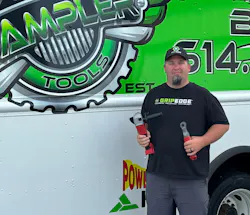
According to Wampler, the larger models cost more than some technicians are willing to spend, often triple the price of a 1/2” pneumatic impact driver. Considering how a 1/2” can handle most tasks, even in a heavy-duty shop, Wampler said many techs are fine with using a pneumatic gun in those instances where a 1/2” cordless won’t work, like fastening and unfastening wheel lug nuts.
“That said, if somebody can figure out how make a more affordable 3/4” or 1” tool, I believe pneumatic could be [finished],” Wampler said.
There are technicians who still believe in the performance of pneumatic tools. Zach Timm, general manager of Block Diesel Repair in Janesville, Wisconsin, is one of them. However, Timm also believes that 1/2” impact guns have closed the performance gap in recent years. To his point, some cordless models are capable of producing around 1,400 ft.-lbs. of breakaway torque, which is on par with pneumatic tools. Then, when you factor in the convenience and speed of going cordless, Timm said more of his technicians are leaning in that direction.
“Our techs are using 1/2-in. cordless impacts on everything from frame bolts to mudflap brackets,” Timm related. “With our emergency roadside service vehicles, a 3/8-in. impact (slightly smaller and lighter) has become the go-to tool for many tasks, like replacing mudflaps, air valve mounts, and door hinges. Anytime you don’t have to fire up the compressor and drag out the line, it’s more efficient.”
Sizing up the ROI
The efficiencies associated with going cordless don’t just apply to those smaller 1/2”-and-under impact wrenches. That is why some tool manufacturers believe more heavy-duty technicians will get past price when they see the overall value of a 3/4” or 1” tool.
“In heavy-duty truck applications, ¾-in. and 1-in. tools remain essential because they provide the torque required for large wheel fasteners and other demanding tasks,” said Ghizlane Haddaoui, a regional head of power tools marketing for Ingersoll Rand, a manufacturer of both cordless and pneumatic tools. “So while pneumatic tools remain relevant in certain situations, such as high-volume shops where continuous operation is required, cordless solutions are increasingly preferred for their mobility, flexibility, and ease of deployment.”
Tony Gumina, senior manager of product marketing at Milwaukee Tool, said technicians aren’t experiencing the same level of sticker shock as years ago. First of all, the cost of cordless technology has become more accessible relative to the performance it delivers. Secondly, more technicians are becoming more aware of the benefits of cutting the cord.
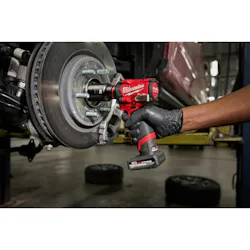
“Ultimately, it’s the combination of performance, versatility, and system-wide compatibility that is driving adoption of cordless impact wrenches, not just the removal of a hose,” Gumina said.
Tips on choosing a cordless impact gun
Choosing the right cordless impact wrench ultimately depends on the type of work being performed. Gumina said it’s important to match performance specifications to application needs.
“Torque output is one of the most critical considerations, especially for heavy-duty work,” Gumina said. “But other factors like tool size, weight, and battery compatibility also play an important role. Many of today’s tools are also being built to better withstand harsh working conditions, including exposure to grease, debris, and drops.”
Those are all things to compare when shopping tools. The advancement of control features is another thing to look at, because control features go hand in hand with the impressive torque output today’s cordless impact guns can produce.
“Many tools now incorporate multiple drive modes to help technicians match output to the specific task,” Gumina pointed out. “Users can select from preset RPM and IPM levels directly on the tool.”
Power modes help prevent things like overtightening and fastener drops, which improves accuracy and versatility across a range of applications. Here are some more insights into a couple of those applications.
Tire and wheel service: “A technician will benefit from a high-torque impact wrench capable of consistently removing and installing lug nuts,” Gumina said. “Having multiple power modes is especially valuable here, as the technician can use maximum torque for removal but switch to a more controlled setting during installation to avoid overtightening. With today’s standards, that level of control is just as important as high power.”
Ingersoll Rand’s Haddaoui said some technicians prefer multiple cordless tools in a wheel-service lane: a 3/4” or 1” impact wrench for wheel removal and pre-tightening, and a torque multiplier for precise final tightening with control and data capture. Compared to a non-cordless system that involves multiple steps using a pneumatic impact wrench, manual torque wrench, and follow-up checks, Haddaoui said some techs see the value of cutting the cord through improved convenience, consistency, and overall efficiency.
Drivetrain and suspension: Gumina said flexibility is key due to the wider range of fastener sizes and materials a technician will encounter. Tools that allow techs to easily adjust speed and torque, either on the tool itself or through a connected app, help improve consistency across jobs and reduce the risk of damaging components.
Regardless of the application, Gumina said one universal concept that applies to all cordless impact wrenches is that more power isn’t always better. As a tool distributor who visits heavy-duty shops every day, Wampler couldn’t agree more.
“I’ve actually had some shop owners ask me to quit selling their techs these cordless impact guns,” Wampler said with a chuckle. “These things are so powerful today that inexperienced techs end up breaking stuff. I tell those shop owners that my job is to sell really good tools and explain the features, but it’s up to the technician to use the tool correctly. When those power mode features are used correctly, a cordless impact gun is a very capable and efficient tool for a heavy-duty technician.”
About the Author
 Gregg Wartgow
Gregg Wartgow
Gregg Wartgow is a freelancer who Fleet Maintenance has relied upon for many years, writing about virtually any trucking topic. He lives in Brodhead, Wisconsin.