AI enhancements hint it’s all downhill from here for maintenance
Tradeshow season is done, and if you’re like me, right now your office has piles of random business cards strewn about, loose product brochures spilling out of drawers and bags, and odd pieces of swag to add to the collection. Luckily, I only had to keep up with leads and notes from the TMC Annual Meeting in Nashville and the NAFA Institute & Expo in Cleveland. Otherwise, I’d still be sorting through it all heading into SEMA/AAPEX.
Aside from this usual haul of industry literature, new contacts, and about 30 hours of interviews, this time I brought back something I hadn’t had in quite some time: true optimism and confidence that the maintenance sector is headed in the right direction.
Technology vendors are starting to harness AI in ways fleets and shops can actually use—or the industry has finally caught up to what the technology can deliver. Either way, we’re on the verge of a big momentum swing, akin to a rollercoaster cresting that imposing first hill.
Let me explain. Fleets’ biggest complaint is that they have all this data from the vehicles, diagnostic tools, and repair history, but can’t make sense of it all. That is changing with a flurry of integrations, acquisitions, and platform enhancements.
On the integration front, one that stands out is Trimble TMT’s pairing with Corcentric, a platform that digitizes invoices, streamlines payments, and improves purchasing and procurement.
With the invoice integration enabled on TMT, the system can “automagically” populate all the necessary data from invoices and repair orders, Brian Mulshine, senior director of TMT product management for Trimble, explained at TMC. During the demo, he pointed to around 30 different fields that would have to be manually typed out after a service event. This could take seven minutes to complete one invoice, he noted. And oftentimes, without proper supervision, they are entering “garbage data,” just trying to get through each mindless task, “but they’re not capturing the data that helps me analyze how my fleet is doing.”
With Trimble’s digital method, the system can assign VMRS codes, and maintenance managers have a far more granular view of what’s happening in the fleet, particularly maintenance cost per mile.
“We’ll get it down to what it costs you per mile to operate that truck by system group, [such as] tires, air conditioning, brakes,” he said. “And now you could look at where you’ve got to focus training and cost improvements and what’s driving those.”
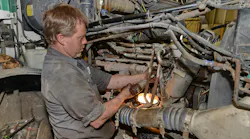
They aren’t the only ones doing this, and you can read more on how digitizing this info can help recover warranty claims.
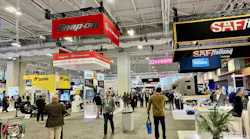 TMC 2026 show floor
 Rock & Roll HAll of Fame NAFA Rev It Up
So the data acquisition and coding are getting easier, which will only expand the data a fleet can analyze. This is crucial for predictive and prescriptive maintenance because the bigger the sample size and the longer the history, the more accurate they will be. And predictive got a major boost right after TMC, with Bosch acquiring Uptake and Fullbay taking on Pitstop. These moves prove the technology is mature enough to really scale, and I would bet this is just the beginning.
If you have data fatigue, or are sick of hearing how some new platform will revolutionize shop management, I get it. But now there is binding agent to make disparate data more cohesive: large language models. When linked to your CMMS or telematics platform, these ChatGPT-style bots can contextualize any internal data you need instantly, so you know exactly what’s happening without digging through spreadsheets and talking to team leaders all day.
Motive kicked this off last year with AI Answers, where a user can type in “What was my average downtime last month?” and find out in mere seconds.
At NAFA, Collective Data CEO and founder Jason Wonase introduced that platform’s new “Ask Anything” tool. It not only provides the answer to questions such as “What vehicles should I consider replacing, and why?” Wonase explained, but can create a series of graphs and charts to visualize the data. And you can choose who to share those charts with. You might want your C-suite to have the full view, but pull out specific data for the maintenance supervisor of a vendor.
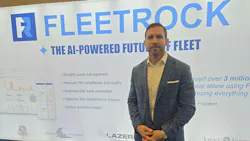
I also ran into Joseph King, founder and CEO of Fleetrock, a fleet and shop maintenance platform that offers many of these aforementioned AI and predictive tools.
It’s used by Love’s, Leonard’s Express, and all sorts of public and utility fleets, along with small fleets as well. I asked him what to make of all these new developments and if they really are as big a deal as I suspect.
“It’s a compelling moment right now in time,” he said, because AI has been “democratized to the point where all of fleets, regardless of size, regardless of industry, now can take advantage of this.”
But the revolutionary technology “has to be in a place that you can use it,” he said. Fleetrock is currently working to “shift to systems of intelligence, where AI is embedded across all the workflows within the fleet management system, as well as layering in prediction,” King said. He said this “combination of AI, engagement and prediction [is what’s] driving this system of intelligence and that’s creating significant efficiencies, cost reduction and optimization for our customers today.”
If all this keeps up, I can only imagine what another year or two of development will do for fleets and shops. It’s an exciting time, and now I can’t wait for what we will see next spring.
The thing about rollercoasters, though, is that the rider has no control. As these AI platforms evolve, there needs to be a focus on aiding—and not replacing—the fleet leaders whose experience cannot be replicated by an algorithm.
 gettyimages1334503619
 warranties
About the Author
 John Hitch
John Hitch
Editor-in-chief, Fleet Maintenance
John Hitch is the award-winning editor-in-chief of Fleet Maintenance, where his mission is to provide maintenance leaders and technicians with the the latest information on tools, strategies, and best practices to keep their fleets' commercial vehicles moving.
He is based out of Cleveland, Ohio, and has worked in the B2B journalism space for more than a decade. Hitch was previously senior editor for FleetOwner and before that was technology editor for IndustryWeek, and managing editor of New Equipment Digest.
Hitch graduated from Kent State University and was editor of the student magazine The Burr in 2009.
The former sonar technician served honorably aboard the fast-attack submarine USS Oklahoma City (SSN-723), where he participated in counter-drug ops, an under-ice expedition, and other missions he's not allowed to talk about for several more decades.