Trump promises to straighten out right to repair, but is the fix already in?
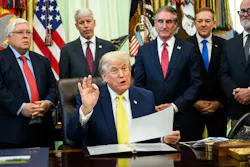
After months of little to no movement on federal right to repair legislation, the topic is heating up again in Congress and now, the Oval Office.
On June 3, President Donald Trump met with Andrew Frick, the president of Ford Blue, General Motors CEO Mary Barra, representatives from the Alliance for Automotive Innovation and the National Automobile Dealers Association (NADA), and Roger Penske, founder and chairman of Penske Corp., to discuss right to repair.
The president revealed the meeting took place the next day during an announcement on clean coal, appearing to call out the auto leaders for going against public interest.
“We had the auto industry in yesterday; they don't want people to fix their car,” Trump asserted. "That's strange. I never heard of that. They have a thing…nobody's allowed to fix their car."
Trump then brought up someone who was sentenced to seven years in jail “because he fixed his own car.” The president appeared to be referring to Troy Lake, a Wyoming diesel shop owner convicted of disabling emissions-control systems on hundreds of pickup trucks. Lake was actually sentenced to one year and one day in federal prison. He served roughly seven months before being transferred to home confinement, and later received a presidential pardon.
He followed by recalling former classmates who were “horrible” at traditional classes like arithmetic, “but they could fix an engine blindfolded.” And now, as Trump tells it, the auto industry is trying to stop people like this from fixing their own cars.
“But we'll get it all straightened out,” Trump cooly assured.
On the positive side, the president appears to recognize that challenges exist in the vehicle repair space and that the industry is filled with highly capable professionals. His populist off-the-cuff statements, though, do misconstrue the root causes of these challenges. The Lake case, for instance, was really more about diesel deleting and EPA emissions rules than right to repair. Under Administrator Lee Zeldin, the EPA has instructed OEMs to make software patches to ease derates and remove DEF sensor requirements.
In Trump’s defense, we routinely cover the subject of right to repair and aren’t quite sure what’s really going on with right to repair. But here we will attempt to straighten out the reality of the current situation as best we can.
Trump-to-truth translation
To be clear, the auto industry is not trying to enact legislation to stop people from fixing their cars. The OEMs signed a Memorandum of Understanding in 2014 to allow independent shops and consumers to perform post-warranty work on vehicles and provide them with the same repair and service information that dealers have, and reaffirmed it in 2023. In 2015, another MOU was signed for vehicles with >14,000 lb. GVWR. Furthermore, the Magnuson-Moss Warranty Act allows consumers to choose non-OEM parts for warranty repairs.
What the automakers are doing is opposing the passage of the Right to Equitable and Professional Auto Industry (Repair) Act, a bill the aftermarket has tried to get through Congress for many years. It was reintroduced in 2025, and this past February was forwarded by the Subcommittee on Commerce, Manufacturing, and Trade to the House Committee on Energy and Commerce for a voice vote.
At its core, the REPAIR Act would codify the MOUs as federal law and grant vehicle owners and their designated repair facilities access to vehicle-generated and telematics data "without restriction or limitation" imposed by manufacturer security gateways and other access controls.
The telematics provision is the sticking point, and a reason that the automakers have vigorously lobbied against the REPAIR Act. Lobbyists for the OEMs, such as the Alliance for Automotive Innovation, argue that allowing OEs and independent shops unrestricted access to certain OEM data would jeopardize vehicle cybersecurity and open the door for IP infringement, where aftermarket vendors can create knock-off versions of OEM parts.
The REPAIR Act does include IP and cyber protections.
Earlier this year, Hilary Cain, SVP of policy for the Alliance for Automotive Innovation, proposed that the Subcommittee on Commerce, Manufacturing, and Trade eschew the REPAIR Act and instead consider a bill drafted by the auto lobby called the SAFE (Safety as First Emphasis) Repair Act. Like the REPAIR Act, it did require that OEMs provide owners and independent repair shops with equal access to vehicle data, repair information, and tools.
While it went nowhere, it did offer insights into what the OEMs appear to really want: their repair guidelines and parts to be used in repairs, and to gatekeep any data that extends beyond making safe repairs to protect IP and vehicle cybersecurity. This means they would not have to release telematics data. And telematics is becoming more and more crucial to vehicle uptime, which is what the real fight is over.
Any user can get basic telematics data now, even without paying for the OEM’s subscription. You can plug a module into the OBD-II port and it can sync to a smart device. The question is not now, but what about the future—where AI is far more advanced and data is everything? Many fleets have already found that historical and real-time vehicle data can predict and prevent engine failure. If that’s expanded across the vehicle repair sector, that’s a serious disruption to the current order of things.
The latest underwhelming development
In the emerging data-dominated repair sector, neither OEM repair networks nor independent shops want to be left at a disadvantage. As a result, resolving the data-access question has become a major issue for both customer choice and competitive balance. The aftermarket has alleged that OEMs seek to control and monetize telematics data, while automakers have serious concerns about cybersecurity, IP, and the free flow of driver behavior data, which insurers and third parties may be able to access.
It’s also a third rail that the House committee does not want to touch. That’s why the key part of the REPAIR Act both sides agreed on was folded into the Motor Vehicle Modernization Act of 2026 (H.R. 7389)
On May 21, the House Energy and Commerce Committee pushed the Motor Vehicle Modernization Act of 2026 (H.R. 7389) forward, allowing a handful of provisions from the REPAIR Act to potentially become law. This includes codifying the memorandums of understanding between consumer and commercial OEMs and the aftermarket repair sector that ultimately ensures dealers do not have a monopoly on repair and service information and tools. The Federal Trade Commission was named as the enforcement agency in another provision to hedge against any situations where an OEM was not providing equal access.
That was perhaps the least objectionable part of REPAIR Act, merely formalizing agreements that have existed for over a decade. The bill, which passed 48-1, did not include any language to clarify access rights to telematics data, to the dismay of the bill’s lead sponsor Rep. Neal Dunn (R-Fla.).
"While the version included in [the May 21] markup represents some progress, the legislation considered by the committee does not fully reflect the original REPAIR Act and fails to protect consumers, independent repair shops and aftermarket manufacturers," Dunn said.
In a statement to Fleet Maintenance, the Auto Care Alliance also noted the provisions aren’t what the aftermarket wanted.
“The Committee’s action represents the first significant congressional movement on federal right to repair legislation in several years and establishes a framework for federal enforcement and further policy development. It also initiates a formal federal review of ongoing market barriers. At the same time, the outcome falls short of delivering the full set of protections and access provisions sought by the aftermarket industry and supported in the REPAIR Act.”
It’s a setback for right-to-repair advocates, but the bill can of course be amended before a full vote. The bill could also ultimately become part of the House's broader surface transportation reauthorization package, the Building Unrivaled Infrastructure and Long-term Development for America's 250th Act.
The ACA noted it will continue to lobby House leaders during the next stages of consideration and advocate for improvements as the bill makes its way to the Senate.
If only current provisions do make their way to becoming law, though, all sides can claim a win. The aftermarket finally gets federal right to repair, the OEMs largely retain their telematics data, and Trump can claim it was all his idea.
About the Author
 John Hitch
John Hitch
Editor-in-chief, Fleet Maintenance
John Hitch is the award-winning editor-in-chief of Fleet Maintenance, where his mission is to provide maintenance leaders and technicians with the the latest information on tools, strategies, and best practices to keep their fleets' commercial vehicles moving.
He is based out of Cleveland, Ohio, and has worked in the B2B journalism space for more than a decade. Hitch was previously senior editor for FleetOwner and before that was technology editor for IndustryWeek, and managing editor of New Equipment Digest.
Hitch graduated from Kent State University and was editor of the student magazine The Burr in 2009.
The former sonar technician served honorably aboard the fast-attack submarine USS Oklahoma City (SSN-723), where he participated in counter-drug ops, an under-ice expedition, and other missions he's not allowed to talk about for several more decades.