What to consider when buying new diagnostic tools
Key Highlights
- Diagnostic hardware reliability directly affects technician productivity, repair timelines, and truck uptime.
- Rugged laptops and tablets must match the demands of shop environments and roadside service.
- Fleets should evaluate diagnostic devices based on durability, serviceability, and total cost of ownership.

A technician is nearly done with a forced regeneration on a Class 8 tractor. The laptop running the regeneration sits on top of a frame rail, with its adapter cable stretched to a diagnostic port. Someone else in the shop walks by, catches the cable, and sends the laptop plummeting to the concrete floor below. The screen goes dark, and the regeneration has to be restarted on a borrowed machine once one becomes available, possibly the following day. While the regeneration can still be completed, the time spent finding another machine and restarting the process causes the truck to miss its dispatch window. Now, other schedules and workflows are out of sync, lowering productivity of the operation.
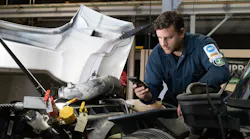
The laptop or tablet is often one of the first tools a technician reaches for in the shop. As digital diagnostic and repair tools become paramount to workflows, technicians increasingly depend on technology both in the bay and in the field. Great software investments must be coupled with equally capable hardware that can reliably perform under environmental stress.
Commercial vehicles are networks on wheels. Aftertreatment, ADAS, telematics, and electrified powertrains all depend on software to diagnose, calibrate, and repair. As a result, diagnostic tools have become more significant. Research reflects how quickly this shift has occurred. In 2016, shops averaged one diagnostic tool for every six technicians. By 2025, the ratio had reached one electronic diagnostic tool for every 2.5 technicians, according to Noregon, reflecting how diagnostic tools became a more integral component of daily maintenance and repair.
Why does rugged hardware matter for diagnostics in the shop and field?
Office or consumer-grade laptops can travel, but they were designed to be handled primarily at a desk. Unlike an office, a service bay introduces concrete floors, fluids, brake dust, metal shavings, pressure washers, and lifts that can put a device several feet in the air. Mobile technicians may also encounter vibration, rain, snow, and extreme temperatures. Utility and vocational fleets can operate trucks across wide service territories, far from the nearest dealer or repair facility.
Technicians can diagnose vehicles in the field with laptops running diagnostic software, allowing a truck to be assessed where it sits instead of first requiring a tow or trip to the shop. However, that approach will only succeed if the device is capable of withstanding the trip and performing reliably once it actually gets there. Unfortunately, many service centers and mobile service trucks still approach diagnostic hardware the same way they'd buy a laptop for the front office.
Technicians have different device needs. For instance, a bay technician running OEM software, reviewing wiring diagrams, or moving between diagnostic applications may desire a larger screen and full keyboard. A mobile technician handling road calls may need the flexibility of a rugged 2-in-1 device that can dock in the service truck and transition to a tablet at the vehicle. For inspections and documentation, a compact rugged tablet with a camera may be enough, assuming it has enough power to last a full shift or hot-swappable batteries in environments where power is hard to come by.
What are the costs of diagnostic hardware failure?
Replacing a failed laptop is only part of the cost. A technician may also have to rerun a diagnostic test, restart a reflash, or stop working until another device is available. Those disruptions add up. A 2026 report estimated that mobile technology problems account for $7.4 billion in annual wages paid to frontline workers while they are unable to work. Meanwhile, labor is also tight. The American Transportation Research Institute (ATRI) found that 65.5% of diesel repair shops were understaffed, with a vacancy rate near 19%. When technicians are already scarce, every minute spent waiting on, rebooting, or replacing a device is valuable time lost that could otherwise be spent getting a truck back on the road.
Then for the truck itself, extra time in the bay can evolve from an inconvenience to a greater issue that affects dispatch schedules, asset availability, and the work waiting behind it. This changes the calculation when IT, fleet, and operations leaders evaluate diagnostic hardware. Reliability and potential operational costs can be just as important as the purchase price. A less expensive laptop can quickly become more costly if its failure creates additional technician downtime, delays a repair, or keeps a revenue-generating vehicle out of service longer.
What should fleets look for when choosing diagnostic hardware?
Ruggedized tablets: Seven must-have features
- Proven drop and impact resistance
- Environmental protection against dust, water, shop fluids, and temperature extremes
- Technician-friendly display, with sunlight-readable touchscreen that can be operated while wearing gloves
- Long-lasting battery, flexible power
- Built-in ports that connect directly to diagnostic adapters and peripherals
- Reliable wireless connectivity (WiFi and cellular)
- Serviceability and lifecycle support, with solid warranty coverage and long-term manufacturer support
Start with durability. Determine whether the device is designed and tested to withstand drops from realistic working heights, such as a fender, workbench, or truck cab. It's also worth looking for testing against recognized standards such as MIL-STD-810H, which can help fleets evaluate how a device performs under demanding environmental conditions beyond unsubstantiated claims. Environmental protection should also match the conditions technicians encounter, from fluids and dust in the shop to rain and extreme temperatures in the field. Screens should remain readable outdoors and responsive when technicians are wearing gloves to avoid any break in workflow.
Power matters just as much, particularly during lengthy diagnostic and reprogramming procedures. A dead battery in the middle of a job can interrupt the work, so fleets should look for enough runtime to see technicians through those procedures. Hot-swappable batteries can extend that runtime without requiring a shutdown or halting work to access power outlets. The device also needs the right ports to connect directly to diagnostic adapters and other equipment without adding unnecessary accessories that can be lost or damaged. And where the technician goes, connectivity has to follow—from Wi-Fi across the bay and yard to cellular service in the field.
Fleet and service organizations also must think about the long term. They should understand how quickly a failed unit can be repaired or replaced, what the warranty covers, and what support is available throughout the device's lifecycle. Leading rugged laptops and tablets are modular, meaning that the same base unit can last for five years or more, while still giving options to upgrade or replace certain components. For example, changing out ports, updating SSDs, or adding fingerprint or contactless smart card readers for authentication and security.
Why should fleets consider diagnostic hardware in their maintenance budgets?
Fleet maintenance operations must already budget for things like diagnostic software licenses, adapter kits, and technician training. The device that ties them together belongs in those budget conversations, too. Rather than treating diagnostic hardware as another IT purchase and evaluating it on price alone, fleet and maintenance leaders need to consider its total cost of ownership, including reliability, serviceability, lifecycle, technician productivity, and the potential impact of device failures on vehicle uptime.
The goal is simple. When a truck rolls into the bay, or a technician rolls up to a breakdown, the tool that starts the repair should be the last thing anyone has to worry about.
About the Author
 Michael Trafton
Michael Trafton is a business development manager for Panasonic Connect North America. He has deep knowledge of and experience with technology solutions and applications for the enterprise space. He develops and implements strategic business plans to support and grow Panasonic Connect’s business, with customer relationship management and customer experience at the core.
Related
 Getty Images 1055693624 Edit Copy