How to measure success in the shop with the KPIs that matter
Key Highlights
- Knowing how to measure success in the shop means understanding the KPIs your shop relies on most, including those for tech performance
- For technician performance, keeping an eye on direct vs. indirect labor, labor productivity by job, repeat repair rate are all good to help you understand your shop's accuracy and productivity
- However, when looking at KPIs, it's also important to consider context, such as inefficiencies that technicians can't change, like shop organization or bay placement.

To find out if a fleet or shop's maintenance team is truly living up to its potential, there’s one critical thing management has to do, according to no-nonsense efficiency consultant Peter Cooper.
“Shop leaders need to manage with facts, not feelings,” he asserted.
The former director of operations for Iowa-based Merx Truck & Trailer—and present CEO of Ascend Consulting —expounded on this maxim with the hypothetical employee “Technician Jim,” who he said “might be a great guy who shows up on time with a positive attitude, but he may also be the guy who takes three hours to do a one-hour job.”
On the flipside, imagine a tech who routinely beats standard repair times, but exudes toxic vibes that poison your shop culture.
In both cases, facts—not feelings—must guide your assessment of their value, and more importantly, how to train them up on the hard and soft skills they lack.
And to do that, the best method is to focus on the key performance indicators that actually matter to your shop’s definition of success, not the ones that make you feel good.
Each shop has different priorities, but the KPIs that matter should lead to more uptime and profitability. But whatever area you want to improve, make sure you can capture and analyze the related data.
“Any goals must be measurable and attainable in some way, otherwise you won’t see improvement,” efficiency guru Cooper said.
Next, because this is a team effort, you have to make sure everyone involved understands the full picture and how the data relates to success.
“It’s essential for fleet maintenance departments to understand what they’re measuring and why,” said Ernest Acevedo, fleet maintenance director at DPV Transportation, a specialty passenger transportation company based in Everett, Massachusetts. “I’ve honestly been in rooms with other fleets where someone says, ‘We’re this percentage in this certain area.’ Okay, so now what? How are you going to use that measurement to make your shop better?”
If they can’t answer, it just might be the sort of esoteric data that feels good to boast about to colleagues, but won’t sway your C-suite or lead to success. The top brass want proven results that bring in more revenue, and the facts explaining how that did or did not happen.
We also want that for you, so we canvassed several experts to find out which KPIs will help you get your facts straight—and lead to a highly successful 2026. And that starts with a trio of technician metrics that serve as the engine for your shop health.
 gettyimages1036965214
 gettyimages1222944288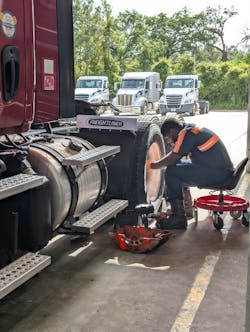
The tech metric trinity
Before we get into the three KPIs, remember that although you want your technicians to service vehicles as quickly as possible, the quest for speed can’t come at the expense of accuracy and safety.
“As a company, our philosophy is that we’d rather take our time and get it right,” said Amanda Schuier, strategic maintenance director at Jetco Delivery, a Houston-based freight carrier. “So we never want to push our technicians too hard. On the other hand, we obviously don’t want people milking the clock.”
Schuier, who is also the immediate past chair of the Technology & Maintenance Council (TMC), pointed to TMC Recommended Practice RP 545, which can help fleets start the process of measuring technician performance. It goes beyond standard repair time and comprises three main metrics to accurately measure tech performance.
Direct vs. indirect labor compares a technician’s time spent working on vehicles to their time spent on non-vehicle-related tasks, like cleaning bays, performing maintenance on tools, and attending training. RP 545 recommends that a fleet’s indirect labor should never exceed 30% of total labor.
Steve Saltzgiver, lead strategic consultant at fleet management software provider RTA, agrees that 25-30% indirect labor is a fair amount of wiggle room to afford technicians. “You can’t expect a technician to perform direct labor when they don’t even have a wrench in their hand,” Saltzgiver said.
Cooper said independent shops should be a little more ambitious in their quest for direct, billable labor.
“For a shop as a whole, 80% billable is a good goal. That said, I would never expect a lead technician to bill more than 75% of their clocked hours. That’s because they should be spending some time mentoring the shop’s more inexperienced technicians.”
But if your best tech is mentoring 40-50% of the time, you might be better off hiring a full-time trainer, because you could be leaving that or much more on the table through lost billable hours.
Labor productivity by job, which some refer to as technician efficiency, is equally important. It compares how long it takes a technician to perform a specific job to the standard repair time. RP 545 recommends a ratio of 0.9, meaning that the technician is slightly beating the SRT. For instance, completing a 3-hour brake job in 2.75 hours is a ratio of 0.9166 (2.75/3).
The lower that number, the more valuable your tech is. This metric is naturally incentivized with flat rate, but hourly shops could consider productivity bonuses to drive this down more (though don’t gamify without guardrails; make safety part of the equation).
Along those lines, tracking Repeat repair rate is absolutely vital to indicating the service quality you want. As Schuier touched on earlier, speed can’t come at the expense of accuracy. Tracking this KPI helps shine a spotlight on quality issues, which enables shop managers to intervene before things get out of hand.
“Repeat repairs, or comebacks, should never exceed 2% of the total repairs being done,” Saltzgiver said. “If a shop or certain technician is seeing more than 2%, there could be a serious problem.”
Using KPIs to drive improvement
Once a maintenance director or shop owner has a way to record and measure all of these technician KPIs, is it simply a matter of looking at the data and deciding if "Technician Jim" gets a raise or gets shown the door? Not at all. While numbers are never supposed to lie, they can sometimes be misleading, failing to tell the whole truth.
“I was working with a shop owner who was concerned that a good technician’s direct labor had slipped down to around 60%,” Cooper said. “So I went to the shop one morning to observe. I noticed that the technician clocked in at 8 a.m., but then had to walk all the way across the shop floor, past six bays, to get to the service window. Then he had to stand there for at least 10 minutes while the service advisor was on the phone. By the time he was handed his first job and walked back to his bay, 20 minutes had flown by. That’s not the technician’s fault. That’s a problem with the process.”
Similarly, a technician’s low direct labor rate could be due to unorganized scheduling or parts management failures. “A technician can’t finish a PM on time if he has to wait for an oil filter to be delivered,” said John Whittet, chief customer officer at Fullbay, a provider of fleet maintenance and shop management software.
On the other hand, if a technician is constantly disorganized, outside smoking, or fiddling with their phone, that’s obviously a different story.
A low labor productivity (or technician efficiency) KPI could also be misleading. Cooper said the No. 1 goal is to make sure your shop’s SRTs are accurate and fair. Secondly, there could be unique circumstances causing a tech's actual time to exceed the standard repair time, such as having to deal with a lot of rust, road salt, seized hardware, etc. Finally, it’s the shop manager’s job to ensure that service advisors are doing a good job with their initial diagnosis, so techs aren’t set up to fail right out of the gate.
In other words, shop managers shouldn’t go blaming the technician until they’re able to put any given KPI into the proper context.
“The job of the manager is to find out the root cause of why a technician isn’t meeting their KPI goal,” Saltzgiver said. “Shop managers should be having one-on-ones with their technicians at least once a month, preferably every two weeks. Then they can go through the metrics together and make sure everyone understands what’s really going on.”
 a4207339_258868ftct_vernon__medium
 technician-semi-truck-manager-rush-enterprises_houston_921_fossum_st
Don’t forget about attitude and behavior
Data-driven KPIs, as previously described, are an important part of measuring technician performance. But those metrics alone cannot be the measure of success.
And though Cooper went on about facts over feelings, he never said to completely ignore feelings. Some feelings, like employee attitude, can be measured and therefore quantifiably improved.
“Much like marketers use net promoter scores to measure how consumers feel about their brand, shops can measure how their technicians feel about their jobs and co-workers,” he explained.
To do so, he suggested managers send out quarterly surveys to techs asking if they receive enough support from leadership and if they get along with co-workers.
“This type of data is more subjective, but provides valuable insights into how individual technicians and the shop as a whole are performing,” Cooper added.
Acevedo noted that a tech’s psychology is a big part of their overall value to a shop. This refers to behavioral traits like hustle, follow-through, and genuine care. Overachieving technicians are focused on productivity, but are also careful to avoid cutting corners. Overachievers treat drivers with respect and are pleasant to be around in the shop.
“Those are the things that don’t show up in maintenance software,” Acevedo said. “A shop manager needs to observe how their technicians act in the shop. All you have to do is watch a person work to see if they care, are sloppy, or have no sense of urgency. These things don’t show up on a time clock, but can cost a fleet dearly.”
As shop-level managers observe these traits and behaviors, Acevedo said their findings should be documented in a technician’s personnel file. Then, when the time comes to conduct an official performance review or simply have a one-on-one meeting, the information is there to be discussed. This helps keep everyone focused on meeting the set standards.
But shops must have clearly defined roles and expectations if they expect technicians to meet certain standards. What skills, trainings, certifications, and behaviors should a technician possess? Every shop must figure this out for itself—and communicate it to its technicians.
Schuier has been working on this very thing at Jetco Delivery. For a Level 1 technician, it’s about attitude and ambition as much as anything else.
“We want our Level 1s to have certain skills, of course,” Schuier said. “We also want them to show up on time, ask questions, gladly help clean the shop when asked, etc.”
As for a Level 2 technician, Schuier said measuring success depends on the situation. Some Level 2 technicians have no interest in rising to a management-type role. That’s okay. “Here I like to find other ways of challenging and motivating them,” Schuier related. “Maybe they would like to attend some training on electrical or diagnostics so they can help with more complex jobs that a Level 3 technician would do. On the other hand, they might be content just doing what they’re doing, even if it’s just PM-related work. That’s okay too, as long as they’re doing a good job with a good attitude.”
As for the most experienced Level 3 technicians, Schuier wants them to help build Jetco’s culture of growing from within.
“I’m looking for technicians who provide leadership and have others look up to them,” Schuier said. “I’m also looking for an attitude where they’re able to see the bigger picture and are willing to stay late to finish a job, for example. They should also be good at maintaining excellent communication with our operations team.”
In other words, Schuier likes to see her experienced technicians begin exhibiting the qualities of a good shop manager. That way, she knows when these technicians are ready to rise from generating KPIs to analyzing them, making their shop a more efficient, productive place.
About the Author
 Gregg Wartgow
Gregg Wartgow
Gregg Wartgow is a freelancer who Fleet Maintenance has relied upon for many years, writing about virtually any trucking topic. He lives in Brodhead, Wisconsin.