Salute to Independents: How indie shops compete and thrive
In a private letter sent to James Madison from Paris in early 1787, Thomas Jefferson wrote (in Latin): “I prefer the tumult of liberty to the quiet of servitude.”
The Declaration of Independence’s lead author was referencing a recent civil uprising known as Shay’s Rebellion [see footnote], to diplomatically debate Madison, who was at the time working on the framework for what would become the U.S. Constitution.
Jefferson was advocating for America to maintain its spirit of independence and warning how centralization leads to complacency and corruption. Madison, as a Federalist, realized the new country required a strong core for logistical efficiency and defense.
Since taking effect in 1789, the Constitution has imbued both philosophies with personal freedom and federal power reaching some semblance of equilibrium via checks and balances. The vehicle repair sector has struck a similar compromise. The centralized large dealers get their marching orders from the OEMs, with streamlined training and the latest technology and tools to ensure quality and reliability. Meanwhile, the independent shops have the freedom to run things their way, as tumultuous as that can be sometimes. Without them, many communities would not be served, and without the competition, large companies could charge whatever they want and pay employees far below what they are worth.
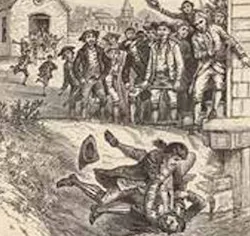
Shay’s Rebellion
There’s a lot to unpack in this seminal moment in America’s history, when it was young, poor, and largely unorganized, but here’s the short version: Massachusetts, like many other former colonies, passed legislation to tax the people, many of whom were Revolutionary War veterans and struggling farmers, to pay the state’s war debts and honor bond notes. If they couldn’t pay, their land was forfeited and they could end up in debtor’s prison. These vets would likely have had the money, but had to sell their promissory notes from the war for pennies on the dollar just to get by to wealthy investors and merchants. These elites included the lawmakers who wrote the legislation and would recoup the full value of the bonds.
Capt. Daniel Shays, a farmer who fought at Bunker Hill and Saratoga, took issue with this arrangement, which was happening across the newly formed union, and led an uprising to block courthouses from processing debts and foreclosing on farms. These protests escalated into violence, culminating in a failed attempt to take the Springfield Armory, where four protesters were killed and 20 wounded.
This event motivated a concerned George Washington to return to public service and exposed the Articles of Confederation as weak, leading to the drafting of the U.S. Constitution. Though James Madison and other Federalists labelled these farmers as anarchists and worse, Shays and his allies were ultimately pardoned. — John Hitch
In this fight for freedom of maintenance, not all indie shops survive, but those that do profit greatly and realize the elusive American dream. And for commercial vehicle customers, having that decentralized option available comes with plenty of advantages, too.
Take New England Fleet Services in East Granby, Connecticut, for example.
“Being an independent, especially one our size, allows us to provide a personal touch that a lot of large companies can’t,” shop owner Nate Taylor said. “Because we’re not a huge dealership or national repair company, we don’t have layers of management. That makes it easier to tailor our processes and services to meet customer needs.”
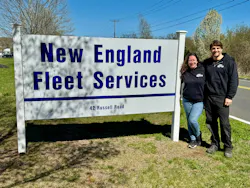
Unlike an operation with a rigid approval process, if a customer asks Taylor to pick up a vehicle rather than drop it off, he has no chain of command to answer to, providing more flexibility for fleets.
“We can make those decisions on the fly, often at no charge to the customer, because we don’t have to get several approvals,” he offered.
Flexibility is not the only advantage, as the sector faces battles on all fronts, from hiring to available funds to keep up with technology. But as the shops we spoke with prove, they have inherited the courage of Americans such as Capt. John Paul Jones, who even on a sinking ship will roar, “I have not yet begun to fight!”
The battle for technicians
As real as the technician shortage continues to be, with the American Transportation Research Institute finding two-thirds of shops are understaffed, independent shops have found their cozy size a real advantage, such as The Service Company, which operates five Ohio locations in and around Dayton and Columbus.
“We still have the ability to feel like a family business,” said Luke Todd, president of The Service Company. “We actually have some technicians who came from dealerships that lost that kind of atmosphere when they got wrapped up in consolidation and got a lot bigger.”
Dick Bascom, founder and owner of Bascom Truck & Auto in Des Moines, Iowa, has also had technicians come to his shop for the work culture. Sometimes they had worked for him in the past, only to leave for a “promotion” at a dealership or fleet.
“A big part of why they return is that our management team is right here in the building,” Bascom said. “If an employee ever has a problem, they don’t have to jump through a bunch of hoops to get it handled. They know which office to go to.”
Those offices are occupied by Bascom’s children, who now run the business: Mike Bascom, general manager; Mandy McWilliams, vice president of finance; and Mandy’s husband, Ronald McWilliams, service manager.
Unlike a large dealership that runs every minor change through a chain of command, the Bascom family can respond with the speed of a Minute Man.
“If anybody ever has a question, concern, or suggestion, all they have to do is walk in and talk to us,” Mandy related. “And if they have a really good idea, we can move quickly.”
She explained that a few years ago, the increased demand for techs had placed “pretty intense wage pressure in the market.” Bascom’s techs were asking about higher pay, too, so Mandy said the company immediately “did the necessary research and financial planning to determine what our local market was.” And because they didn’t have to wait for corporate approval, during which these valued employees could leave for better pay, the shop was able to “give significant raises to our employees right away instead of waiting for the annual review/raise that was still months away.”
With the owners on the shop floor, they can also hear and respond to issues affecting productivity and tech satisfaction. Mandy noted that while chains and dealerships have certain rules in place regarding the purchase of costly tools to perform certain jobs—with decisions made by someone in an office far away—that’s not the case at the family shop. “We can see that need and respond by buying the necessary tool immediately if our shop needs it,” Mandy said.
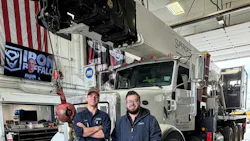
When Iron Buffalo was starting out, it made a big splash with employees by offering generous productivity bonuses, with the year’s top earner winning a trip for two. Co-owners Austin White and Mike Schwarz weren’t expecting the winner to pick Hawaii, nor had they budgeted for such an expense. White thought the tech would choose going to a NASCAR race. But that is where the top tech wanted to go, and a deal is a deal. The shop made it work financially instead of looking for a loophole that a corporate legal or accounting department would likely exploit.
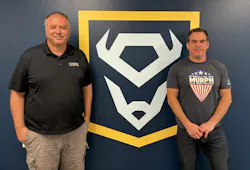
White called the decision a “no-brainer, considering “the amount of revenue that tech is responsible.”
That same tech won the next year as well, again choosing the Aloha State.
Enter Jaziel Espinoza, who started a paid internship his senior year of high school. All the older techs took a shine to Espinoza and wanted him to assist on their work. Espinoza watched and listened, quickly moving up to mobile tech after about two years. Because he could bill about 20 hours a day just taking care of 18 truck tire replacements, he shot up the rankings. Then White told him he was close to first, and Espinoza, who “always wants to be the best in everything,” said he cranked it up a notch that final quarter.
He did choose a race—the F1 Grand Prix in Monaco. It was a dream come true for Espinoza and his girlfriend, and Iron Buffalo has a bond with one of its most promising techs as strong as steel.
Espinoza, on pace to get his ASE Master certification for heavy duty by the time he is 27 thanks to the training path he was put on, noted White and Schwarz made sure to establish “a human connection” with him, and always stress that “if you’re winning, they’re winning.”
Training in general can be another employment differentiator, because it takes a serious commitment for an independent shop to provide it.
“We are able to buy most of the OEM software we need now, so that part has gotten easier through legislation (Right to Repair),” said Mike Bascom. “But it’s still a challenge to get the appropriate information, be it troubleshooting trees or dealer-level training. And we’re not talking about getting some kind of certification. The knowledge is all we want.”
To access the knowledge, Bascom has flown techs down to Tritech’s diesel tech school in Texas. This is something Todd at The Service Company in Ohio has also found value in.
“Tritech puts on some really good classes,” Mike Bascom said. “But we’ve also recently learned about a couple of other options out there, so we’re looking into those as well, because independent shops like ours need this high-level training to keep up with new technologies.”
Marshalling new recruits
A family-oriented work environment, coupled with compensation that is on par with dealerships, puts independent shops in a good position to attract great talent. Some shops are then making an extra effort to ensure a more stable talent pipeline.
For example, Iron Buffalo Truck & Trailer Repair has embedded itself in the area’s high schools, which has enabled the development of a highly effective internship program.
“You can’t just go to a teacher in May and say, ‘I need a couple good students to hire this summer,’” White related. “Because we are so involved in the schools, building relationships with teachers and helping teach classes, I already know who the top students are. We also have a lot of support for our internship program.”
Iron Buffalo budgets for three interns a year, matching whatever wage those students could earn working other part-time jobs. Interns also get academic credit for working in one of the shops. Hours are capped at 20 a week during the school year. Then, interns are given an opportunity to work all summer. “Every intern we’ve had has taken us up on this offer,” White said.
Aside from one who moved to Texas, every intern is also still with Iron Buffalo today. In fact, Iron Buffalo’s top biller in 2025 was Jaziel Espinoza, who interned his senior year in 2022. The mobile tech
“We don’t have a technician shortage at our company,” White related. “We have really good technicians from top to bottom. Plus, we’re a really young shop. It can be done. You just need to be willing to put in the work with the schools.”
About the Author
 Gregg Wartgow
Gregg Wartgow
Gregg Wartgow is a freelancer who Fleet Maintenance has relied upon for many years, writing about virtually any trucking topic. He lives in Brodhead, Wisconsin.