The case for investing in shop amenities
Key Highlights
- Two-thirds of diesel shops are understaffed, highlighting the need for better retention and attraction strategies.
- Respect, growth opportunities, and fair compensation are key factors in attracting and keeping skilled technicians.
- Leadership can demonstrate respect through trust, transparency, and maintaining clean, well-equipped facilities.
- Investing in amenities like break rooms and organized workspaces boosts morale, communication, and productivity.
- Facility upgrades, such as renovated break rooms and fitness centers, can improve employee engagement and reduce turnover.
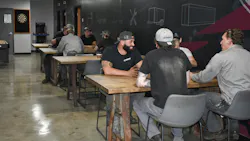
With two-thirds of diesel shops reportedly understaffed, as a recent American Transportation Research Institute survey suggests, fleet maintenance departments have a much bigger issue on their hands than how to bring artificial intelligence into operations. According to experts specializing in improving shop operations, they must get smarter about keeping the humans in the shop. That starts with remembering they are humans.
One of these experts is Kenneth Eggen, an executive-level consultant who owns K.M.E. Services. Forty years ago, he turned wrenches; now he turns around trucking companies as an interim COO for a year or more, looking at ways to improve their finances, safety, and maintenance operations. He has managed hundreds of shops in his long career and insists that turnover has never been a problem for him.
“I find [technicians] want a little latitude, to be treated with respect and not like a number,” he said, explaining shops display respect through the obvious levers, including providing competitive pay, the right tools, and training.
Christopher Lawson, the founder of Technician Find, a consulting and marketing business for independent shops that offers creative ways to hire techs, offered similar guidance.
“There are really three areas that a shop has to be really concerned about: respect, growth, and then money—in that order,” Lawson said. “Those are the ones that are going to attract talent, and they’re also the ones that are going to get people to leave.”
He emphasized that “nailing all three is not only a full force multiplier for productivity and retention, it’s also for attraction.”
The industry belabors the issues of growth, or career development, and money all the time, but respect, a facet of culture, is harder to define. It’s not like disrespect, where you feel it in your blood and bones.
To Eggen, leadership conveys respect via trust, consistency, and transparency. In actual, real day-to-day shop life, these intangible virtues reveal themselves in all the little things not directly associated with generating revenue: keeping the shop clean, a decent break room, and a climate-controlled work area.
Some would call these amenities—little extras that shops could address once the 1,000 fires in the shops are put out, and there’s a surplus of money. They’re actually opportunity investments to prove to techs that they are seen as more than their standard repair times or PM volume, to prove you see them as people.
And in return, they very well could become productivity machines for you.
“CEOs focus on numbers; what drives the numbers are the attitudes of the people in that shop,” Eggen reasoned. “And leadership invested in the facilities shows the technicians how much the leadership does or doesn’t care about the people.”
But according to Eggen, the Great Freight Recession over the last few years has impacted how much of the budget goes to facility improvements and amenities that aesthetically reflect a shop’s respect for its hard-working techs.
"Many companies have just stopped investing in people—and that’s the biggest issue I see out there,” he said.
Clean look
“When you demand and deliver clean facilities with everything functioning, it just speaks to the overall efficiency, the level of respect for the employee,” Eggen said, boasting that vendors would tell each other his shops had floors clean enough to eat off of.
When he goes to a new shop to gauge their current standing, he beelines for the tire area, and the state of order or chaos tells him most of what he needs to know. To help the techs keep the shop orderly, the floor should be clearly striped where A/C machines and jack stands belong.
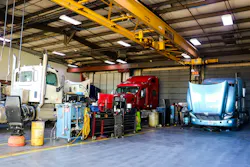
The restroom is another area. “If you go in and there’s no paper towels in the restroom, it drives me up a wall,” he exclaimed.
Eggen recalled a shop visit a few years ago where he entered “the worst, nastiest place I’d ever seen in my life.” The shop manager argued that the business did not have enough money to clean. “Cleaning the shop up just takes some labor,” Eggen retorted.
Eggen won the argument, and the shop cleaned up. Even the fleet’s drivers were taken aback by the new look.
“It sets a whole different standard and process, or aesthetic appeal, when [employees] see effort being put into it like that,” he offered.
Cleanliness is represented in the “Shine” pillar of the Lean 5S methodology: Sort, Set in order, Standardize, and Sustain are the others. Large operations have adopted these with a religious adherence, but any shop can wipe down counters and ensure shared tools and equipment have a set home.
Naturally, this makes the shop a place of work to be proud of, but according to consultant Jamie Irvine, founder of Heavy Duty Consulting Corp., there are real repair efficiency and accuracy benefits.
“There is a correlation with the cleanliness and orderliness of the shop, and the organizational capacity of the team doing repairs,” Irvine told Fleet Maintenance. “I recently toured a shop that was a disaster with stuff piled on the floor, and when I did the assessment of the shop’s performance, they scored very low with frequent diagnostic issues, comebacks, and overall fleet dissatisfaction.
“Conversely, one of my clients in Wisconsin has a clean, organized shop, parts room, and customer area,” he continued. “And they have recently improved tech efficiency and utilization by 14% in one quarter.”
Gimme a break (room)
Lawson recalled an indie shop visit in Boston some years ago where the break room fridge was generously stocked with several kinds of drinks and the pantry stuffed with cookies and chips. The techs could take what they wanted, no charge. Lawson commented on what a great perk they had.
According to Lawson, the shop owner revealed there was a side bonus: “The guys don’t go down the street to get coffee or to get energy drinks or to get a snack, burning 20 minutes, walking back and forth.”
There’s another bonus, too. If the break room is clean and welcoming, ideally with a working coffee maker and microwave, it can become a place where techs and other employees start the day on the same level, maybe engaging in small talk or assessing a difficult diagnosis from the previous day. Whatever the topic, they are together and communicating.
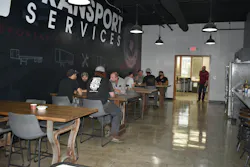
That’s something Transport Services, Inc., a Translead dealer and repair shop based in North Royalton, Ohio, has learned since a large-scale renovation of the company’s second floor in 2023, now dedicated to recharging the technicians’ and other employees’ batteries, and has become the shop’s cultural epicenter.
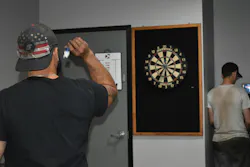
What was once used solely for storage now includes a stylish kitchenette, sturdy hardwood tables, three soundproof privacy rooms with recliners, and extra flourishes, including a shuffleboard table, a stand-up arcade game (NFL Blitz), and a dartboard for good measure. A Cleveland-themed graffiti mural also fills up the walls, providing extra personality.
According to the company’s president, Adam Therrien, the cushy digs keep the techs from wandering out for lunch, saving the tech and shop time. Therrien also hosts quarterly staff meetings there, potlucks, and catered meals.
He said prior to the renovation, the break room was far smaller, and “not everybody wanted to eat on top of each other,” so they left for lunch.
“Now they do stay around, and I definitely see more folks eating together now that we have a larger space,” he added.
Boosted camaraderie became a side bonus to the 50-year-old trailer dealership’s initial goal to retain techs, Therrien said. The shop also has a full gym that was installed on the first floor in 2018 for the same reason. In both cases, it looks like they spared no expense (though the stunning wall mural is really cost-effective peel-and-stick decals).
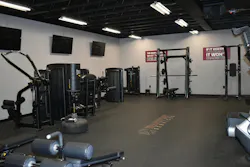
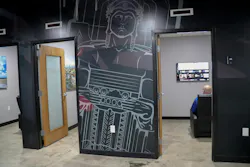
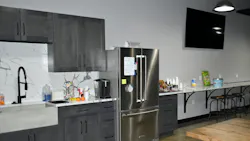
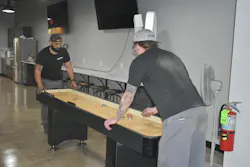
“We just try to go above and beyond, and show people that, first off, if we take care of our own, they’re going to stay longer,” he offered. “And then when we walk a [potential hire] around—they see the gym, the cafeterias, and the things that we do—I think it helps us attract new people.”
Therrien and his father, Albert Therrien, the founder and CEO, also understand they are not the only ones in the area trying to attract the best talent.
“We’re competing with the company next door to us. The company down the street from us,” Therrien said. “And in order to attract good people, there’s got to be some additional offerings at any place of business nowadays.”
Therrien asserted retention has been good since the 2023 renovation, and he knows what they spent, but admitted he can’t quantify the revenue generated by this significant investment, or the maintenance department’s dedication to apprenticeships and training. Though he mused that the true ROI is seen in how long many of the techs have stayed with the family business.
“If we hadn’t updated the building and done all these additions, we wouldn’t have been able to attract the people that we currently have,” Therrien said.
He agreed that the extra features have made the techs more engaged in the work and culture, and that does show up on KPI reports.
“If they see the investment in them, or in the building and processes, we get it back in the sense of their productivity,” he asserted.
About the Author
 John Hitch
John Hitch
Editor-in-chief, Fleet Maintenance
John Hitch is the award-winning editor-in-chief of Fleet Maintenance, where his mission is to provide maintenance leaders and technicians with the the latest information on tools, strategies, and best practices to keep their fleets' commercial vehicles moving.
He is based out of Cleveland, Ohio, and has worked in the B2B journalism space for more than a decade. Hitch was previously senior editor for FleetOwner and before that was technology editor for IndustryWeek, and managing editor of New Equipment Digest.
Hitch graduated from Kent State University and was editor of the student magazine The Burr in 2009.
The former sonar technician served honorably aboard the fast-attack submarine USS Oklahoma City (SSN-723), where he participated in counter-drug ops, an under-ice expedition, and other missions he's not allowed to talk about for several more decades.