Key Highlights
- Peterbilt’s Model 358 improved truck maintenance access with a tilting hood design still used today.
- Mack’s Maxidyne engine boosted torque, reduced shifting, and improved driver efficiency and fuel economy.
- Electronic engines and aerodynamic designs transformed heavy-duty trucks into more efficient equipment.
We've already covered the first decade of American trucking, starting in 1898, the era of specialization and refinement that came in the years that followed, and advancements like refrigerated transport between 1930 and 1958.
By the 1960s, American trucking had matured into a vital freight network, and innovation shifted from foundational ideas to improving how trucks performed, lasted, and were serviced.
As fleets grew larger and freight demands increased, manufacturers spent the next two decades introducing technologies that improved efficiency, maintenance, and reliability, laying the foundation for the modern heavy-duty truck.
1965 - Peterbilt Model 358 tilts maintenance for the better
In 1959, Peterbilt introduced the 282 and 352 cabover-engine models, which provided unprecedented access to the powertrain, as the whole cab could tilt forward. It remains the standard method for COEs. In 1965, Pete turned to making conventional trucks easier to access with the Model 358. The truck’s aluminum hood was joined to the grille, and the whole assembly tilted forward to reveal the engine, radiator, and other components, greatly improving maintenance efficiency, from an owner-operator checking fluid levels to technicians working on the engine. This one-piece-style hood was also the first to be adorned by Pete’s bird. Two years later, the design was tweaked with the Model 359 to accommodate larger, more powerful engines.
1967 - Mack maxes out
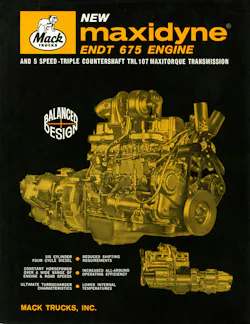
In the 1960s, diesel engines had to be kept above a certain minimum RPM, typically about 1,500, to maximize injection system performance and fuel economy. Transmissions at the time had at least 10 very close forward ratios. But as injection systems improved and engines began being turbocharged, the landscape began changing. In 1967, Mack Trucks changed everything with the Maxidyne engine concept. Doug Maney, the curator of the Mack Museum, described that the high-pressure fuel pump was redesigned so the amount of fuel injected for each power stroke was mechanically increased as the engine was lugged down, as when climbing hills or just after an upshift. This was termed “torque-rise,” as the torque increased to compensate for lost RPM as the engine lugged down. Ultimately, this reduced the need for constant shifting. This in turn eased drive fatigue and drivetrain wear, while improving fuel efficiency.
The turbocharger had to be carefully matched to the engine’s airflow characteristics and the amount of fuel, but the concept allowed the engine to develop much more torque at a lower RPM than in the past, without smoke. It all worked because the increase in fuel would raise the exhaust temperature, causing the turbo to turn fast enough to ensure the engine got more than enough air to prevent exhaust smoke even when at low RPM.
Mack’s highway trucks were then equipped with a simple, 5-speed TRL-107 transmission, a gearbox with three countershafts to handle the increased torque. This sounds unworkable, but consider this: The original Maxidyne had 222 HP at 2,100 RPM and 207 HP at 1,200 with a peak rating of 237 at 1,700, meaning the driver lost only 7% of the horsepower after an upshift. The process was further advanced by 1973. In that year, Maxidyne engines developed 300 hp, achievable with an unusual system Mack developed for cooling the intake air between the turbo and the engine.
Although the rest of the industry never went to a 5-speed gearbox, the steps on 10-speed transmissions became wider, and the 9-speed, where only 8 gears got you up to speed in normal acceleration, was introduced.
1985 - Detroit Diesel uses electronic injection
Prior to the mid ‘80s, diesel injection was hydro-mechanical. That was when Detroit Diesel, then owned by GM, put the first electronic engine control module (ECM) on a Series 92 V8 diesel engine. The ECM, for the first time, made it practical to vary the timing of injection with the more powerful camshaft-operated unit injectors used by Detroit and Cummins. The electronic processor was coupled with sensors that precisely measured factors such as engine RPM, crankshaft position, and turbo boost pressure.
The result was an engine that was more efficient, produced less particulate and smoke, and could react more quickly when the driver pressed down on the accelerator. The more precise injection produced a more responsive engine that emitted less smoke and particulates while increasing efficiency.
Fellow diesel manufacturers soon followed with electronic controls, now essential in building efficient, low-emission diesel engines.
1985 - Aerodynamic T600 redefines fuel efficiency
People still talk about the long lines at fuel pumps because of the 1970s oil embargo, but for truckers, the price volatility could cost them their livelihood. According to the U.S. Energy Information Administration (EIA), diesel prices doubled from 1975 to 1985. Class 8 trucks were lucky to break 5 mpg at the time. Kenworth had been thinking about the problem that whole time and how to improve efficiency.
“Sitting in those legendary lines for gas is what got me thinking about fuel economy,” recalled director of research and development Larry Orr in a 75th commemorative book for Kenworth. “I knew we could improve fuel economy on heavy trucks by improving their aerodynamics.”
He and his team spent the next decade trying to outsmart wind resistance, using wood and wax models in a wind tunnel to divine a more aerodynamic cab. The early 80s recession slowed the project down, but the research yielded the KX prototype, which looked like a sloped cabover, with a clean angle from the shortened grille and past the windshield. Then long-nose trucks made a comeback, and Orr said the team “had to go back to the drawing board.”
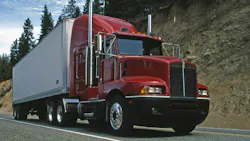
They used the W900B as a starting point and introduced a sloped hood, lowered bumpers, side skirts, roof fairings, and a setback front axle. An air cleaner was also added under the hood. The turning radius and ride were also improved. The look was deliberately not as radical as possible, knowing the industry’s feelings on drastic changes. Testing on the new design on a track revealed it was 22% more efficient than the W900B, and despite the unconventional look, management approved the T600 project to continue. A road test from Phoenix to Miami Beach found the T600 could average 9 mpg. The truck launched in 1985 and by year’s end accounted for 40% of new business for the OEM and earned the name “Anteater,” which is far better than “Gas Guzzler.”
The dramatic design led the other OEMs to follow suit, with the Freightliner FLD and Peterbilt’s Model 372 coming out over the next few years. At Kenworth, the T600A gave way to more improvements with the T600B, such as aero side mirrors, and then the T680 in 2013. The Next Gen version, launched in 2021, added 6% better efficiency. In fact, every OEM’s new heavy-duty truck launch places aero changes and efficiency front and center, with an entire side industry dedicated to truck and trailer aero accessories such as sideskirts and wheel covers.
About the Author
 John Hitch
John Hitch
Editor-in-chief, Fleet Maintenance
John Hitch is the award-winning editor-in-chief of Fleet Maintenance, where his mission is to provide maintenance leaders and technicians with the the latest information on tools, strategies, and best practices to keep their fleets' commercial vehicles moving.
He is based out of Cleveland, Ohio, and has worked in the B2B journalism space for more than a decade. Hitch was previously senior editor for FleetOwner and before that was technology editor for IndustryWeek, and managing editor of New Equipment Digest.
Hitch graduated from Kent State University and was editor of the student magazine The Burr in 2009.
The former sonar technician served honorably aboard the fast-attack submarine USS Oklahoma City (SSN-723), where he participated in counter-drug ops, an under-ice expedition, and other missions he's not allowed to talk about for several more decades.