How to diagnose AMT clutch actuation and wear issues
Key Highlights
- AMT clutch life depends on load, driving conditions, and low-speed maneuvers, despite automated clutch control.
- Inspect sensors, wiring, software, and perform clutch calibrations to help maintain AMT performance.
- Diagnose actuator, air, and electrical faults with bi-directional scan tools and system fault codes.
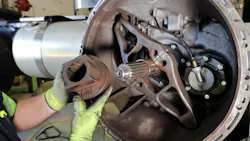
While automated manual transmissions (AMTs) share many mechanical components with traditional manual transmissions, the big difference is that an AMT relies on sensors and computers to automate clutch engagement and gear shifts. That bodes well for vehicle performance, clutch reliability, and drivability.
“In many cases, automated transmissions can last longer than manual ones, mainly because the system applies the clutch more consistently than a human driver typically can,” said DJ Painter, test engineer at Noregon, a provider of diagnostic tools.
But knowing what can decrease clutch performance will help fleets keep drivers happy and trucks out of the shop.
For instance, driver behavior and type of load can both diminish clutch life.
“Heavy loads, stop-and-go driving, backing, hill starts, and low-speed maneuvering can still wear out an automated clutch quickly,” Painter pointed out.
Heat and slip are two issues that affect conventional friction clutches, added John Kimes, president and CEO of Sigma Powertrain, a powertrain development company whose core technologies include a unique mechanical e-clutch that doesn’t rely on friction material as the primary torque-transfer mechanism.
“A conventional friction clutch has to manage torque while allowing controlled slip, and that slip creates heat,” he continued. “Over time, excessive heat can lead to glazing, accelerated friction material wear, plate distortion, release bearing wear, actuator stress, and calibration issues as the system tries to compensate for clutch wear.”
There is also the automation aspect to consider. In addition to staying on top of clutch wear, Painter said technicians must add the following procedures to their regular maintenance protocols:
- Inspecting wiring, connectors, and sensors
- Checking for software updates
- Performing clutch calibrations or relearns when needed
Upstream actuation issues
Technicians must also pay attention to potential upstream issues that can impact clutch function. With an automated transmission, solenoids direct either pneumatic or electrical flow to actuate the clutch when the TCM (transmission control module) commands them to. Thus, a vehicle’s air or electrical system presents another potential failure mode.
Kevin Snow, global technical services director for Eaton Cummins Automated Transmission Technologies, said electric actuator issues can include:
- Cable/connector crimping and corrosion
- Motor brush dust (specific to DC brush motors)
- Position sensor failures
- Power supply and chassis battery issues
- Circuit board-level issues such as cracked solder joints
“These components typically have fault codes associated with the failure modes,” Snow said. “They can detect electrical shorts, opens, and over-voltage.”
Pneumatic actuator issues, meanwhile, may include:
- Air supply contamination (resulting in “stuck” valves)
- Low or high air supply pressure
- Airline fitting leaks
- Poor air system maintenance (i.e. not changing filter at least annually)
“There are fault codes associated with the air system and at the component actuator level,” Snow said. “The Eaton Endurant transmission’s Mechatronics Transmission Actuator (MTM) has its own pressure sensor to verify supply pressure. We also have rail position sensors and associated fault codes if we can’t get into a gear or clutch position. The overall air system supply can be verified by using the vehicle SAE J1939 datalink to communicate with the ABS system or cab components that measure and provide the air supply pressure.”
When troubleshooting clutches on AMTs, a bi-directional scanner can be an invaluable tool because it allows two-way communication with the vehicle’s control systems.
“The technician can command the clutch actuator and related solenoids, perform calibration routines, and monitor real-time data from the ECM, transmission controller, motor controller, and clutch position sensors to verify whether the clutch system is responding correctly,” Kimes explained.
Keeping an eye on clutch wear
Modern automated clutches can last a long time under normal use, typically to at least the 400,000-mile mark. But as touched on earlier, there are certain operating conditions that can lead to premature wear.
Other extenuating circumstances can also have an impact on clutch wear, such as vibration harmonics generated by the engine due to an engine or thrust washer issue. Engine downspeeding can also have an influence.
“As engines continue to downspeed, you get different harmonics and torsionals through the system,” said Kevin Snow, global technical services director for Eaton Cummins Automated Transmission Technologies. “The clutch release system ends up actuating all the time, bringing the friction and other mechanical components together. Then there’s the vibration coming from the engine as it downspeeds. Essentially, low rpm and different harmonics can really beat up a clutch.”
“A technician may notice things like shudder, slipping, harsh engagement, delayed launch, calibration faults, high clutch temperature history, excessive actuator travel, or learned clutch wear values moving out of range,” added John Kimes, president and CEO of Sigma Powertrain.
Regardless of why or when excessive clutch wear might begin to show, the advanced prognostic systems of today’s automated transmissions will give the fleet a heads-up.
With Eaton’s Endurant HD and XD, for example, the TCM uses sensor data to calculate the fully exhausted position (FEP) of the linear clutch actuator (LCA). The FEP gets bigger as the clutch wears because the LCA is having to travel farther. A proprietary algorithm analyzes the FEP alongside additional factors to determine when the clutch is wearing out.
Eaton’s Fault Code 706 (Clutch Position Out of Range)—also known as SPN 2983, FM 17—alerts technicians to this excessive wear. Snow said this happens two to six weeks prior to failure so service can be scheduled proactively. FC 706 is transmitted over the vehicle’s datalink and can be viewed through Eaton’s web-based diagnostic portal, IntelliConnect, as well as third-party telemetry platforms such as Geotab.
So what should happen when a technician sees FC 706?
Snow said it’s time to inspect the clutch housing. Defects could be found with internal components like the release yoke assembly, including release yoke pivot pin fractures, yoke roller wear, roller bushing failure, or cracked plastic sockets on the release yoke assembly. It’s also possible that the transmission release bearing could seize and cause damage to the diaphragm spring fingers. Any defective components or assemblies must be replaced to ensure proper actuation of the clutch.
How to diagnose clutch-abusing driver behavior
Diagnostic tools like Eaton’s ServiceRanger Pro, a PC-based tool for Eaton and Eaton Cummins automated transmissions, are critical to diagnosing and resolving clutch-related issues in automated transmissions. Tools like this are also needed when recalibrating an automated clutch after it has been serviced.
But did you know that diagnostic tools can also be an invaluable resource when it comes to clutch abuse prevention? That’s right, even though a huge benefit of an automated transmission is that a computer handles the clutch actuations and gear shifts, certain driver behaviors can still affect clutch performance and longevity.
“Eaton’s Endurant transmission, combined with tools like ServiceRanger and the IntelliConnect remote diagnostics platform, enables fleets to turn Vehicle Performance Analytics (VPA) data into actionable coaching opportunities for drivers,” said Kevin Snow, global technical services director for Eaton Cummins Automated Transmission Technologies.
By analyzing patterns such as high-energy launch events, start gear utilization, neutral coasting frequency, and manual intervention rates, fleets can identify behaviors that impact not only clutch life, but also fuel efficiency and overall vehicle performance.
“IntelliConnect presents this data in a clear, objective way,” Snow said. “This allows fleets to guide drivers with data-backed insights rather than subjective feedback, helping improve driving habits, extend component life, and reduce total operating cost,” Snow said.
About the Author
 Gregg Wartgow
Gregg Wartgow
Gregg Wartgow is a freelancer who Fleet Maintenance has relied upon for many years, writing about virtually any trucking topic. He lives in Brodhead, Wisconsin.