Cool approach to technician retention
Key Highlights
- Providing shade and cooling fans in outdoor work areas can prevent heat-related injuries and improve technician morale.
- Climate-controlled shops with proper thermostats and solar energy solutions help manage utility costs while maintaining comfort.
- High-volume, low-speed fans like the Cool Boss HVLS model offer energy-efficient airflow for large shop spaces, enhancing comfort year-round.
- Portable evaporative coolers and industrial fans are versatile options for targeted cooling in specific work zones or during peak heat periods.
- Upgrading shop layouts with dedicated parts storage and climate control can increase efficiency, technician satisfaction, and retention rates.
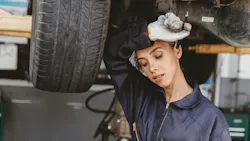
We previously discussed how some shops have found a competitive advantage when hiring and retaining technicians through investing in better common areas to eat, train, and even work out. Providing comfort in the bay is just as important.
While technicians require far less cooling power than the data centers powering your AI tools, they still get hot, and the last thing you want is for them to overheat. These are, after all, the engines of shop productivity.
But ensuring their internal temperature is regulated has not always been a priority.
Fleet consultant Kenneth Eggen, who operates K.M.E. Services, recalled a southern Louisiana shop he visited where the tire bay was too small to fit tractors or trailers, so the tire tech did all his work outside under a blazing sun.
After “watching this guy kill himself out in this heat,” Eggen went to the company president and suggested installing a carport-style canopy for shade and a large cooling fan.
“So, they did that, and the guy was immensely appreciative,” Eggen said. “He’s like, ‘Man, nobody’s ever given crap before—and I’ve been doing this for six years.’”
A portable shop fan can range from under $100 to over $1,000. That’s not a small investment. On the other hand, recruiting estimates put onboarding a new diesel tech at more than $5,000. And then you must factor in the revenue lost while placing and training the new hire. Inland Empire Fleet Maintenance, an independent repair shop based in Colton, California, estimated they spend $15,000 to hire a tech and get them up to speed.
And that new hire will be more likely to accept an initial offer and stick around if the shop can control its climate to some degree. According to WrenchWay’s 2026 Voice of the Technician survey, 43% of techs (auto, collision, and diesel) and related vocational students agreed a temperature-controlled shop was a “must have,” with 51% saying it’s “nice to have.”
A shop with heating and A/C should consider managerial control over the thermostat as a “must have.” When Jay Williamson and his brother Steven Williamson, owners of the Wabash dealership River-Roads Sales and Leasing, and heavy-duty repair shop, AAA Truck & Trailer Services, relocated the businesses from St. Louis’ North City neighborhood across the Mississippi River to a new location in Granite City, Illinois, they made the investment in climate control.
One mid-spring cool and overcast day, the brothers were walking through the 10-bay trailer shop and realized several of the techs were wearing jackets and sweater vests.
“We looked at the thermostats, and they were set on like 65 [degrees F],” Jay started, before Steve emphatically interjected with “It was like a meat locker!”
They are not sure if someone possibly liked to work in frigid temperatures and turned the A/C all the way down, or it was an accident, but they installed different thermostats that the techs don’t have to adjust, just to be safe.
For such a large building, the cooling cost is a substantial investment. But the brothers were able to get grants to help install solar panels, which Jay estimated offsets 40% of their electrical costs. They are currently looking at adding more panels to double the savings. This way, the techs stay comfortable, and the utility costs stay within reason.
The Granite City shop also added a mezzanine, allowing parts to be stored on two levels.
“In our last facility, we didn’t even really have a parts room,” Steve said. “Now we have a dedicated, secure parts room.”
That makes inventory easier and more efficient to find and retrieve, a bonus for the shop and the 25 or so techs trying to get a repair done.
“One of the top three complaints I hear from technicians is having the right parts at the right time,” said Irvine, who hosts The Heavy Duty Parts Report podcast. “If you get this system in place, it definitely improves technician satisfaction and retention rates.”
Shop cooling solutions
Keeping techs comfortable doesn't always require a complete HVAC overhaul. From portable fans and evaporative coolers to industrial ceiling fans and shop air conditioners, there are a variety of options designed to improve airflow and help maintain more comfortable working conditions in the bay. Here are a few.
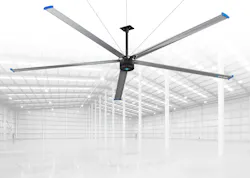
The Cool Boss by BendPak CB-20HVLS industrial ceiling fan helps large shops achieve year-round comfort, maximize energy savings, and boost productivity. The 20-ft. diameter fan is quiet and built to last with high-strength aluminum alloy blades. Winglets on the blade ends improve aerodynamic performance, increase airflow, and reduce turbulence to maximize energy efficiency. Like all Cool Boss high-volume, low-speed fans, the CB-20HVLS uses a high-efficiency brushless permanent magnet synchronous motor to deliver more torque with up to 50% less energy consumption than traditional AC motors. The motors also offer greater reliability, reduced maintenance and longer service life.
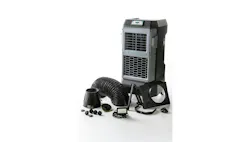
The Portacool VORTEX Precision Cool Kit, No. PACVTX700K, is designed to deliver targeted cooling for trailers, docks, and people. This kit is an add-on for the Portacool APEX 700 evaporative cooler. It features a durable, high-velocity nozzle with a 180-degree pivot mount and an integrated LED light. The quick-mount system bolts onto the APEX 700 and can be installed, removed, or repositioned in minutes. Made of rugged, durable materials and built for industrial use, the VORTEX comes with a 1-year warranty on all parts.
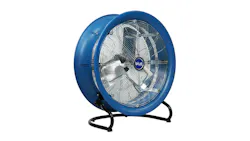
The Blue 2200 Residential Floor Fan is the first Patterson-designed, ETL-listed, high-performance, heavy-duty, residential and commercial floor fan. Designed in the U.S. and crafted with durable, rugged components from Patterson's tried-and-true, industrial-grade High-Velocity Fans, the Blue 2200 is ideal for residential and commercial areas such as garages, basements, workshops, and kitchens. Weighing only 32 lbs., the floor fan is easily portable and features a 3-speed controller. Order online with a flat-rate shipping fee of $25.
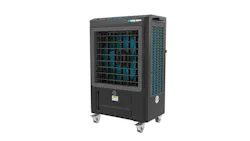
The Cool Boss CB-19SL Portable Evaporative Air Cooler blows chilled air at a volume of 6,840 cubic feet per minute. The CB-19SL stands at just over 44" tall and weighs 40 lbs when empty, and it produces a noise level of 62 dB or less. It features a specialized Honeycool evaporative medium that provides increased cooling performance with reduced water consumption compared to conventional pads. The CB-19SL housing is rotomolded as a single, seamless component for leakproof operation. It also includes three fan speeds, antibacterial housing, oscillating swing louvers, and a 15' power cord that plugs into any standard outlet.
About the Author
 John Hitch
John Hitch
Editor-in-chief, Fleet Maintenance
John Hitch is the award-winning editor-in-chief of Fleet Maintenance, where his mission is to provide maintenance leaders and technicians with the the latest information on tools, strategies, and best practices to keep their fleets' commercial vehicles moving.
He is based out of Cleveland, Ohio, and has worked in the B2B journalism space for more than a decade. Hitch was previously senior editor for FleetOwner and before that was technology editor for IndustryWeek, and managing editor of New Equipment Digest.
Hitch graduated from Kent State University and was editor of the student magazine The Burr in 2009.
The former sonar technician served honorably aboard the fast-attack submarine USS Oklahoma City (SSN-723), where he participated in counter-drug ops, an under-ice expedition, and other missions he's not allowed to talk about for several more decades.