How Commercial Truck & Mobile Repair supports technicians and fleet customers
Key Highlights
- Cross-training helps repair shops service diverse truck and trailer fleets more effectively.
- Encouraging technicians to tackle unfamiliar repairs builds skills and strengthens shop teamwork.
- Investing in tools and technician development can improve retention and reduce burnout.
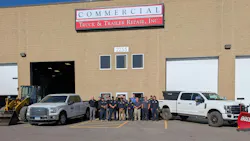
Jacob Marshall has been in the vehicle repair business his entire career. He even owned his own automotive shop for five years before making the switch to heavy-duty in 2013. The past year has arguably been the most rewarding. As shop manager for Commercial Truck & Mobile Repair’s St. Paul, Minnesota, location, Marshall has been immersed in his favorite segment of the industry, heavy-duty, while working with a team that has great camaraderie and loves learning as much as he does. Marshall joined Commercial Truck & Mobile Repair, also known as Commercial Truck & Trailer Repair, in late 2024 after spending the previous four years as maintenance manager for a large fleet. He liked working for a fleet, but felt like he needed more excitement.
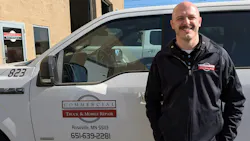
“Basic fleet maintenance can get a little mundane, and I’m a pretty fast-moving guy,” Marshall related. “Our general manager, Kevin Harrop, reached out to me. We talked quite a bit and had great rapport. A couple months later, he called again and said he had an opening. So I came on board, and we’ve been moving at a clip ever since.”
Sponges soak in tribal knowledge
Commercial Truck & Mobile Repair, which also has a location in Houston, is owned by Berger Allied, which also owns transportation companies like Beyond Distribution, Relocation Today, and Logix Transportation. Commercial Truck naturally provides fleet services to those sister companies.
“Our shop in St. Paul also provides service to many other OTR fleets including Old Dutch Foods, Cintas, Bimbo Bakeries USA, and Airgas,” Marshall pointed out. “Additionally, we have quite a few construction industry customers that have fleets of dump trucks.”
Given the broad array of vehicles his shop must service, Marshall said it’s important to have a diversely skilled team of technicians who are willing to jump in where necessary to help each other out. He also said this is where a more artistic skill set is required for effective service department management. Like most shops, his team includes senior technicians who’ve seen everything, and younger techs who have skills but need experience. There’s a fine balance between driving efficiency and building camaraderie.
“We’re always pushing our younger technicians to take on certain jobs, maybe something like hydraulics, to continue learning and gaining that experience,” Marshall said.
To that point, the biggest trait Marshall looks for in a new technician is the desire to be pushed.
“Some technicians are happy spending their entire career doing PMs for a fleet,” Marshall said. “I totally understand that and support that. But at our shop, we like to hire technicians who tend to be sponges of information.”
That philosophy was reinforced in Marshall’s mind after a recent experience at a local technical college’s career fair.
“One thing I noticed was that so many young students came to our booth asking about the different types of things they could work on and what they would be able to learn by working at our shop,” Marshall recalled. “That’s a mindset we look for when hiring people, and it’s also a mindset we want to harbor within our existing staff. We motivate our people to have the desire to take on new jobs, and to take advantage of all the tribal knowledge in our shop. We always encourage our technicians to bounce ideas off each other and really work together, at least when time allows.”
Core values are the glue
Some repair shops, and really just small businesses in general, say it’s a challenge to foster camaraderie within a multigenerational workforce. Marshall said he has seen that at other places he’s worked and remains conscious of it today. But generational strain hasn’t been a problem at Commercial Truck’s St. Paul location, and Marshall attributes that to the core values the company instills in each employee.
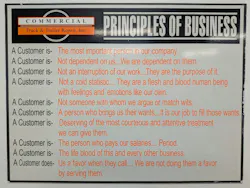
“We’ve had people retire recently who’d been here for 25 or even 44 years, and they’d been working hand in hand with technicians in their 20s,” Marshall related. “They got along great, and I think it helps that everyone is focused on one common goal, the customer. There’s a sign in our breakroom that has 11 principles of business. Each starts with the phrase, ‘A customer is (or does).’ I think that’s why we don’t have a lot of friction in our shop, even though we have generational differences and even cultural and language differences. The customer is always the common denominator that everyone is focused on.”
Marshall said it’s also a big help that the parent company fully supports Commercial Truck & Mobile Repair’s shops and technicians, giving shop managers the resources needed to set everyone up for success.
“We never hesitate when there’s a chance to tool-up,” Marshall said. “That’s actually one of the things that helps bring good technicians to us, and also helps keep the ones who are already here from getting burned out or feeling like everything is just about the bottom line.”
Marshall said he’s always buying unique tools that are needed for various engine repairs. He also doubled the number of battery packs available to mobile techs, an especially popular move in the winter months. Speaking of winter, Marshall also purchased a salt spreader for the half-ton pickup they use to clear their parking lot and sidewalks when it snows.
“That spreader has made a huge difference in helping break down the thick ice that can form on the pavement in front of our shop doors due to water dripping from the ice dams formed on the roof above,” Marshall said.
At Commercial Truck & Mobile Repair, the focus is on customers, just as their principles of business state. But for shop managers like Marshall, the focus is also on the technicians who take care of those customers. By investing in techs and fostering a teamwork-driven environment, they’ve been able to bridge generational gaps and continue moving at a fast clip, which is just the way Marshall likes it.
About the Author
 Gregg Wartgow
Gregg Wartgow is a freelancer who Fleet Maintenance has relied upon for many years, writing about virtually any trucking topic. He lives in Brodhead, Wisconsin.