How the driver's lobby can give shops a competitive edge
Key Highlights
- Driver-focused amenities can improve the shop experience and encourage repeat business from truckers.
- Clean, comfortable lobbies and lounges can signal attention to detail and make drivers feel valued.
- Investing in shop culture can strengthen technician retention and help fleets weather market downturns.
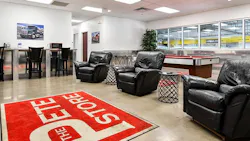
We have recently touched on various areas of the shop to attract and retain vehicle repair technicians, from the bay, where climate control is key to staying comfortable during long, arduous shifts, to the break room, where a shop’s culture can really blossom with a few extra amenities. But we can’t leave out the drivers. They are typically the least enthusiastic about being in the shop and want to get out as soon as possible—but if you run a dealership or third-party repair shop, you want them to come back as often as they need.
That is only assured with accurate and prompt repairs at a fair price, but it starts when they enter the facility.
“The lobby is super important,” explained Chris Lawson, the founder of Technician Find, a consulting and marketing business for independent shops. “Aside from the fact that it’s usually the first thing that your customers see, I think it just projects a level of care and attention to detail.”
A standout he cites as the best is an indie shop called E.L.M. Repair and Refrigeration in Edgar, Wisconsin.
“When you walk in, it looks like a dealership,” Lawson said, noting the leather recliners and big-screen televisions. “That’s the layout, it’s huge.”
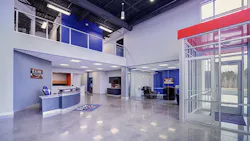
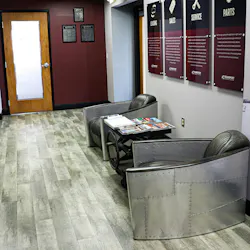
Transport Services has a modest-but-memorable lobby to welcome visitors. This includes modern luxury plank flooring and high-end Aviator-style chairs. Guests can also walk a few paces over to the swanky meeting room dominated by a giant table made of rich mahogany and flanked by photos of Cleveland’s Art Deco Guardians of Traffic and other local landmarks.
AAA Truck & Trailer Services in Granite City, Illinois, not only invested in high-end climate control for its technicians, but also put a lot of thought into the driver lobby. The site, which also serves as Wabash dealership River-Roads Sales and Leasing, has a premium location right off Interstate 270, nestled between a Flying J and Rush Truck Center. Construction to improve traffic at the off-ramp recently concluded, adding to the potential new customers that can come through for maintenance and repairs. The shop estimates that trailers comprise about 80% of the work across three locations.
To ensure a memorable experience—knowing many of these truckers have been on the road for a while—the facility added a driver’s lounge with two shower stalls and washers and dryers, all complimentary.
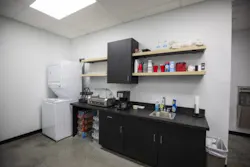
“We wanted to create a place where drivers feel valued and comfortable,” said co-owner Steve Williamson.
Word of mouth will help the business and ultimately provide the techs with more work.
“Drivers talk a lot, and reputations get built up quickly—and they get demolished pretty quickly,” he added.
So far, in addition to scheduled fleet work, the shop draws up to 10 walk-in customers a day. As that number grows, so will amenities.
“The ultimate goal for us is to get a hot dog machine going,” Williamson said. “We just haven’t had the volume quite yet, but it’s starting to develop.”
Signs point to the freight recession nearing an end, according to the brothers, who also own freight brokerage firm End 2 End Logistics, as well as an inland drayage fleet called Endpoint Truck Service.
“Freight rates today are actually where they were back in the COVID era,” noted the company’s other owner, Jay Williamson. “Our feeling is we’ve gone through the tough times, which have made us sharper and better.”
And that started with focusing on the techs.
“We made some decisions that probably cost us extra, but we did that in an attempt to attract and retain techs—and I think it’s actually worked out,” Jay concluded.
One final word. Any investment, whether in a break room, lobby, new shop equipment, or whatever, should not be viewed only as a quick fix to lure new talent, but also as a hedge against the next cyclical downturn, offered Adam Therrien, president of Transport Services.
“When you invest in your own culture, it obviously helps with the good times, but also really shows its value when the market is tighter,” he said. “Because the ones who value being an employee at the company want to go to battle with you… and help everybody get out of whatever downturn the market presents.”
About the Author

John Hitch
Editor-in-chief, Fleet Maintenance
John Hitch is the award-winning editor-in-chief of Fleet Maintenance, where his mission is to provide maintenance leaders and technicians with the the latest information on tools, strategies, and best practices to keep their fleets' commercial vehicles moving.
He is based out of Cleveland, Ohio, and has worked in the B2B journalism space for more than a decade. Hitch was previously senior editor for FleetOwner and before that was technology editor for IndustryWeek, and managing editor of New Equipment Digest.
Hitch graduated from Kent State University and was editor of the student magazine The Burr in 2009.
The former sonar technician served honorably aboard the fast-attack submarine USS Oklahoma City (SSN-723), where he participated in counter-drug ops, an under-ice expedition, and other missions he's not allowed to talk about for several more decades.