American trucking revolutions: 1990s–2000s welcome the digital age of maintenance
Key Highlights
- Automatic tire inflation systems helped fleets improve trailer tire safety, uptime, and maintenance efficiency.
- Web-based repair databases gave technicians faster access to all-makes truck and trailer service information.
- Advanced diagnostic tools helped fleets manage increasingly complex emissions and electronic truck systems.
We've already covered the first decade of American trucking, beginning in 1898, followed by the industry's era of specialization and refinement, as well as the innovations between 1930 and 1958 that introduced technologies like refrigerated transport. Most recently, we explored how the 1960s through the 1980s brought advances in aerodynamics, electronic engine controls, and serviceability that transformed heavy-duty trucks into more efficient, reliable machines.
By the 1990s, the focus shifted again. As emissions regulations tightened and electronics became standard equipment, manufacturers introduced technologies that reshaped engine performance, diagnostics, and fleet operations. Between 1993 and 2007, the industry entered a new era defined by cleaner diesel engines, onboard diagnostics, telematics, and the digital tools that continue to influence truck maintenance today.
1993 - Automatic tire inflation hits the market
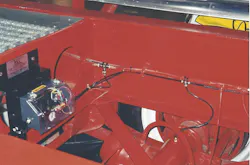
When it comes to trailer tires, inflation is a good thing. The lower it is, the higher the risk of a blowout. That’s a serious risk to safety and uptime. With drivers’ ability to accurately determine tire pressure during pre- and post-trips spurious at best, and nails and debris waiting to damage tires in transit, keeping tires properly inflated has been a serious industry challenge. It’s decidedly less so for those using automatic tire inflation systems, invented by Pressure Systems International (P.S.I.) in the early ’90s. The system gauges when psi drops below the fleet-designated level and forces compressed air into the tire to the desired level. Industry estimates say about 70% of new trailers are spec’d with some form of ATIS. The P.S.I.-made version is marketed as the Meritor Tire Inflation System (MTIS). The company has also gotten into tire pressure monitoring systems and telematics solutions for all commercial vehicles to ensure proper inflation.
2006 - Truck repair gets boost with Mitchell 1’s Tractor-Trailer.net
During the Depression, Glenn Mitchell and Ron Sager, Jr. worked at Chrysler’s parts fulfillment counter in Detroit. To verify the dealer customers’ orders were accurate, a struggle as parts and reference codes often overlapped, the men would sometimes reference 10 catalogs. Knowing they could improve this system, they started making a database of parts numbers and prices. This list caught on with parts counter folks, and Mitchell published the first Mitchell Manuals in 1946. It included illustrations and served as the collision sector’s first estimating guide.
It would be 41 years before the Mitchell Manual for Light, Medium & Heavy Duty Truck Maintenance was released, which streamlined repairs in the truck aftermarket. By 1996, the ON-DEMAND Truck Edition came out on CD-ROM, seven years after the original ON-DEMAND.
A turning point came in 2004, when parent company Snap-on, which acquired Mitchell Repair Information Company six years earlier, decided to expand its truck and trailer side. Dave Costantino, director of heavy-duty market development for Mitchell 1, went on a road trip across America in 2004/2005 to listen to truckers and techs at shops, truck stops, and industry events. After integrating Snap-on customer input and forming a team of 45 experienced diesel techs, Mitchell 1 launched the Tractor-Trailer.net database in 2006, the first web-based all-makes repair software. It was brimming with service and repair info for 3,000 different Classes 7 & 8 trucks and trailers.
“Instead of being pigeonholed in one specialty, techs now had more information to do more types of work—work that had previously been foreign to them,” explained Kristy Coffman, Mitchell 1’s director of the commercial vehicle group.
A decade later, the company rolled out TruckSeries, the cloud-based repair platform for medium- and heavy-duty trucks that provides diagnostic, repair, and labor estimating tools. Recent additions include the ability to view TMC recommended practices and interactive wiring diagrams.
2007 - All-makes scan tool arrives just in time for the aftertreatment era
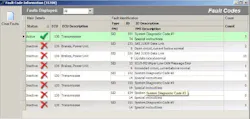
In the ’90s and early 2000s, Bill G. Hathaway provided support products to engineers building J1587 and J1939 networks on trucks and developing diagnostic software for major OEs. Because more trucks started including both protocols, Noregon combined its applications around 2005 for both in one scan tool solution. The PC-based software displayed diagnostic data, faults, and a list of all electronic components on the vehicle. Most importantly, it covered all makes and models in the heavy-duty sector, so a diesel tech could diagnose Cummins, Detroit, and Paccar engines with the same tool. Before, they would rely strictly on OE tools, so when it was commercialized as JPRO in 2007, it caught on quickly.
“When JPRO was introduced, it changed how technicians diagnosed trucks,” explained Noregon product manager Jason Hedman. “Rather than diagnosing each component individually, they finally had a tool that could read the entire vehicle without switching between a half dozen diagnostic applications.”
That same year, the EPA mandated that diesel trucks must have a diesel particulate filter, something new and untested that would add diagnostic trouble codes for JPRO to assess. And the march towards lower emissions has added increasingly complex components, such as SCRs and DEF sensors. Complexity came to safety and electrical systems, too, requiring JPRO to evolve into a full truck diagnostic solution.
“We were at the forefront of aftertreatment diagnostics just like we’re leading the charge on CAN bus diagnostics today,” Hedman asserted.
About the Author

John Hitch
Editor-in-chief, Fleet Maintenance
John Hitch is the award-winning editor-in-chief of Fleet Maintenance, where his mission is to provide maintenance leaders and technicians with the the latest information on tools, strategies, and best practices to keep their fleets' commercial vehicles moving.
He is based out of Cleveland, Ohio, and has worked in the B2B journalism space for more than a decade. Hitch was previously senior editor for FleetOwner and before that was technology editor for IndustryWeek, and managing editor of New Equipment Digest.
Hitch graduated from Kent State University and was editor of the student magazine The Burr in 2009.
The former sonar technician served honorably aboard the fast-attack submarine USS Oklahoma City (SSN-723), where he participated in counter-drug ops, an under-ice expedition, and other missions he's not allowed to talk about for several more decades.