How AI helps fleets turn maintenance data into decisions
Key Highlights
- AI-powered fleet platforms help managers find maintenance trends and cost overruns hidden in operational data.
- Predictive tools can analyze fault codes across similar vehicles to estimate what may happen next and when repairs are needed.
- Automated invoice scanning and work-order coding reduce repetitive administrative work and improve cost analysis.
- AI can bring repair history and vehicle data into a single workflow, helping technicians diagnose issues with more context.
- Industry leaders describe AI as a way to support shop teams and improve uptime—not replace technicians.
AI use in the shop is on the rise, and it won't be long before the technology is completely embedded into every bay, back office, and front counter. For specifics on how AI is aiding technicians with troubleshooting and repairs, take a look at our story on how AI as a diagnostic sidekick. But the potential scale of improvements a repair operation can make with AI extends far beyond finding the root cause of a fault code. By smartening up your management software tools with AI, you can improve the life and overall uptime of thousands of assets. And this realization has kicked off an AI arms race in the sector.
Anecdotally, we attended several dozen press conferences since last October, and the only company that didn’t overtly mention AI was Chevin Fleet Solutions, which at the NAFA 2026 Institute and Expo last April launched a no-code, drag-and-drop feature to customize its FleetWave platform dashboards and assign viewing permissions.
But Richard Clark, Chevin’s global head of product, noted the feature was added because “with the advent of AI, the data can almost overwhelm fleet managers.” The platform also already includes agentic AI and predictive maintenance, and Clark noted the company roadmap includes even more AI.
As for the ones who included AI, it’s virtually all of the rest. Features ranged from agentic AI that finds specific questions about internal data to scanners that digitize work orders and automatically assign VMRS codes.
Each provides tools to reduce how much detective work is needed to identify problem areas in the shop, like excessive roadside repair spend or parts cost overruns. More importantly, the AI helps drill down and tap into data reserves that many fleets simply lack the resources to leverage.
“Our industry faces a significant challenge: shops have access to vast amounts of operational data but often lack the software and tools to effectively understand it and make decisions from it,” noted Fullbay CEO Trent Broberg. Since May, Fullbay has had a flurry of AI activity, upgrading its shop management platform with more AI, calling it Fullbay Next.
The company also acquired predictive maintenance provider Pitstop and partnered with Truck Genius to offer comprehensive shop analytics, advanced data visualization, AI-powered invoice automation, and real-time performance tracking.
A critical point is that managers don’t have to wait for monthly or quarterly deep dives. They can prompt the agentic AI about outstanding PM items or to segment which trucks in the fleet require the most maintenance, explained Jason Wonase, Collective Data CEO and founder.
“We’ve been paying attention to [AI] for a long time, and experimented with it, and now finally, we believe we have a good reason to really push this deep into our platform,” he noted at that aforementioned NAFA event.
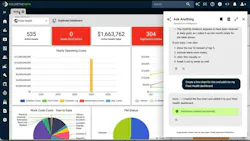
Besides linking real-time vehicle and internal repair data to visualize all this data in new ways, Collective Data can also bring in external spreadsheets and system data into the fold to create tables. A diagnostic-minded leader could theoretically take this data and ask AI to generate a fishbone diagram to troubleshoot vexing shop issues.
It’s not uncommon for these tools to directly help troubleshoot issues in the bay and the back office. Similar to Fleetio’s AI Service Advisor, Motive Maintenance launched in August and bridges inspection and vehicle/asset health data with the repair workflow in the shop.
“A lot of deep dives can be done, because all of the data that we are now building with Motive Maintenance also sits in Motive Analytics,” said Sri Teja Kolluri, staff product manager at Motive. “That allows customers to diagnose some of these bigger questions, like what parts are being replaced the most? Then they actually see the fault codes from these vehicles and come up with a predictive analysis.”
Meanwhile, the tech can receive important time-stamped data—such as DTCs, GPS info, and engine RPM—contextual data that fosters a more informed diagnosis.
“When they’re opening the work order, they would view all that information, including when the DTC was first observed and when it last occurred,” he said. “They don’t even have to open a different diagnostic screen for that. You can do that entire investigation within Motive Maintenance.”
Every trouble code tells a story
The investigation can zoom out and zoom in as the maintenance team needs to address immediate and long-term issues.
Let’s say a fleet put off resolving DTC P2463 (DPF soot accumulation) on one truck too long and had to replace a head gasket. The manager, wanting to prevent more costly downtime, would likely want to know how prevalent this code is and the cost of fixing now versus waiting.
Under normal conditions, it would take an expert familiar with that code several days to manually figure that out, offered Sean McGee, VP of product and engineering at Samsara. And “for many fleets, it would be impossible to really do that right at scale,” he said.
With AI, it can be instantaneous. “The AI can scan all the historical patterns and then give you a recommendation based on this fault code, [answering] what’s likely to happen next?” he said.
McGee demonstrated this to Fleet Maintenance using a new Samsara Connected Asset Maintenance feature called Enhanced Fault Code Insights. He clicked on a unit that had a fault code, and the description popped up. Then, because the asset was a 2024 Freightliner Cascadia that has a Detroit Diesel DD13 engine, it provided more context based on aggregated data from 100,000 other similar assets in the Samsara network that had that fault code.
The system showed a sensor calibration would likely fix the issue. But then if you wait, it predicted 23% of the time a new code would pop up within 518 miles. And from there, nearly half the time the issue escalates to throw another code, which, if unaddressed, would lead to an expensive roadside repair.
For a scenario like this to work, scale is vital.
“To tell a story about this fault code, you got to have a lot of these,” noted McGee, who said Samsara has accumulated trillions of data points from millions of vehicles in the last decade.
Enhance, not replace
There’s no denying that AI will disrupt routines and displace workers. If you spend your days manually entering invoices, you’re out of luck. AI can scan and contextualize those in seconds.
But for shop managers, this can “eliminate the grind,” Samsara’s McGee offered. He pointed to the company’s AI invoicing scanner that directly addressed a major time-suck for shop managers.
“On any given day, they’re inundated with invoices from vendors,” McGee said, explaining they have to read them, key in the info, check what work was done and parts were used, categorize them, and check if the fleet was overcharged by comparing the billed hours to the SRT. He said “millions of hours are being wasted” across the industry by doing these tasks manually.
Samsara’s AI invoice scanner can do this instantly, which has freed up more than 100,000 hours so far, McGee said.
Trimble’s TMT platform has integrated Corcentric to do similar tasks, populating invoices and repair orders, assigning VMRS codes to help managers analyze data.
Brian Mulshine, the former senior director of TMT product management for Trimble, explained this granular view can “get it down to what it costs you per mile to operate that truck by system group, [such as] tires, air conditioning, brakes. And now you could look at where you’ve got to focus training and cost improvements and what’s driving those.”
But will AI evolve to a point where it takes that fleet manager’s job as well?
Fullbay SVP Shiva Bhardwaj, who founded Pitstop and worked at his family’s repair shop in Canada, knows both sides of the equation and understands the concern about AI replacing people.
He arguably has contributed to it, creating an AI receptionist called Claudia for his family’s shop. They were missing calls and revenue until Claudia was “hired.” The AI receptionist answered 20 more calls a week that would have been lost, with four of those calls leading to business estimated at $1,200 extra per week. It’s now an add-on to Fullbay Next.
“I’ve played with a lot of AI tools like this, and I’m honestly blown away by how far the technology has come in such a short amount of time,” Fullbay’s Broberg said.
Pitstop’s predictive maintenance, though, was the key technology in the deal. It boasts a 94% accuracy rate and has fascinating potential when combined with data from 5,000+ locations that use Fullbay.
Bhardwaj noted that predictive maintenance exists “to get to the root cause faster,” dropping “breadcrumbs” of data from previous repairs to help shops fix issues right the first time.
“We want to be able to, with a click of a button, route that whole diagnostic data, the root cause, all the analysis, from Pitstop into that service request to that shop,” he explained of the longer goal.
But it’s still up to the tech to complete the diagnosis and repair.
“There’s no robot or AI going to come in that’s going to replace that,” Bhardwaj asserted.
What AI can do is help fleets and shops remain competitive during future economic downturns by detecting and avoiding catastrophic failures and profit leaks, Bhardwaj said.
“These things can make the difference for some businesses, and that’s really what keeps the lights on,” he concluded.
About the Author
 John Hitch
Editor-in-chief, Fleet Maintenance
John Hitch is the award-winning editor-in-chief of Fleet Maintenance, where his mission is to provide maintenance leaders and technicians with the the latest information on tools, strategies, and best practices to keep their fleets' commercial vehicles moving.
He is based out of Cleveland, Ohio, and has worked in the B2B journalism space for more than a decade. Hitch was previously senior editor for FleetOwner and before that was technology editor for IndustryWeek, and managing editor of New Equipment Digest.
Hitch graduated from Kent State University and was editor of the student magazine The Burr in 2009.
The former sonar technician served honorably aboard the fast-attack submarine USS Oklahoma City (SSN-723), where he participated in counter-drug ops, an under-ice expedition, and other missions he's not allowed to talk about for several more decades.