You can't afford to ignore AI's scary potential
Last month, an AI researcher named Jacob Coxon announced on social media that he had resigned from Anthropic because his employer, the company behind Claude, as well as his former bosses at OpenAI (ChatGPT), were “gambling with our lives” by speeding toward the creation of a self-improving superintelligence.
“The people building AI earnestly believe that it could kill us all by the end of the decade,” Coxon wrote.
The chance of that happening is higher than 0%, but not by much. When I prompted ChatGPT, the artificial assistant put those odds at ~1% by 2030. The large language model admitted it was a “rough subjective probability,” because even with access to nearly all our knowledge, AI has severe limitations. One of those, I believe, is its ability to kill all of humanity, something we ourselves have tried and failed at for the better part of a century.
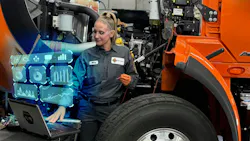
But AI is better at some things than us, like absorbing terabytes of data and quickly analyzing and sculpting the most relevant bits into digestible charts and graphs. And in the time it takes you to look up a fault code’s definition, some companies’ AI-powered CMMS can find and contextualize all the times that fault code happened and what it will cost the fleet in time and money if not addressed.
At a broader scale, a fleet or shop can diagnose what fault codes cost the most downtime over a year, and then do an AI-assisted root cause analysis of why that might be. And these aren’t edge cases; it’s where most of the industry will likely be by 2030.
And while I cannot in good conscience condone AI using my friends and family as some sort of bio-electric power plant, I see no harm in technicians and maintenance leaders experimenting with AI tools to help them troubleshoot issues faster and more accurately. Really, the only scary thing about AI is what will happen if you ignore how it can help your operation.
If you don’t believe me, then at least consider the words of the President of the United States, Donald J. Trump, who chimed in on Truth Social about AI after Coxon’s warning went viral: “There is a SICK conspiracy going on against AI and Data Centers, and the only one that is happy about it is China. WHOEVER WINS AI, WINS!”
OK, maybe he wasn’t referring to how agentic AI and data analytics can revolutionize diagnostic speed and accuracy, but we talked to several fleet maintenance experts who do. Take a look at them in my latest coverage on how AI is being used to diagnose issues on the vehicle and overall in the shop:
- AI’s newest role: The ultimate diagnostic sidekick
- How AI helps fleet maintenance managers reduce costs and prevent downtime
- Shops finding more ways for AI to enhance, not replace human work
AI is a controversial subject, so I don’t expect everyone to agree, but in a time when maintenance costs are rising and shops are understaffed, delegating things like data entry and analysis to the machines can shave hours off repairs and administrative work, allowing you to focus on fixing what needs to be fixed and containing problems instead of letting them get out of control.
Let’s hope the transhumanist nerds attempting to create an AI singularity can do the same.
About the Author
 John Hitch
Editor-in-chief, Fleet Maintenance
John Hitch is the award-winning editor-in-chief of Fleet Maintenance, where his mission is to provide maintenance leaders and technicians with the the latest information on tools, strategies, and best practices to keep their fleets' commercial vehicles moving.
He is based out of Cleveland, Ohio, and has worked in the B2B journalism space for more than a decade. Hitch was previously senior editor for FleetOwner and before that was technology editor for IndustryWeek, and managing editor of New Equipment Digest.
Hitch graduated from Kent State University and was editor of the student magazine The Burr in 2009.
The former sonar technician served honorably aboard the fast-attack submarine USS Oklahoma City (SSN-723), where he participated in counter-drug ops, an under-ice expedition, and other missions he's not allowed to talk about for several more decades.
Related

 dreamstime_xxl_238880808