Early data shows Fleetio AI Service Advisor speeds up repairs by 2.5 hours
Key Highlights
- The AI considers a vehicle's maintenance history and fault codes to provide more context for supporting repair decisions.
- During beta testing, repairs took an average of 2.5 fewer hours with AI Service Advisor.
- More fleet platforms are using AI to prioritize maintenance and uncover patterns in vehicle data.

Fleetio announced that after six months of beta testing, AI Service Advisor is now generally available to fleet customers, promising to free up managers’ time and save money by speeding up repairs and identifying valid warranty work.
The additional feature on the Fleetio CMMS platform serves as what the company describes as “a built-in maintenance expert” that analyzes a vehicle’s maintenance and fault code history and other relevant factors to help fleet maintenance managers make faster decisions, while automating work orders, approving “low-risk” repairs, and ultimately, saving the fleet time and money.
AI Service Advisor was designed to:
- Draft work orders and auto-resolve eligible issues
- Approve low-risk repairs within Fleetio's Maintenance Shop Network
- Track fault code history and identify patterns
- Assess in-progress maintenance actions in relation to repair history, parts cost, warranties, and internal maintenance trends
During the open beta testing, the intelligent software was able to reduce repair time by an average of 2.5 hours, according to Fleetio. It also assessed over $1.4 billion in maintenance spend during that period.
At its core, the AI advisor brings all the relevant data in a fleet’s data lake to the surface, making it easier to see and act on.
“AI Service Advisor evaluates maintenance in context, looking at an individual vehicle’s service history, previous costs, parts and labor, warranty opportunities, and broader maintenance patterns so teams can make a better decision about the work in front of them,” Brianna Perry-Lang, senior product marketing manager at Fleetio, told Fleet Maintenance.
For example, at the time of repair, the driver-reported issue is considered along with the vehicle’s history to recommend corrective actions.
“Instead of receiving a vague description and having to piece together where to begin, technicians start with a clearer picture of the issue, relevant vehicle context, and the work that may resolve it,” she said. “The technician still applies their expertise to diagnose the root cause and complete the repair; AI helps them get to a useful starting point faster.”
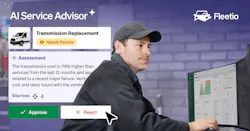
Service Advisor also recommends preventative maintenance work that could be done while the vehicle is already in the shop, adding additional uptime. Perry also offered that aside from assessing a fleet’s worth of historical data, Service Advisor could change what types of makes and models a company invests in.
“If a manager is deciding whether to continue investing in a particular vehicle, for example, they have a much richer history of what has been repaired, what it has cost, how often work has required closer review, and what patterns have emerged over the vehicle’s life,” she said.
More weeks in a year
AI hasn’t learned how to slow down time (yet), but Fleetio’s AI has been trained to scan and analyze troves of documents in the time it would take a manager to sip their morning coffee. And unlike tired, overworked humans who were not meant to stare at computer screens and spreadsheets for the majority of their life, AI does not get transpose numbers or miss pertinent data due to fatigue.
“The fact that I don’t have to go line by line on every work order is huge,” said Jill Perry, fleet administration manager at Ramos Oil. “AI Service Advisor is incredible because there’s absolutely no way one person can catch everything,"
Perry noted the Fleetio AI automatically flags issues “that require a deeper dive,” saving her 90 minutes a days, or 400 hours a years. That’s the equivalent of nearly 10 work weeks.
Fleetio notes that the user sets up which actions are automated. While some fleets may want to approve every single outsourced work order to ensure any downtime is optimized to include pending PMs, another may auto-approve oil changes or minor repairs to get the truck back on the road.
Evolving platform
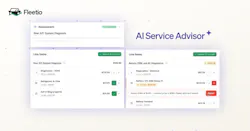
As Service Advisor grows, Fleetio said it will evolve from an evaluation tool for fleet maintenance departments to a primary conductor of the workflow, assisting with writing service orders, troubleshooting vehicle issues, and prioritizing work.
These features are becoming commonplace on most if not all major fleet management platforms as AI becomes more embedded in the industry. Among Fleetio customers, one in three already use AI to prioritize work and uncover more insights from their data.
“We’re moving toward a world where fleet technology does more than surface information,” Fleetio CTO Jorge Valdivia asserted. “It should understand the context behind a decision, apply what it has learned from years of operational data, and help determine the right action in the moment.”
But in Perry’s mind, it all goes back to how the intelligence is used at the time of repair. Each accurate corrective action becomes a building block for better recommendations in the future.
“By improving and learning from those individual decisions, we’re building the foundation for intelligence that can increasingly help fleets identify patterns across vehicles and make better long-term decisions about maintenance strategy, lifecycle and cost,” she concluded.
About the Author
 John Hitch
John Hitch
Editor-in-chief, Fleet Maintenance
John Hitch is the award-winning editor-in-chief of Fleet Maintenance, where his mission is to provide maintenance leaders and technicians with the the latest information on tools, strategies, and best practices to keep their fleets' commercial vehicles moving.
He is based out of Cleveland, Ohio, and has worked in the B2B journalism space for more than a decade. Hitch was previously senior editor for FleetOwner and before that was technology editor for IndustryWeek, and managing editor of New Equipment Digest.
Hitch graduated from Kent State University and was editor of the student magazine The Burr in 2009.
The former sonar technician served honorably aboard the fast-attack submarine USS Oklahoma City (SSN-723), where he participated in counter-drug ops, an under-ice expedition, and other missions he's not allowed to talk about for several more decades.